Optimizing Risk Adjustment and HCC Coding in Value-Based Care
Introduction: The Shift toward Value-Based Care
Healthcare is rapidly evolving from volume-driven models to value-based care, where reimbursement is directly tied to patient outcomes, quality metrics, and cost efficiency. In this transformation, risk adjustment in healthcare plays a foundational role by ensuring that providers are compensated fairly based on the complexity of their patient populations.
At the center of this system lies risk adjustment coding, a structured methodology used to capture patient conditions and translate them into measurable risk scores. However, achieving accuracy in this process is far from simple. Incomplete documentation, missed diagnoses, and fragmented data often result in underreported patient risk and revenue leakage.
This is where HCC medical coding becomes critical. By mapping diagnoses to HCC diagnosis codes, healthcare organizations can accurately represent disease burden and calculate the HCC risk score, which determines reimbursement under value-based models such as Medicare Advantage.
With increasing complexity and data volume, traditional manual approaches are no longer sufficient. The industry is now shifting toward HCC medical coding automation, powered by AI and advanced analytics, to optimize accuracy, efficiency, and scalability.
Understanding Risk Adjustment Coding and HCC Framework
To optimize performance, it is essential to understand what is HCC coding and how risk adjustment coding works within healthcare systems.
What is HCC Coding?
Hierarchical Condition Category (HCC) coding is a risk adjustment model that groups related diagnoses into categories based on severity and expected healthcare costs. Each condition is mapped from ICD-10 codes into HCC categories, which contribute to a patient’s overall HCC risk score.
How Risk Adjustment Coding Works
The process of risk adjustment coding involves:
- Capturing diagnoses from clinical documentation
- Assigning appropriate ICD 10 HCC coding
- Mapping codes to HCC categories
- Calculating the patient’s risk score
- Using the score to determine reimbursement
Accurate coding ensures that healthcare providers receive fair compensation while maintaining compliance with regulatory requirements.
The Challenges in HCC Coding in Healthcare
Despite established HCC coding guidelines, organizations face several challenges in HCC coding in healthcare:
- Incomplete Clinical Documentation
Physicians often document patient encounters under time constraints, leading to missing or insufficient details required for accurate coding.
- Missed HCC Opportunities
Undocumented or uncoded chronic conditions result in lower HCC risk scores, directly impacting reimbursement.
- Data Fragmentation
Patient data is often spread across EHRs, lab systems, and claims platforms, making it difficult to obtain a unified view.
- Manual Coding Limitations
Traditional medical coding services rely heavily on human intervention, which can lead to inconsistencies and errors.
- Compliance Risks
Failure to adhere to HCC coding guidelines can result in audits, penalties, and reputational damage.
These challenges highlight the need for advanced risk adjustment solutions that go beyond manual workflows.
The Role of HCC Gap Analysis in Risk Optimization
One of the most effective strategies for improving accuracy is HCC gap analysis.
What is HCC Gap Analysis?
HCC gap analysis identifies missing, undercoded, or undocumented conditions that should be included in a patient’s risk profile.
Why It Matters
- Ensures complete capture of patient conditions
- Improves HCC risk adjustment accuracy
- Prevents revenue loss
- Supports compliance and audit readiness
However, manual gap analysis is time-consuming and reactive. This is where automation transforms the process.
HCC Medical Coding Automation: A Game Changer
Modern healthcare organizations are adopting HCC medical coding automation to overcome traditional limitations.
What is HCC Medical Coding Automation?
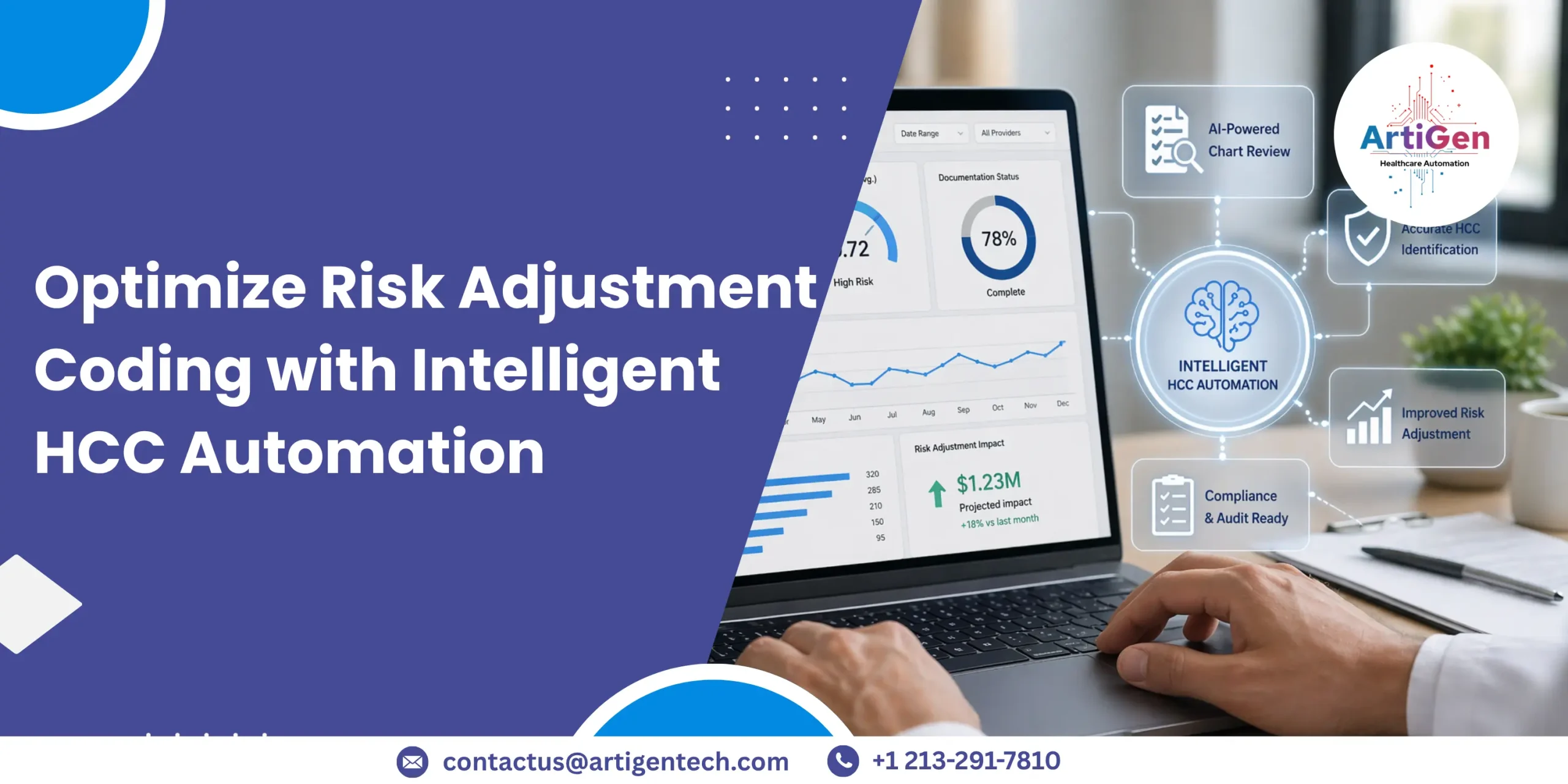
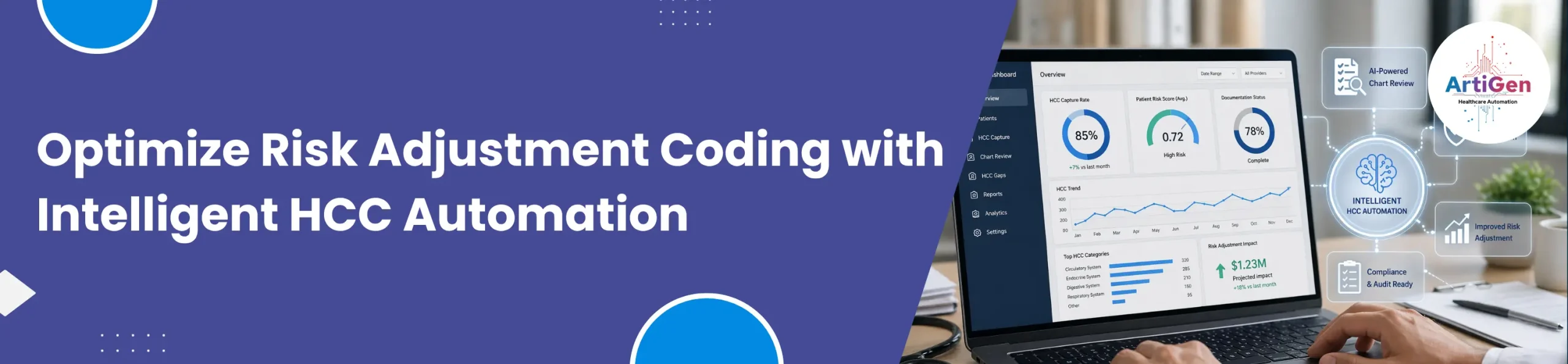
It is the use of AI, machine learning, and NLP to automate the extraction, validation, and assignment of HCC diagnosis codes from clinical data.
Key Capabilities
- Automated data extraction from unstructured clinical notes
- Real-time coding suggestions
- Intelligent HCC gap analysis
- Predictive risk scoring
- Continuous compliance monitoring
By leveraging risk adjustment coding software, organizations can achieve higher accuracy and efficiency.
Key Technologies Powering HCC Coding Automation
- Natural Language Processing (NLP)
NLP enables systems to interpret physician notes and extract relevant diagnoses for HCC medical coding.
- Machine Learning Models
ML algorithms analyze historical data to identify coding patterns and predict missing conditions.
- Predictive Analytics
Predictive models estimate future patient risk and prioritize high-value charts.
- Data Integration Platforms
Unified platforms connect EHRs, claims data, and lab results to provide a complete patient view.
These technologies form the backbone of advanced healthcare coding solutions.
Benefits of Optimizing Risk Adjustment Coding
Implementing intelligent risk adjustment solutions offers significant advantages:
- Improved Accuracy
Automation reduces errors in ICD 10 HCC coding and ensures all relevant conditions are captured.
- Enhanced Revenue Integrity
Accurate HCC risk scores lead to appropriate reimbursement.
- Increased Efficiency
Automation minimizes manual effort in medical coding services.
- Better Compliance
Systems are aligned with updated HCC coding guidelines.
- Faster Turnaround Time
Real-time processing accelerates coding workflows.
- Data-Driven Insights
Organizations gain actionable insights for population health management.
Best Practices for HCC Coding Optimization
To maximize results, healthcare organizations should adopt HCC coding best practices:
Ensure Comprehensive Documentation
Accurate coding begins with detailed clinical documentation.
Leverage Advanced HCC Coding Tools
Modern HCC coding tools enhance accuracy and efficiency.
Conduct Regular HCC Gap Analysis
Continuous monitoring ensures no conditions are missed.
Train Clinical and Coding Teams
Education on HCC coding guidelines improves alignment.
Implement Risk Adjustment Coding Software
Automation ensures scalability and consistency.
ArtigenTech’s Approach to Risk Adjustment Solutions
At ArtigenTech, we understand that optimizing risk adjustment coding requires more than just technology—it requires intelligent integration of workflows, data, and clinical context.
End-to-End HCC Coding Automation
Our solutions automate the entire coding lifecycle, from data ingestion to validation and reporting.
AI-Driven HCC Gap Analysis
Advanced algorithms identify missing diagnoses and suggest accurate HCC diagnosis codes.
Real-Time Coding Assistance
Clinicians and coders receive contextual recommendations during documentation.
Scalable Risk Adjustment Coding Software
Our platform supports high-volume processing while maintaining accuracy and compliance.
Compliance-Centric Design
Built-in validation ensures adherence to evolving HCC coding guidelines.
By combining AI with domain expertise, ArtigenTech delivers next-generation healthcare coding solutions that drive measurable outcomes.
Unlock accurate risk adjustment with AI-powered HCC coding solutions.
Contact us today! – https://www.artigentech.com/contact-us/
The Future of Risk Adjustment in Healthcare
The future of risk adjustment in healthcare is driven by intelligent automation and predictive intelligence.
Emerging Trends
- AI-powered real-time coding assistants
- Fully automated HCC medical coding automation platforms
- Predictive HCC risk score modeling
- Integrated clinical and financial workflows
- Continuous learning systems
Healthcare organizations that adopt these innovations will gain a competitive advantage in value-based care.
Conclusion: Driving Value through Intelligent HCC Coding
Optimizing HCC risk adjustment is essential for success in value-based care. However, traditional coding approaches are no longer sufficient to handle the complexity of modern healthcare systems.
By leveraging advanced risk adjustment solutions, healthcare providers can:
- Improve coding accuracy
- Enhance reimbursement outcomes
- Reduce administrative burden
- Ensure compliance
With the integration of HCC medical coding automation, organizations can transform their approach to risk adjustment coding—moving from reactive processes to proactive, data-driven strategies.
ArtigenTech stands at the forefront of this transformation, delivering intelligent HCC medical coding services and scalable healthcare coding solutions that bridge the gap between clinical documentation and accurate coding.
The future of healthcare lies in precision, automation, and intelligence—and it begins with optimizing risk adjustment
Get a Quote
Recent blog post