
How Clinical Language Is Converted Into ICD-10 and CPT Codes
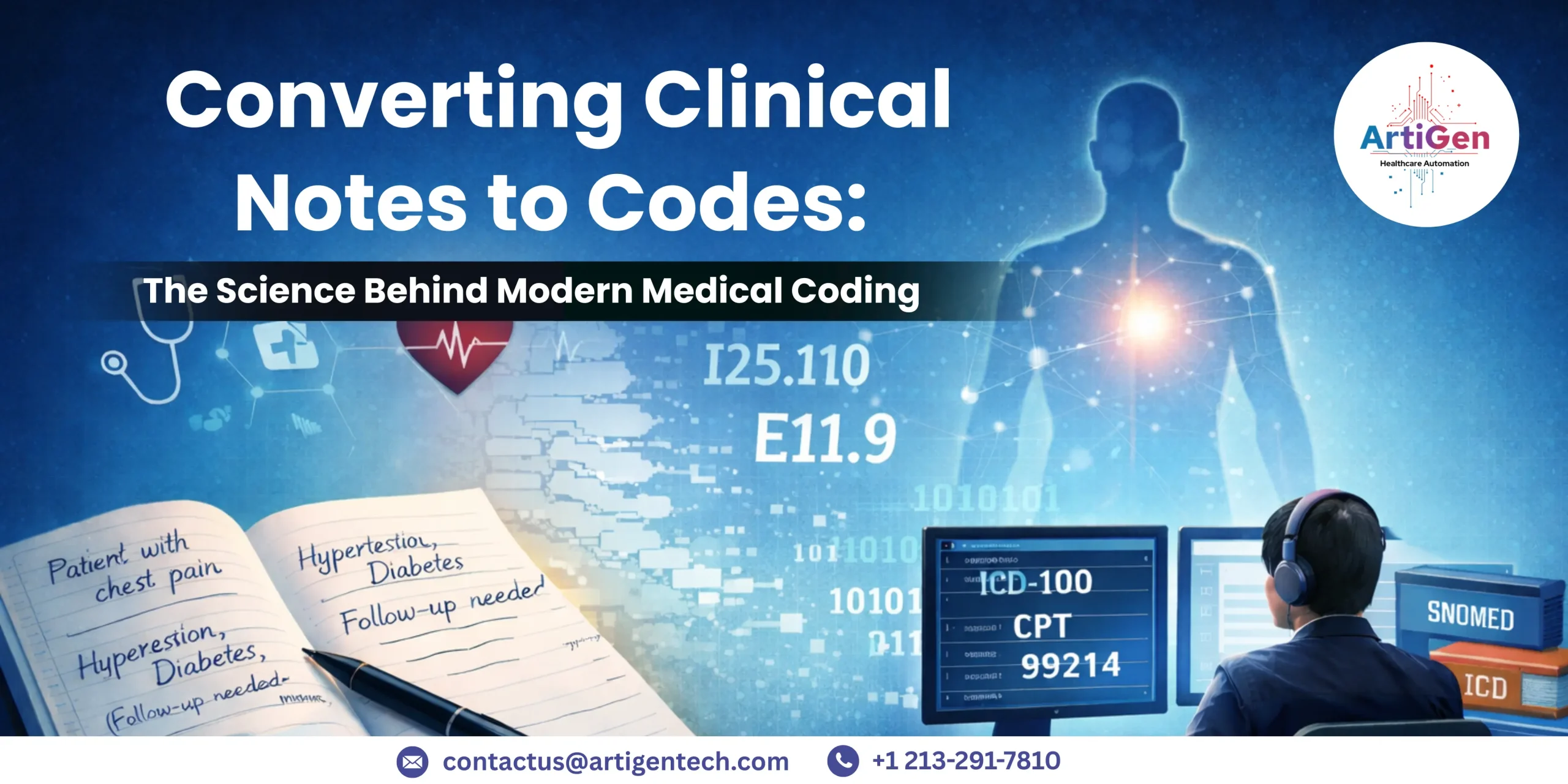
In the world of medical billing and coding, everything begins with one critical source: clinical language. Physician notes, discharge summaries, operative reports, and progress notes may seem like normal paperwork, but they are what maintain the whole revenue cycle, compliance condition, and claim outcomes functioning.
However, one of the trickiest parts of the medical coding process is turning free-text clinical documentation into accurate ICD-10, CPT codes and required billable modifiers. Denials, compliance risks, or delayed reimbursements may result from a single inappropriate diagnosis invalid modifiers, unspecific CPT or unclear procedure description.
This blog breaks down how clinical language is converted into diagnosis and procedure codes, where traditional workflows fail, and how medical coding automa tion and AI medical coding software—like those offered by ArtigenTech—are redefining accuracy, compliance, and efficiency.
Understanding Clinical Language in Healthcare Documentation
Clinical language is not standardized prose. It is a mix of:
- Medical terminology
- Abbreviations
- Shorthand notations
- Specialty-specific phrasing
- Contextual clues
For example:
“Patient presents with SOB, hx of CHF, admitted for acute exacerbation.”
The clinical documentation coding process requires accurate interpretation of the diagnostic intent, acuity, and historical context contained in this single sentence.
Although human coders are taught to read between the lines, manual interpretation is no longer scalable due to the growing volume of documentation and payer examination.
Why Clinical Documentation to Coding Is So Complex
There is more to converting clinical documentation to coding than just matching words to codes. Coders need to think about:
- Clinical context
- Documentation completeness
- Coding guidelines
- Payer-specific rules
- Compliance requirements
The challenge intensifies when:
- Notes are unstructured
- Providers use inconsistent terminology
- Documentation lacks specificity or laterality
- Periodic updates on Coding and billing guidelines
At this point, medical coding software and AI medical coding software stop being optional and start to become necessary.
Step-by-Step: The Medical Coding Process Explained
Let’s walk through how clinical language is converted into ICD-10 and CPT codes in a real-world workflow.
When healthcare professionals record patient encounters, the process begins:
- SOAP (Subjective, Objective, Assessment, Plan) notes
- Progress notes
- Operative reports
- Discharge summaries
Clinical notes are converted to codes using these notes as the raw input.
Issue: Clinical notes are often unstructured and written for patient care—not coding precision.
2. Clinical Documentation Review
Next, documentation is reviewed to identify:
- Diagnoses treated
- Procedures performed
- Medical decision-making level
- Supporting evidence (MEAT criteria)
This step is critical for diagnosis and procedure coding accuracy.
Risk area:
Missing specificity or hierarchy leads to incorrect ICD-10 coding guidelines application.
3. Diagnosis Coding Using ICD-10
ICD-10 coding translates clinical diagnoses into standardized alphanumeric codes.
To code accurately, coders must identify:
- Condition severity
- Laterality
- Acuity
- Complications
- Underlying causes
- ICD guidelines (Code first, combo codes, add on, exclude 1 and others)
For example:
- “Diabetes” vs
- “Type 2 diabetes mellitus with diabetic chronic kidney disease, stage 3”
Challenge:
Clinical language often lacks the specificity required by ICD-10 and CPT coding standards.
4. Procedure Coding Using CPT Codes
Procedure and service codes are assigned using CPT coding guidelines.
Coders examine:
- Procedures performed
- Time spent
- Technique used
- Modifiers required
Automated CPT coding reduces manual lookup errors by allowing AI systems to recognize procedure patterns straight from documentation.
5. Validation against Coding Guidelines
Each code that is assigned needs to adhere to:
- ICD-10 coding guidelines
- CPT coding guidelines
- Payer specific rules
- LCD coverage
- National Correct Coding Initiative (NCCI) edits
By taking this step, downstream denials are avoided and compliance is ensured.
Where Traditional Medical Coding Breaks Down
Traditional workflows encounter persistent problems even with skilled professionals:
- Delays in manual reviews
- Human exhaustion and irregularities
- Gaps in the documentation
- Coding variation across teams
- Difficulty keeping up with guideline updates
These gaps result in:
- Errors in coding
- The risks of compliance
- Denials
- Leakage of revenue
This is why organizations are moving toward medical coding automation services.
The Role of AI in Clinical Documentation to Coding
AI medical coding software uses advanced technologies to streamline the clinical documentation coding process, including:
- Natural Language Processing (NLP)
- Machine Learning
- Contextual clinical understanding
- Rule-based compliance validation
Instead of simply reading words, AI understands clinical intent.
How AI Converts Clinical Notes to Codes
AI systems analyze documentation to:
- Extract diagnoses and procedures
- Understand context and relationships
- Map terms to ICD-10 and CPT codes
- Validate against coding guidelines
- Flag documentation gaps
This enables automated medical coding with high accuracy and consistency.
Automated Medical Coding vs Manual Coding
Aspect | Manual Coding | Automated Medical Coding |
Speed | Slow | Real-time |
Consistency | Varies by coder | Standardized |
Compliance | Risk-prone | Built-in rules |
Scalability | Limited | Highly scalable |
Accuracy | Depends on experience | Data-driven |
Medical coding automation doesn’t replace coders—it augments them.
Why Coding Accuracy Depends on Clinical Language Interpretation
Incorrect interpretation of clinical language leads to:
- Upcoding or undercoding
- Denials
- Compliance audits
- Revenue loss
By improving how clinical documentation is converted into codes, organizations improve:
- Claim acceptance rates
- Coding accuracy
- Compliance confidence
- Financial outcomes
ArtigenTech’s Problem-Solving Approach to Medical Coding
At ArtigenTech, we address the root cause—not just the symptoms.
Our AI medical coding software is designed to:
- Accurately interpret clinical language
- Apply ICD-10, CPT, Modifiers and HCPCS coding guidelines
- Support automated CPT coding
- Ensure compliance by design
- Reduce manual workload for coding teams
Key Capabilities of ArtigenTech’s Medical Coding Automation
- Clinical language understanding using advanced NLP
- Automated diagnosis and procedure coding
- Real-time guideline validation
- Continuous learning from coding patterns
- Audit-ready documentation support
This ensures every stage of the medical coding process is optimized.
Benefits of AI-Driven Clinical Documentation to Coding
Healthcare organizations benefit from medical coding automation in the following ways:
- Higher coding accuracy
- Faster turnaround times
- Reduced denials
- Stronger compliance posture
- Improved coder productivity
Above all, it ensures that clinical records accurately represent the treatment provided.
The Future of Medical Coding Is Automated
It is no longer viable to rely only on manual workflows as regulations tighten and documentation volumes increase.
The future lies in:
- AI medical coding software
- Intelligent medical coding automation
- Seamless clinical documentation to coding workflows
Organizations that adopt these technologies early gain a competitive edge in accuracy, compliance, and revenue performance.
Final Thoughts
AI-powered medical coding software guarantees consistency, scalability, and compliance at a level that manual systems cannot match, even though human expertise is still crucial.
ArtigenTech helps healthcare organizations to convert clinical documentation into precise, accurate, and revenue-ready codes by bridging the gap between the two.
Now is the ideal moment to transition to automated medical coding, with ArtigenTech as your reliable partner, if your company wants to update its medical coding process, reduce risk, and improve outcomes.