Risk-Adjustment & Hierarchical Condition Category Coding: What Are They and Why Do They Matter?
Introduction
In today’s evolving healthcare ecosystem, accurate medical coding is no longer just about documenting diagnoses—it plays a critical role in determining reimbursement, improving patient outcomes, and ensuring compliance. Among the most impactful coding methodologies used today are HCC coding and risk adjustment.
You’re not the only one who has ever wondered what risk adjustment is in medical coding or what a hierarchical condition category is. These ideas are at the center of value-based care models and have reshaped how healthcare organizations take care of groups of patients.
This blog provides a complete, easy-to-understand guide to HCC coding, risk adjustment coding, and why they matter for healthcare providers, payers, and patients.
What is Risk Adjustment in Healthcare?
Before we get into HCC, let’s talk about what is risk adjustment.
Risk adjustment is a method used in healthcare to guess how much future healthcare will cost based on a patient’s health and demographic information. It makes sure that providers who treat sicker patients get paid the right amount.
What is risk adjustment in medical coding?
In coding, medical risk adjustment coding means recording all of a patient’s relevant diagnoses and conditions so that their true health complexity is shown.
This process uses healthcare risk adjustment models to give each patient a risk score. The higher the risk score, the more you can expect to pay for care.
What is HCC in Medical Coding?
Now let’s talk about the most important question:
What is HCC in medical coding?
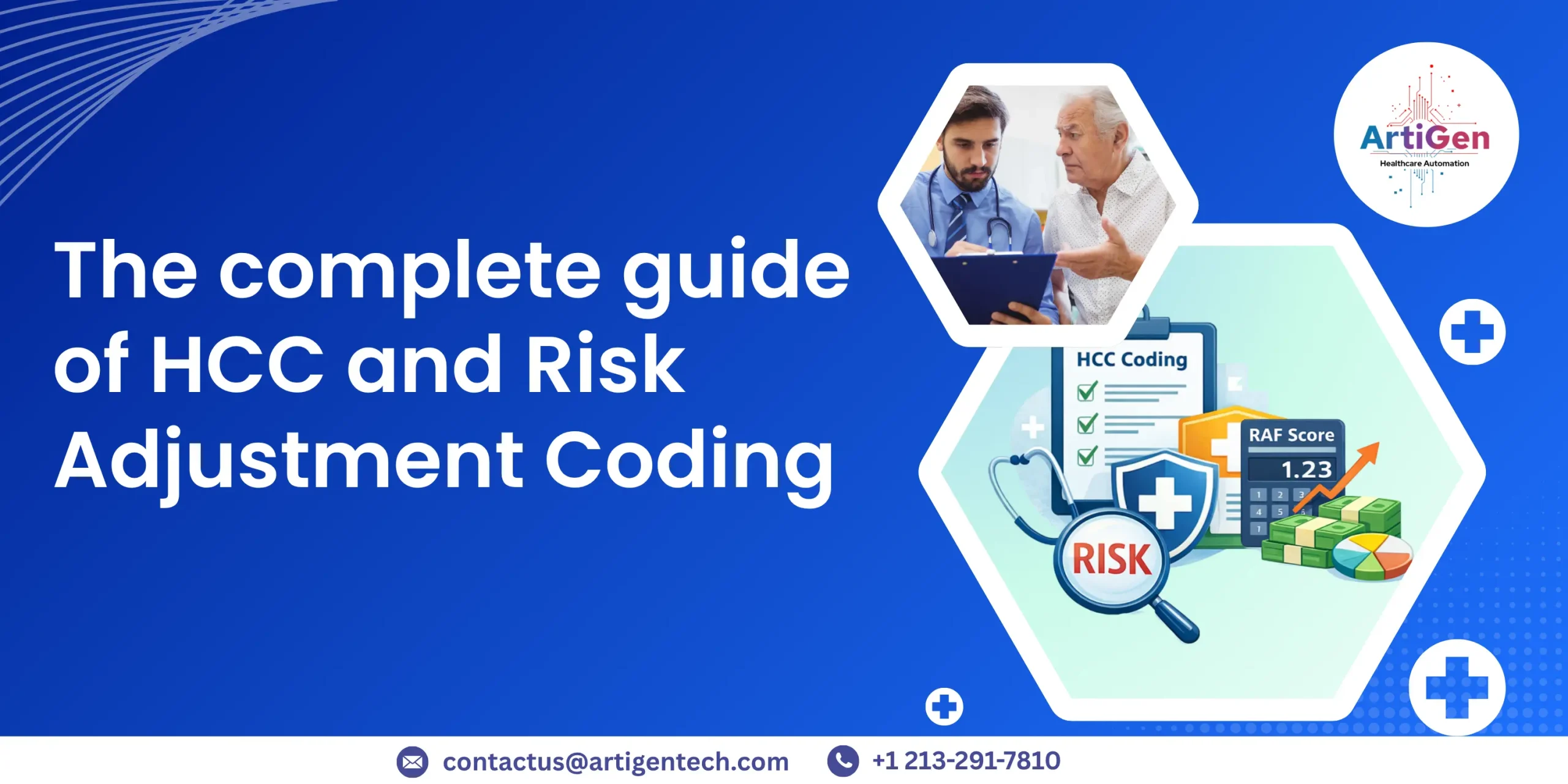
HCC (Hierarchical Condition Category) is a risk adjustment model that CMS (Centers for Medicare & Medicaid Services) uses to put similar diagnoses into groups that can help predict healthcare costs.
What is CMS HCC in medical terms?
CMS-HCC is a certain way to figure out risk scores for Medicare Advantage patients based on their medical history.
Understanding Hierarchical Coding
What is hierarchical condition category?
The term hierarchical coding refers to the structure within HCC models where conditions are ranked based on severity.
For example:
- If a patient has multiple related conditions, only the most severe condition is counted.
- This prevents duplicate or inflated risk scores.
This system ensures accurate representation of patient health without overcoding.
How HCC Coding Works
HCC coding explained
HCC coding is the process of linking diagnosis codes (ICD-10) to HCC categories. These categories then help figure out a patient’s risk score.
The process of coding for HCC risk adjustment
- Keeping track of patient visits
- Using ICD-10 to code diagnoses
- Putting diagnoses into HCC groups
- Using risk adjustment models to figure out risk scores
This is called HCC risk coding or HCC risk adjustment coding.
What Does HCC Mean After a Diagnosis?
A common question is:
What does HCC mean after a diagnosis?
If a diagnosis fits into an HCC category, it means that the condition raises the patient’s overall risk score.
For example:
- Diabetes with complications → Higher HCC score
- Mild diabetes → Lower HCC score
This has a direct effect on reimbursement and care planning.
Types of Risk Adjustment Models
There are several risk adjustment models in healthcare, including:
- CMS-HCC model (Medicare)
- RXHCC (Pharmacy-based risk adjustment)
- Commercial payer models
What is RXHCC?
RXHCC focuses on medication data to predict healthcare costs and is often used alongside traditional HCC models.
Why HCC Coding and Risk Adjustment Matter
Understanding the importance of HCC coding and risk adjustment goes beyond compliance—it directly impacts financial performance, care quality, and long-term sustainability in value-based healthcare models.
1. Accurate and Optimized Reimbursement
In value-based care settings, reimbursement is closely linked to the risk profiles of patients. Correct HCC risk adjustment coding makes sure that providers get paid based on how complicated their patients really are.
2. Enhanced Patient Care and Outcomes
Providers can find high-risk patients early if they have accurate risk adjustment documentation and coding. This makes it possible to manage care ahead of time, keep an eye on chronic diseases, and make treatment plans that are unique to each patient.
3. Stronger Compliance and Audit Readiness
Regulatory bodies like CMS require strict compliance to HCC Coding guidelines and risk adjustment coding guidelines. Failure to comply can lead to audits, penalties, and claim denials.
4. Data-Driven Population Health Management
Medical coding risk adjustment is an important part of strategies for improving the health of the whole population. Healthcare organizations can:
- Find patterns in long-term health problems
- Use resources wisely
- Make preventive care programs better
This changes how healthcare is delivered from reactive to proactive.
5. Financial Stability in Value-Based Care
As healthcare shifts toward value-based models, HCC medical coding becomes necessary for financial stability. Accurate coding makes it possible for businesses to effectively balance cost, quality, and results.
How ArtigenTech Solves These Challenges
ArtigenTech uses advanced AI-driven technologies to deal with the difficulties of HCC coding and risk adjustment by
- Ensure accurate capture of diagnoses aligned with HCC coding guidelines
- Enhance risk adjustment documentation and coding through intelligent validation
- Reduce revenue leakage caused by missed or incomplete coding
- Support compliance with evolving risk adjustment models
ArtigenTech helps healthcare organizations get both accurate financial information and better patient care outcomes by combining automation with clinical intelligence.
HCC Coding Guidelines
Providers must follow HCC coding guidelines and risk adjustment coding guidelines to make sure their work is correct.
Key guidelines include:
- Document all chronic conditions annually
- Ensure diagnoses are supported by clinical evidence
- Follow MEAT criteria (Monitor, Evaluate, Assess, Treat)
- Avoid unspecified or incomplete diagnoses
Proper risk adjustment documentation and coding is critical for capturing the full patient profile.
Role of an HCC Coder
What is an HCC coder?
An HCC coder is a specialized medical coder responsible for:
- Reviewing patient records
- Assigning accurate diagnosis codes
- Ensuring compliance with HCC coding guidelines
- Supporting medical coding risk adjustment processes
They play a crucial role in maintaining coding accuracy and maximizing reimbursement.
Retrospective HCC Coding
What is retrospective HCC coding?
Retrospective HCC coding involves reviewing past medical records to identify missed diagnoses that could impact risk scores.
This process helps:
- Capture undocumented or missed HCC conditions
- Improve coding accuracy
- Recover lost revenue
- Compliance & audit risks
Common Challenges in HCC Coding
Despite its importance, implementing accurate HCC coding and risk adjustment is not without challenges. These issues often lead to revenue loss, compliance risks, and operational inefficiencies.
1. Incomplete or Inaccurate Documentation
One of the biggest challenges in risk adjustment coding is insufficient clinical documentation. Providers may fail to capture all relevant chronic conditions or document them clearly, leading to undercoding.
Without proper risk adjustment documentation and coding, even valid diagnoses may not translate into HCC categories.
2. Coding Errors and Misinterpretation
Incorrect mapping of ICD-10 codes to HCC categories can result in inaccurate risk scores. Misinterpretation of HCC coding guidelines or lack of expertise in hierarchical coding often leads to errors in HCC risk adjustment coding.
3. Lack of Awareness among Providers
Many clinicians still lack clarity on:
- What is risk adjustment in medical coding
- What does HCC mean after a diagnosis
This gap leads to missed opportunities in capturing patient complexity accurately.
4. Frequent Regulatory Changes
Continuous learning is necessary to update risk adjustment models in healthcare and CMS guidelines. Organizations without specialized resources may find it difficult to stay up to date with changing risk adjustment coding guidelines.
5. Fragmented Data and Systems
Maintaining a unified view is challenging because patient data is frequently dispersed across several systems. This fragmentation raises the possibility of overlooking important diagnoses and affects medical coding risk adjustment.
6. Time-Intensive Manual Processes
Manual chart reviews, which are laborious and prone to human error, are a major component of traditional HCC coding services. Workflows become slower and less efficient as a result.
7. Challenges in Retrospective HCC Coding
Retrospective HCC coding aids in the identification of missed diagnoses, but accurately reviewing historical records takes a lot of work. This procedure may be inconsistent and ineffective without the right tools.
How ArtigenTech Addresses These Challenges
ArtigenTech helps overcome these barriers by:
- Automating chart analysis to improve medical risk adjustment coding accuracy
- Identifying missed diagnoses for better retrospective HCC coding outcomes
- Providing real-time insights aligned with HCC coding guidelines
- Integrating data across systems to eliminate fragmentation
- Reducing manual workload through intelligent automation
- Provides the accurate history of the patient visit details and services rendered by the Provider
This enables healthcare organizations to streamline operations, improve coding accuracy, and ensure compliance with minimal effort.
Best Practices for Risk Adjustment Coding
To maximize the benefits of HCC coding and risk adjustment, healthcare organizations must adopt structured and strategic approaches.
1. Ensure Comprehensive Documentation
Effective risk adjustment coding starts with accurate documentation. All active and chronic conditions must be accurately and consistently documented by providers.
Diagnoses are valid for coding and in line with HCC coding guidelines when MEAT criteria (Monitor, Evaluate, Assess, and Treat) are followed.
2. Capture Conditions Annually
HCC coding is based on a yearly model, meaning conditions must be documented and coded every year. Missing annual documentation can lead to reduced risk scores and lost revenue.
3. Follow Standard Coding Guidelines
Adhering to risk adjustment coding guidelines and HCC coding guidelines is essential. Coders should:
- Use specific and accurate diagnosis codes
- Avoid unspecified codes & downcoding/upcoding
- Ensure proper mapping to HCC categories
4. Invest in Training and Education
Continuous training helps coders and providers understand:
- What is hierarchical condition category
- Updates in risk adjustment models
- Best practices for medical coding risk adjustment
This reduces errors and improves coding quality.
5. Leverage Technology and Automation
Modern healthcare organizations are adopting AI-driven solutions to enhance risk adjustment documentation and coding.
Automation helps:
- Identify gaps in documentation
- Suggest accurate codes
- Improve efficiency in HCC risk coding
6. Conduct Regular Audits
Routine audits are essential to ensure compliance and accuracy in HCC risk adjustment coding. Audits help:
- Identify missed diagnoses
- Correct coding errors
- Improve overall coding performance
7. Strengthen Collaboration between Teams
Effective medical coding risk adjustment requires collaboration between:
- Providers
- Coders
- Clinical documentation specialists
This ensures that documentation aligns with coding requirements.
8. Optimize Retrospective Coding Processes
To identify lost opportunities and raise risk scores, implement organized workflows for retrospective HCC coding.
How ArtigenTech Enables Best Practices
Healthcare organizations can apply these best practices with the help of ArtigenTech by:
- Using AI-driven insights to improve risk adjustment coding and documentation
- Encouraging precise and legal HCC risk adjustment coding
- Automating processes to increase productivity and decrease manual labor
- Offering real-time analytics that are in line with risk adjustment models in healthcare
- Providing intelligent auditing and validation to facilitate ongoing improvement
ArtigenTech assists companies in creating a high-performing, scalable, and compliant risk adjustment coding ecosystem by fusing cutting-edge technology with domain knowledge.
The Role of Technology in HCC Coding
Medical coding risk adjustment is being transformed by technology.
Some notable developments are:
- AI-powered coding tools
- Automated documentation analysis
- Predictive analytics for risk scoring
- Real-time coding validation
These innovations increase compliance, decrease manual labor, and improve overall efficiency & accuracy.
Future of Risk Adjustment and HCC Coding
The following factors will shape risk adjustment coding in the future:
- Automation and artificial intelligence
- Highly sophisticated risk adjustment models in healthcare
- Electronic health record (EHR) integration
- Processing data in real time
HCC coding services will be even more important as healthcare moves toward value-based care.
Why Healthcare Organizations Must Prioritize HCC Coding
Organizations that invest in HCC coding and risk adjustment benefit from:
- Increased revenue accuracy
- Better patient outcomes
- Stronger compliance
- Improved operational efficiency
Ignoring HCC in medical coding can lead to financial losses and compliance risks.
Conclusion
Understanding what is HCC in medical terms and what is risk adjustment in medical coding is essential for modern healthcare organizations.
In the healthcare ecosystem, hierarchical coding, risk adjustment coding, and HCC coding are essential for both improving patient care and determining reimbursement.
By following proper HCC coding guidelines, ensuring accurate risk adjustment documentation and coding, and leveraging advanced technologies, organizations can unlock the full potential of value-based care.
Learning hierarchical condition category coding will be essential to remaining competitive, compliant, and patient-focused as the healthcare sector develops.