
Why Similar ICD-10 Codes Cause Denials — AI Pattern Analysis
How Medical Coding Automation is Transforming Denial Prevention in 2026
ICD-10 claim denials continue to be one of the largest operational and financial challenges for healthcare providers, billing companies, and revenue cycle management (RCM) teams in today’s rapidly changing healthcare ecosystem. Even seasoned coders find it difficult when similar ICD-10 codes result in claim denials, which can lead to revenue leakage, delayed reimbursements, compliance risks, and increased administrative workload.
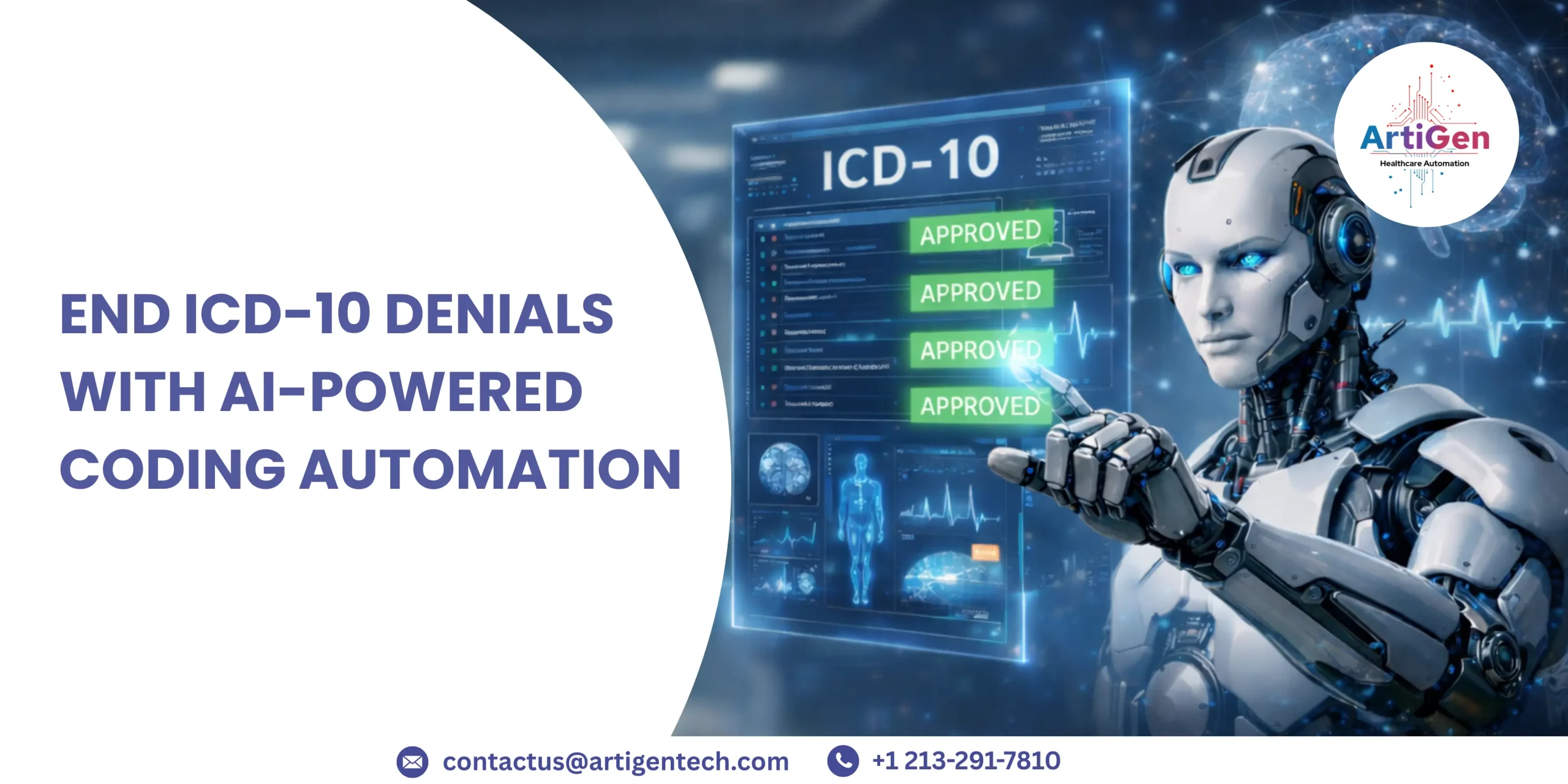
Medical coding denials are still on the rise despite ongoing training and system improvements because of growing coding complexity, payer rule modifications, gaps in documentation, and regulatory updates. This is where the future of healthcare revenue cycle automation is being redefined by AI in medical coding, medical billing automation, and predictive denial management.
At ArtigenTech, we leverage AI-based denial prevention, predictive analytics in medical billing, and healthcare coding automation to help organizations prevent ICD-10 claim rejections, reduce revenue leakage, and drive sustainable financial performance.
In this extensive article, we talk about:
- Why claim denials are caused by similar ICD-10 codes
- How hidden denial triggers are found using AI pattern analysis
- How coding errors are decreased by AI medical coding automation
- How ICD-10 coding denials are avoided through predictive analytics
- How ArtigenTech uses cutting-edge AI to resolve medical coding denials
Understanding the Growing Challenge of ICD-10 Coding Denials
With over 70,000 diagnosis codes, the ICD-10 coding system offers unmatched specificity. Although this level of detail increases clinical accuracy, it also adds a great deal of complexity. Payer denials may result from even a minor variation in ICD-10 code selection
Why ICD-10 Coding Is So Complex Today
Several factors contribute to increasing ICD-10 claim denials:
- High Code Similarity: Manual selection is vulnerable to error because many ICD-10 codes only differ by one character.
- Clinical Documentation Gaps: Coders must interpret incomplete data because providers frequently document inaccurately.
- Regular Code Updates: Coders must receive ongoing training due to the yearly ICD-10 revisions.
- Payer-Specific Policies: Different medical necessity and reimbursement regulations are enforced by each payer.
- Limitations of Manual Coding: Coding errors are increased by human fatigue and cognitive overload.
ICD-10 coding denials now make up 10–20% of all claims, which puts a significant financial burden on healthcare organizations.
Why Similar ICD-10 Codes Cause Claim Denials
Selecting the incorrect similar ICD-10 code can result in claim rejection even in cases where clinical documentation is accurate. Let’s examine the most typical causes.
- Lack of Clinical Specificity
Clinical precision was intended to be captured by ICD-10. However, even in cases where documentation requires more specific information, coders frequently choose unspecific or generalized diagnosis codes.
For example:
- E11.9: Complication-free type 2 diabetes mellitus
- E11.65: Hyperglycemia and type 2 diabetes mellitus
Despite their similarities, these codes result in very different reimbursement outcomes. ICD-10 coding denials are a result of payers rejecting unspecified codes more frequently.
Medical coding denials are greatly decreased by AI-powered systems that identify subtleties in documentation and suggest the most accurate codes.
- Medical Necessity Mismatch
Diagnosis codes must always back up the medical need for a procedure. Even small errors in matching procedure and diagnosis codes can lead to claim denials.
AI in medical coding uses extensive historical data to pinpoint the diagnosis-procedure pairs that are often rejected. This enables:
- Real-time claim scrubbing
- Automated alerts before submission
- Predictive denial management
This method significantly boosts medical billing automation accuracy.
- Laterality and Anatomical Confusion
ICD-10 requires the specification of laterality (left, right, or bilateral) and encounter type (initial, subsequent, or sequela). Coders frequently make errors in selecting the appropriate variants due to the constraints of time.
AI-driven natural language processing models are employed to scrutinize clinical documentation, ensuring anatomical accuracy and thereby mitigating the ICD-10 claim rejections resulting from laterality discrepancies.
- Modifier Errors and Bundling Issues
Major medical coding denials often arise from incorrect or missing modifiers, such as -25 or -59. Healthcare coding automation, powered by artificial intelligence, uses payer-specific rules to ensure modifiers are placed correctly and that bundling guidelines are followed.
- Outdated Code Usage
Annual ICD-10 revisions often mean codes are retired or changed. This constant flux can leave manual coding processes lagging, which in turn can trigger claim denials when the wrong codes are used.
AI medical coding automation, on the other hand, keeps its code libraries current, guaranteeing compliance in real-time.
How AI Pattern Analysis Identifies Denial Triggers
AI-driven denial prevention, unlike its rules-based predecessors, uses predictive analytics in medical billing. This approach allows it to identify complex patterns hidden within vast datasets of claims.
Core Capabilities of AI Pattern Analysis
- Historical Claims Mining – Analyzes past denials to identify root causes.
- NLP-Based Documentation Parsing – Reads clinical notes for coding gaps.
- Predictive Modeling – Forecasts denial probability before submission.
- Automated Feedback Loops – Learns continuously from outcomes.
This approach transforms revenue cycle automation from reactive correction to proactive prevention.
How AI Reduces Coding Errors and Prevents ICD-10 Claim Rejection
- Intelligent Code Selection
How AI reduces coding errors across large claim volumes is demonstrated by the models’ analysis of documentation context, comorbidities, lab values, and procedure notes.
2. Predictive Denial Management
Predictive denial management predicts the likelihood of a claim failure based on past payer actions. AI helps organizations to avoid ICD-10 claim rejections by identifying high-risk claims and recommending changes prior to submission.
3. Automated Claim Scrubbing
Real-time validation checks are used by sophisticated medical billing automation platforms to identify:
- Pairs of diagnoses and procedures that are incompatible
- The absence of modifiers
- Coding guidelines unique to payers
- Insufficient documentation
4.Continuous Learning & Model Optimization
Unlike traditional coding tools, AI in medical billing evolves by studying:
- Denial outcomes
- Patterns of successful appeals
- Payer feedback loops
This process enables a constant refinement of the accuracy of AI-driven medical coding automation.
Predictive Analytics in Medical Billing: A Game Changer
Traditional denial management looks backward. Predictive analytics in medical billing, however, offers a more forward-thinking approach, allowing for:
- Real-time scoring of denial probabilities
- Financial forecasting
- Workflow optimization
- Resource planning
By pinpointing the reasons why ICD-10 codes cause claim denials, healthcare organizations can proactively boost their reimbursement results.
Business Impact of AI-Based Denial Prevention
Healthcare providers leveraging AI for denial prevention see some clear benefits:
- They report a 30–50% drop in ICD-10 coding denials.
- Reimbursement cycles speed up.
- Accounts receivable days shrink.
- Operational costs decrease.
- Compliance improves.
- Staff become more productive.
This shift transforms revenue cycle automation into a strategic asset, not just an expense.
How ArtigenTech Solves Medical Coding Denials Using AI
In order to address denial issues at scale, ArtigenTech specializes in healthcare coding automation, medical billing automation, and AI in medical coding.
Our AI-Powered Medical Billing and Coding System
Our exclusive AI programs make use of:
- Deep learning models that have been trained using millions of medical records
- Clinical documentation analysis using advanced natural language processing
- Denial forecasting using predictive analytics
- Coding validation engines that operate automatically
- Constant observation of payer rules
ArtigenTech’s Intelligent Denial Prevention Workflow
- Clinical Note Ingestion – NLP extracts diagnosis and procedural intent
- AI Coding Recommendation – Suggests optimized ICD-10, CPT, HCPCS codes
- Predictive Risk Scoring – Flags high-risk claims
- Automated Pre-Submission Scrubbing – Validates compliance
- Denial Pattern Learning – Continuously improves models
This closed-loop system dramatically reduces medical coding denials and enhances revenue cycle automation.
Real Business Outcomes Delivered by ArtigenTech
Our clients consistently achieve:
- 40% reduction in ICD-10 claim denials
- 35% improvement in first-pass yield
- 25% faster reimbursement cycles
- 30% reduction in manual coding workload
The Future of ICD-10 Coding: Autonomous & Predictive
The future of medical coding lies in autonomous medical coding powered by AI. In this model:
- AI performs first-level coding
- Human experts handle complex exceptions
- Predictive analytics continuously optimize workflows
This hybrid approach delivers scalability, accuracy, and financial sustainability.
Why Healthcare Leaders Must Act Now
Healthcare companies need to update their revenue cycle strategies due to growing regulatory complexity, decreasing margins, and increased payer scrutiny.
It is now necessary to invest in AI medical coding automation, medical billing automation, and predictive denial management for the following reasons:
- Sustainability of finances
- Adherence to regulations
- Effectiveness of operations
- An improved experience for patients
Final Thoughts
It is no longer unclear why similar ICD-10 codes cause denials. Healthcare companies can now transition from reactive corrections to proactive optimization with AI-based denial prevention.
Providers can drastically lower ICD-10 coding denials, safeguard revenue, and create a revenue cycle that is ready for the future by utilizing AI in medical coding, predictive analytics in medical billing, and healthcare coding automation.
We at ArtigenTech are honored to be at the vanguard of this change, assisting healthcare institutions in achieving financial excellence, optimizing coding accuracy, and removing denial risks.
Ready to eliminate ICD-10 coding denials and transform your revenue cycle?
Find out how your billing performance can be revolutionized by ArtigenTech’s AI-powered medical coding automation.