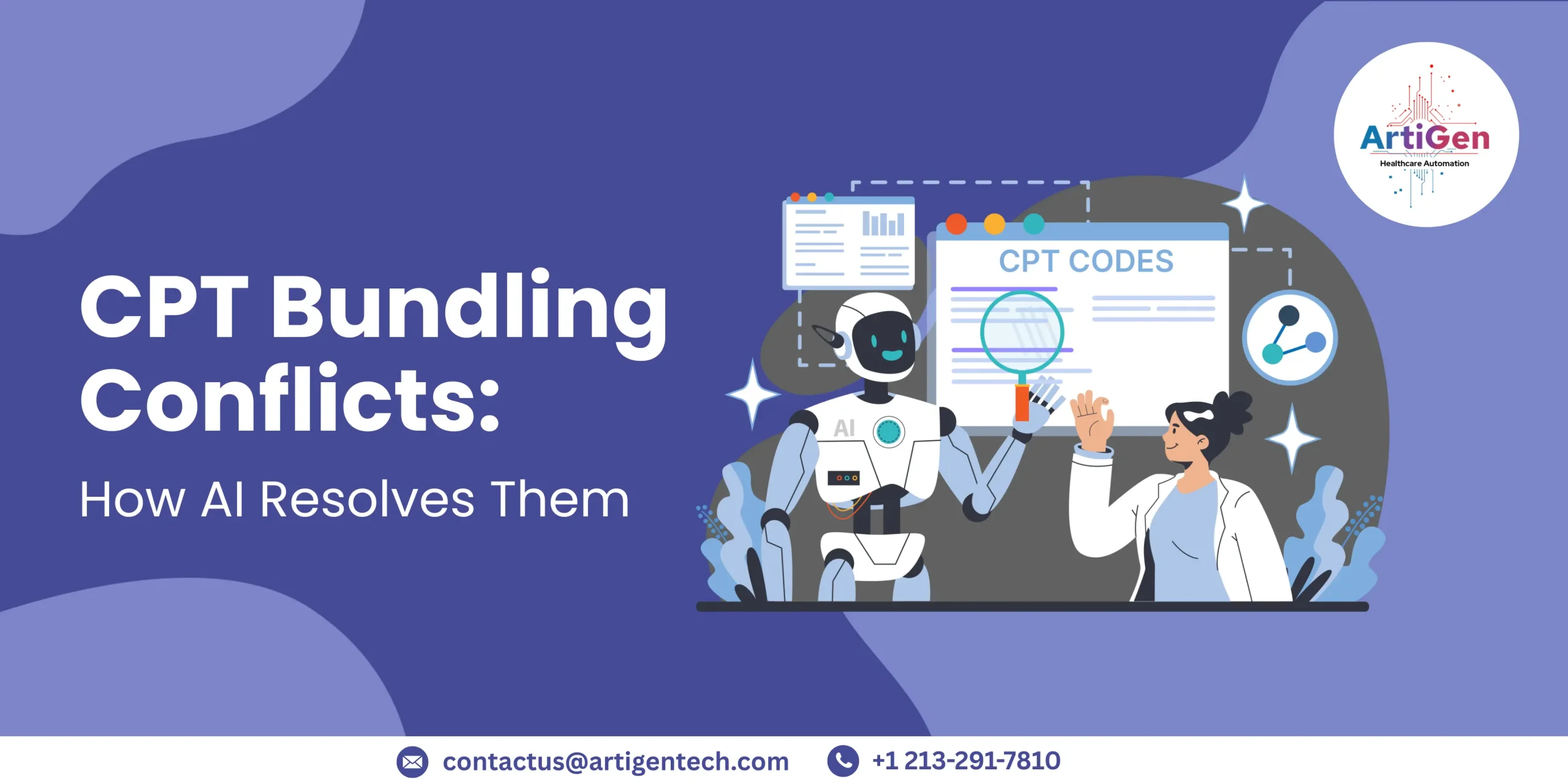
CPT Bundling Conflicts: How Automation Resolves Them
Introduction: Why CPT Bundling Conflicts Are a Growing Revenue Risk
In the ever-changing world of healthcare reimbursement, medical coding denials continue to be a major challenge, preventing the smooth processing of claims and the predictability of revenue. One of the more insidious culprits behind these denials, CPT bundling conflicts, frequently goes unnoticed, a silent drain on resources until denial rates start to spike.
CPT bundling conflicts arise when healthcare providers bill for several procedures individually, despite payers viewing them as components of a single, overarching service. This practice triggers claim rejections, reductions, or outright denials. The result? CPT bundling denials in medical billing, delayed reimbursements, and a significant uptick in administrative work.
The dynamic nature of bundling rules exacerbates the inherent difficulties. Specifically, the National Correct Coding Initiative (NCCI) edits, payer-specific policies, and modifier stipulations are subject to frequent modification. Consequently, manual review procedures are often unable to adapt, resulting in to both CPT coding errors, CPT unbundling errors, thereby increasing the potential for compliance violations.
This is where automation becomes critical.
Healthcare organizations today are turning to AI to tackle medical coding denials. They’re using automated CPT coding validation, claims editing automation, and coding compliance automation to get ahead of bundling conflicts. The goal? To spot and fix these issues before claims even get to the payer.
This newsletter explores:
- Why CPT bundling conflicts happen
- How they impact revenue cycle performance
- How automation resolves bundling issues at scale
- How organizations can reduce denials while maintaining compliance
Understanding CPT Bundling Conflicts in Medical Billing
What Are CPT Bundling Conflicts?
CPT bundling conflicts surface under a few specific circumstances:
- When two or more CPT codes are billed independently.
- When a payer deems one code to be included within another.
- When billing practices contravene NCCI edit validation rules.
These conflicts are commonly identified through:
- Column 1 / Column 2 code pairings.
- Mutually exclusive procedure edits.
- Comprehensive and component procedure edits.
If not addressed properly, these problems result in medical coding denials and lost revenue.
Why CPT Bundling Denials Are So Common
CPT bundling denials in medical billing stem from a variety of issues.
- A rise in the complexity of procedures
- Several services rendered in a single interaction
- Gaps in documentation
- Inconsistent use of modifiers
- Manual coding workflows
- Lack of real-time NCCI edit checks
It is difficult for even seasoned coding teams to manually find bundling conflicts among a large number of claim submissions.
The Financial and Operational Impact of CPT Coding Errors
1. Direct Revenue Loss
Unresolved bundling conflicts result in:
- Rejections of claims
- Reimbursements in part
- Write-offs due to timely filing limits
These losses expand over time and have an immediate effect on margins.
2. Increased Administrative Burden
Each denied claim triggers:
- Manual review
- Correction and resubmission
- Appeals processing
This slows operations and increases cost per claim.
3. Compliance and Audit Risk
Persistent CPT unbundling errors can raise red flags during payer audits, increasing the risk of:
- Recoupments
- Penalties
- Compliance investigations
Why Manual Processes Fail to Prevent CPT Bundling Conflicts
Conventional coding processes mainly depend on:
- Human recall of NCCI regulations
- Documents with static references
- Analysis of post-submission denial
But:
- Every quarter, NCCI updates
- There are many different payer rules.
- Modifier logic depends on the context.
For large-scale claims denial prevention, this renders manual processes unreliable.
How ArtigenTech Resolves CPT Bundling Conflicts with Intelligent Automation
The speed, consistency, and real-time intelligence needed to handle CPT bundling conflicts at scale are absent from manual review procedures. This is where ArtigenTech makes a quantifiable difference.
By integrating intelligence right into the coding and claims process, ArtigenTech’s automation-first platform is intended to handle CPT bundling conflicts, CPT unbundling errors, and medical coding denials. ArtigenTech uses AI to stop medical coding denials, allowing healthcare organizations to:
By leveraging AI to tackle medical coding denials, ArtigenTech empowers healthcare organizations to:
- Perform automated CPT coding validation in accordance with the most recent NCCI revisions.
- Before submitting claims, use real-time NCCI edit validation.
- Recognize inappropriate unbundling and prevent CPT bundling denials in medical billing
- Verify that the use of modifiers is both clinically and financially justified.
- Reduce rework through proactive claims editing automation
ArtigenTech moves organizations toward true claims denial prevention, preventing errors at the source, as opposed to responding to denials after submission.
How Automation Reduces Coding Denials Caused by CPT Bundling
By moving from reactive correction to proactive prevention, automation drastically changes how businesses handle bundling conflicts.
1. Automated Validation of CPT Coding
Real-time claim analysis is done by automated CPT coding validation engines by:
- Evaluating CPT combinations in light of recent NCCI modifications
- Assessing the relationships between procedures
- Recognizing incorrect unbundling
This promises that CPT bundling conflicts are identified prior to submission.
2. NCCI Edit Validation in Real Time
Continuous NCCI edit validation is carried out by automation, including:
- Checks in Columns 1 and 2
- The detection of mutually exclusive codes
- Validation of modifier allowance
This removes the need for out-of-date manual references.
3. NCCI Edits and CPT Modifiers Explained by AI
The use of modifiers in code is one of the most susceptible to mistakes areas.
Automation helps by:
- Examining the context of documentation
- Assessing the suitability of modifiers like -59 or -25
- Recommending the placement of compliant modifiers
This ensures proper unbundling only when it is clinically acceptable.
Automated Claim Scrubbing: Preventing Bundling Errors Before Submission
A crucial component of claims editing automation is automated claim scrubbing.
Prior to filing claims, cleaning instruments:
- Verify CPT combinations.
- Use payer-specific bundling guidelines
- Determine which modifiers are absent or incorrect.
- Look for inconsistencies in the documentation
Claims with possible bundling problems are fixed up front, enhancing:
- First-pass acceptance rates
- The velocity of cash flow
- Accuracy of coding
AI to Prevent Medical Coding Denials: Beyond Rule-Based Checks
Static rule engines are only one aspect of modern AI.
AI-Powered Evaluation of Documents
Using AI and NLP:
- Interprets clinical notes without structure
- Verifies that unbundling is supported by the documentation
- Finds discrepancies between billed codes and procedure descriptions
This dramatically reduces false positives and unnecessary denials.
Identification of Predictive Denial
AI examines past denial trends to:
- Determine which CPT combinations have a high risk of denial.
- Initiate pre-submission adjustments
- Always improve prevention reasoning
This represents a significant breakthrough in of claims denial prevention
How to Fix CPT Bundling Conflicts Using Automation
Automation resolves bundling conflicts through a multi-layered approach:
- Real-time CPT combination analysis
- Automated NCCI edit validation
- Context-aware modifier recommendations
- Pre-submission automated claim scrubbing
- Continuous learning from denial outcomes
Together, these capabilities address bundling conflicts at every stage of the revenue cycle.
How to Prevent CPT Unbundling Denials Long Term
Organizations must implement a preventive strategy in order to attain sustainable denial reduction.
Important Best Practices Driven by Automation
- Integrate workflows with coding compliance automation
- Continue to update the NCCI
- Make modifier logic uniform among programmers.
- Automate the editing of claims in billing systems
- Keep an eye out for bundling denial trends.
Consistency is ensured by automation, which is not possible with manual processes.
Coding Compliance Automation: Reducing Risk While Improving Accuracy
Coding compliance automation guarantees the following:
- CPT codes comply with payer regulations.
- The use of modifiers is justified.
- Billed services are supported by documentation
This improves audit readiness in addition to lowering denials.
Measuring the Impact of Automation on CPT Bundling Denials
Organizations implementing automation commonly report:
- CPT bundling denials have significantly decreased.
- Increased rates of first-pass claim acceptance
- Reimbursement cycles are accelerated.
- Reduced rework amounts
- An increase in coder productivity
These outcomes demonstrate how automation reduces coding denials while protecting revenue.
The Strategic Value of Claims Editing Automation
Claims editing Automation is now essential, not optional.
It permits:
- Enforcing rules consistently
- Scalability in times of volume spikes
- Reliable revenue results
Most significantly, it turns CPT bundling management into a controlled procedure rather than a risk area.
The Future of CPT Bundling Management
Automation will become even more important as payer scrutiny and coding complexity rise.
Future capacities consist of:
- Predictive denial modeling that is advanced
- Scoring for compliance in real time
- More advanced documentation intelligence powered by AI
Businesses that implement automation now will be better equipped to handle reimbursement issues in the future.
ArtigenTech: Transforming CPT Bundling Management into a Revenue Advantage
ArtigenTech offers a scalable, automation-driven method of revenue protection for healthcare organizations dealing with recurrent CPT bundling conflicts. ArtigenTech assists businesses by smoothly integrating with current coding, billing, and EHR systems.
- Reduce CPT bundling denials in medical billing
- Increase the acceptance rates of first-pass claims
- Increase adherence by using NCCI edit validation
- Reduce operational friction and coder rework
- Prevent long-term claims denial prevention
ArtigenTech adds intelligence, consistency, and control to coding knowledge rather than replacing it. As a result, the revenue cycle is quicker, cleaner, and more impervious to payer scrutiny.
Final Thoughts: Turning CPT Bundling Conflicts into a Competitive Advantage
Despite being one of the most avoidable reasons for medical coding denials, CPT bundling conflicts continue to reduce revenue because of manual constraints.
By utilizing:
- AI to prevent medical coding denials
- Automated CPT coding validation
- NCCI edit validation
- Automated claim scrubbing
- Coding compliance automation
Healthcare companies can lower denials, safeguard revenue at scale, and proactively address bundling issues.
Managing CPT bundling conflicts is no longer a question.
The real question is:
How much revenue can your organization afford to lose without automation?