Why Coding Rework Happens and How AI Prevents It
Introduction: The Hidden Cost of Coding Rework
Software development teams invest significant time and resources in building innovative applications, improving customer experiences, and accelerating product delivery. Yet one challenge continues to impact development efficiency across organizations of all sizes: coding rework.
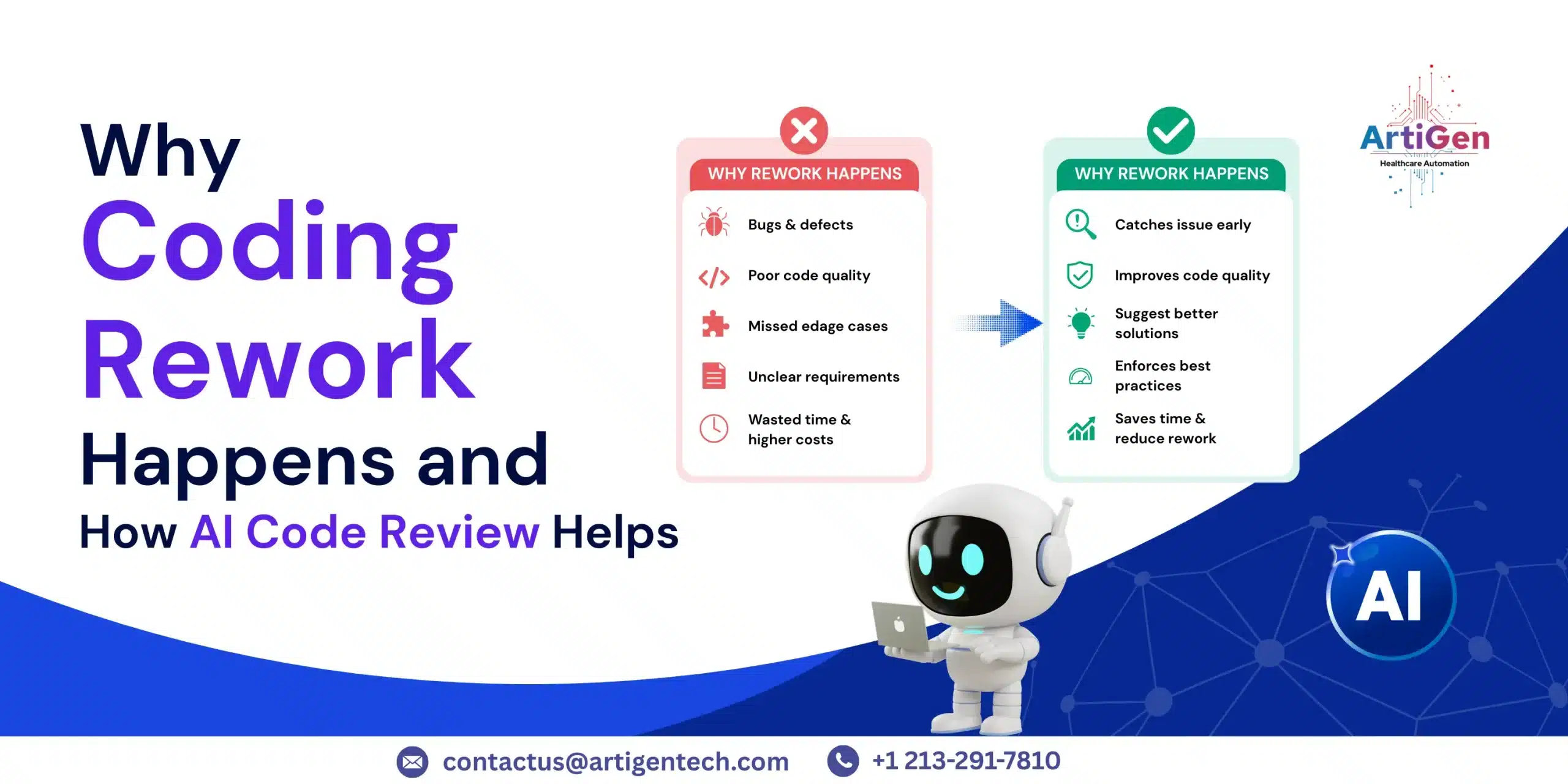
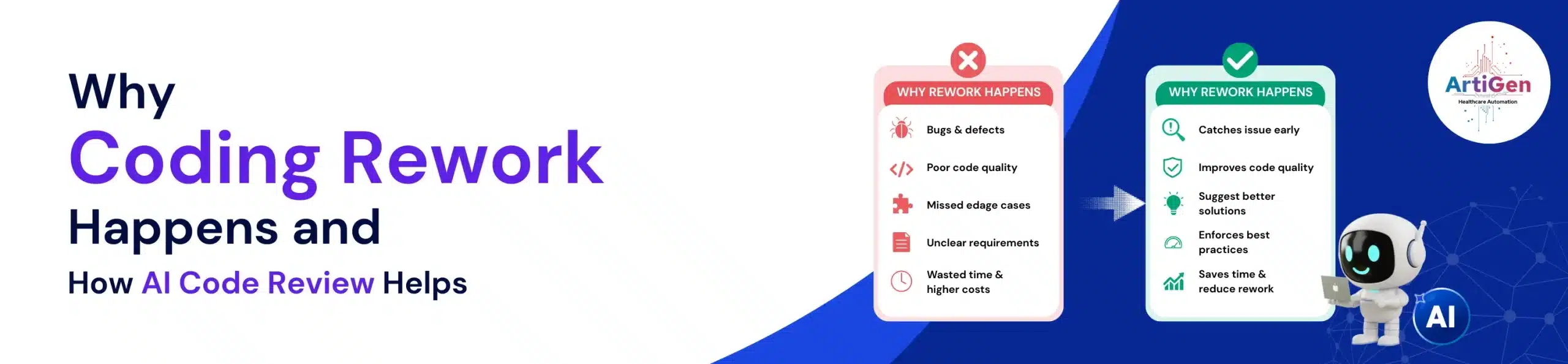
Coding rework occurs when developers must revisit previously completed code to fix defects, address quality issues, resolve security vulnerabilities, improve performance, or align with changing requirements. While some level of refinement is expected during development, excessive rework can delay releases, increase operational costs, and negatively impact software quality.
Organizations are increasingly recognizing the reduction of rework as a way of improving productivity and maintaining a competitive advantage. This is where AI coding assistant technologies are changing modern software development workflows. AI code review, AI coding tools and AI-powered chat review solutions are assisting teams to find issues earlier, improve code quality and reduce unnecessary rework through intelligent automation.
At ArtigenTech we believe that AI-enabled development workflows are becoming essential for organizations that want to accelerate delivery cycles, improve code quality and enable scalable software engineering operations.
Understanding Coding Rework
Before we dive into how AI prevents coding rework, it’s worth understanding why coding rework happens in the first place.
Coding rework refers to modifications made to existing code due to:
- Defects discovered during testing
- Security vulnerabilities
- Poor coding standards
- Incomplete requirements
- Performance issues
- Integration failures
- Architectural inconsistencies
Many software teams spend a considerable percentage of their development cycles fixing issues that could have been prevented earlier.
Understanding why coding rework happens enables organizations to deploy better quality controls and automation strategies.
Common Reasons Why Coding Rework Happens
1. Inadequate Code Reviews
One of the most common causes of rework in code is a poor review process.
Manual reviews are often subject to the availability, experience, and time constraints of the reviewers. In a fast-paced development cycle review points are sometimes skipped.
This results in:
- Logic errors
- Security flaws
- Poor coding practices
- Maintainability challenges
Modern AI code review software helps development teams find these issues before deployment.
2. Lack of Consistent Coding Standards
Development teams frequently consist of multiple engineers working on the same codebase.
Without standardized coding practices, inconsistencies can emerge, including:
- Different naming conventions
- Duplicate logic
- Structural inconsistencies
- Poor documentation
When standards are not consistently enforced, code quality assurance becomes increasingly difficult.
Organizations are now using intelligent code analysis platforms to automatically assess code quality and enforce coding standards throughout the development process.
3. Manual Testing Limitations
Traditional testing approaches often struggle to keep pace with modern development requirements.
Manual testing may fail to identify:
- Edge cases
- Integration failures
- Regression defects
- Performance bottlenecks
That’s why many organizations are investing in automated software testing solutions and software testing automation.
Teams can use AI in software testing with automated validation to find issues before they become expensive rework.
4. Poor Requirement Interpretation
Another major factor contributing to coding rework is unclear or evolving business requirements.
Developers may:
- Misinterpret specifications
- Miss critical functionality
- Implement incorrect workflows
When these problems arise later, teams have to go back over work already done, resulting in delays and extra expense.
Advanced AI development tools can assess requirements, generate recommendations and improve the alignment between development teams and business stakeholders.
5. Security Vulnerabilities
Security flaws often remain hidden until late-stage testing or production deployment.
Common issues include:
- Hardcoded credentials
- Input validation failures
- Authentication weaknesses
- API vulnerabilities
Modern secure code review practices increasingly use AI-based analysis to identify vulnerabilities early.
Organizations utilize AI code review tools to improve software security and reduce costly rework.
The Business Impact of Coding Rework
Medical Coding automation rework affects more than development timelines.
The consequences often include:
Increased Development Costs
Reworking existing code requires additional engineering effort, testing resources, and project management oversight.
Delayed Product Releases
Teams spend time fixing issues instead of developing new features.
Lower Productivity
Developers become trapped in maintenance cycles rather than innovation-focused activities.
Reduced Software Quality
Frequent rework often indicates underlying quality challenges.
Customer Dissatisfaction
Delays and software defects impact on user experience and customer trust.
These challenges have driven demand for software development automation and AI-enabled development workflows.
How AI is Transforming Software Development
Artificial Intelligence is reshaping how software is designed, developed, tested, and maintained.
Modern organizations are increasingly adopting:
- AI coding assistant platforms
- AI coding tools
- AI code review software
- AI development tools
- DevOps automation
- Software development automation
These technologies increase the efficiency of the developers and improve the quality of the code in general.
AI Coding Assistants: The First Line of Defence
An AI coding assistant acts as a real-time development companion.
Instead of waiting for code reviews or testing cycles, developers receive immediate recommendations while writing code.
Modern AI coding assistants help with:
- Code generation
- Error detection
- Refactoring recommendations
- Security validation
- AI healthcare documentation suggestions
AI reduces the chance of future coding rework dramatically by identifying issues early.
Organizations that use AI coding assistant solutions typically experience faster development speed and stronger code consistency.
AI Code Review: Finding Problems Before They Grow
Traditional reviews rely heavily on human expertise.
Human reviewers are still needed, of course, but AI code review offers another layer of intelligent analysis.
Modern AI-powered code review systems continuously analyze code for:
- Logic errors
- Security vulnerabilities
- Code duplication
- Complexity issues
- Compliance violations
Advanced AI code review tools can review thousands of lines of code within seconds.
Benefits of AI code review include:
- Faster review cycles
- Improved consistency
- Reduced reviewer fatigue
- Earlier defect detection
This is one of the most effective ways to prevent coding rework before it impacts production environments.
Automated Code Review Tools and Intelligent Analysis
Modern development teams increasingly deploy automated code review tools alongside manual reviews.
These tools use intelligent code analysis to evaluate:
- Code quality
- Maintainability
- Security risks
- Performance concerns
Traditional static analysis tools do not understand context and can provide less actionable recommendations than AI-driven platforms.
By incorporating automated code review tools, organizations can improve code quality assurance while reducing the accumulation of technical debt.
The Role of AI in Software Testing
Testing remains one of the most critical phases of software development.
Modern AI in software testing capabilities help organizations:
- Detect defects faster
- Improve test coverage
- Automate regression testing
- Prioritize high-risk scenarios
By combining software testing automation with automated software testing, teams can continuously validate applications throughout the development process.
Benefits include:
- Faster feedback loops
- Reduced manual effort
- Earlier defect detection
- Improved software reliability
These advantages directly reduce coding rework and improve release confidence.
AI-Powered Code Refactoring
Poor code structure often creates long-term maintenance challenges.
Modern code refactoring tools powered by AI help developers improve:
- Readability
- Performance
- Scalability
- Maintainability
Instead of looking optimization opportunities manually, AI systems suggest improvements automatically.
It’s a proactive approach that minimizes future maintenance and avoids unnecessary rework.
DevOps Automation and Continuous Quality
Successful software delivery increasingly depends on DevOps automation.
AI-powered DevOps environments enable:
- Continuous integration
- Continuous testing
- Automated deployment validation
- Real-time monitoring
DevOps automation and software development automation are combined to create a development ecosystem where quality checks are applied throughout the software lifecycle.
This greatly decreases defects that get into production.
Benefits of AI Code Review for Development Teams
Organizations implementing AI code review software often experience measurable improvements.
Faster Development Cycles
Developers spend less time fixing avoidable issues.
Improved Code Quality
Continuous code quality assurance improves maintainability and reliability.
Reduced Security Risks
AI-driven secure code review identifies vulnerabilities earlier.
Lower Technical Debt
Proactive recommendations prevent accumulation of problematic code.
Better Developer Productivity
Developers are more focused on innovation and feature delivery.
These benefits highlight the increasing benefits of AI code review across modern development environments.
ArtigenTech’s Approach to AI-Powered Development
At ArtigenTech, we help organizations modernize software engineering through intelligent automation.
Our AI-driven solutions support:
- AI coding assistant capabilities
- AI code review
- Automated code review tools
- Intelligent code analysis
- Software testing automation
- DevOps automation
- Software development automation
- Secure code review
Implementing AI across development workflows helps organizations reduce coding rework, improve delivery speed and increase software quality.
Whether it’s building enterprise applications, cloud platforms, healthcare systems, or digital products, AI-powered development practices empower teams to achieve greater efficiency and scalability.
The Future of AI-Driven Software Development
The future of software engineering will increasingly rely on intelligent automation.
Emerging innovations include:
- Autonomous code review systems
- Predictive defect detection
- AI-generated testing frameworks
- Real-time code optimization
- Advanced AI development tools
- Intelligent DevOps ecosystems
As AI continues evolving, organizations that embrace AI coding tools, AI code review software, and automated software testing will gain significant competitive advantages.
Conclusion
Coding rework still remains one of the most critical challenges for modern software development teams. The first step toward improving efficiency, quality, and delivery speed is to understand why coding rework happens.
Technologies such as AI coding assistants, AI-powered code review, automated code review tools, software testing automation, and intelligent code analysis enable organizations to discover problems sooner and avoid expensive rework.
ArtigenTech helps companies leverage AI-powered development solutions for better code quality, faster delivery, stronger security, and scalable software innovation.
The future of software development is not just faster—it is smarter, more automated, and powered by AI.