How AI Automates Gastroenterology Medical Coding Workflows
Introduction
Gastroenterology practices perform a high volume of complicated procedures, diagnostic services, endoscopic exams and surgical procedures on a daily basis. Coders are responsible for correctly assigning diagnosis and procedure codes and ensuring compliance with payer guidelines, from colonoscopies and upper GI endoscopies to advanced therapeutic procedures. As coding gets more complex, healthcare organizations are increasingly turning to AI medical coding and medical coding automation solutions for efficiency, accuracy, and revenue cycle performance.
Traditional Gastroenterology Medical Coding often involves extensive manual chart reviews, code selection, documentation validation, modifier assignment, and claim verification. Such manual processes can lead to coding inconsistencies, delayed reimbursements and increased administrative burden.
Today, AI coding software, automated medical coding and computer assisted coding software are transforming how providers are handling gastroenterology coding services. Intelligent automation, machine learning and Natural Language Processing (NLP) enable healthcare organizations to improve compliance and productivity and simplify coding workflows.
At ArtigenTech, we enable healthcare organizations to modernize coding operations with sophisticated AI medical coding software, intelligent workflow automation and scalable coding solutions that support specialty-specific workflows such as gastroenterology.
Why Gastroenterology Coding Is Complex
Accurate Gastroenterology Medical Coding is the translation of clinical documentation into specific diagnosis and procedure codes. Gastroenterology visits are often associated with multiple procedures, combinations of diagnoses, and payer-specific requirements.
Typical coding challenges are:
- Complex gastroenterology CPT codes
- Multiple diagnosis mappings
- Procedure bundling and unbundling rules
- Appropriate use of gastroenterology modifiers
- Evolving gastroenterology coding guidelines
- Documentation gaps
- Compliance requirements
Coders must constantly evaluate gastroenterology coding procedures and adhere to payer-specific gastroenterology billing guidelines. Minor coding errors can lead to claim denials, lost revenue or compliance risks.
This growing complexity is driving adoption of healthcare coding automation and automated medical coding platforms.
The Role of AI in Medical Coding
AI in medical coding is based on advanced technologies such as NLP, machine learning, and predictive analytics to analyze clinical documentation and automatically suggest accurate medical codes.
Modern AI coding software can do:
- Integrate with EHR, EMR, and billing systems for seamless workflow management.
- Automatically assign ICD-10-CM, CPT, HCPCS, and GI specialty-specific codes from clinical documentation.
- Analyze unstructured medical records using NLP and ML
- Improve coding accuracy and consistency
- Accelerate coding turnaround time (TAT)
- Prioritize high-complexity cases for coder review while automating routine encounters.
- Support Computer-Assisted Coding (CAC) by providing intelligent code recommendations to coders.
- Enhance revenue cycle performance by minimizing denials and optimizing reimbursement opportunities.
Unlike traditional manual workflows, AI Medical Coding systems learn from coding patterns and get better with accuracy each time.
This results in faster coding turnaround times, improved coding consistency and better compliance for healthcare organizations.
How AI Automates Gastroenterology Medical Coding Workflows
1. Automated Clinical Documentation Review
One of the biggest challenges in gastroenterology medical billing is the long clinical documentation.
AI systems automatically scan:
- GI Endoscopy Coding reports
- Colonoscopy findings
- Pathology reports
- Operative notes
- Procedure documentation
- Physician assessments
Advanced AI medical coding software can extract relevant information and identify clinical terms needed to assign codes.
This process is very beneficial to clinical documentation improvement as it detects missing details prior to claims submission.
Benefits include:
- Faster chart review
- Reduced manual effort
- Improved documentation quality
- Better coding accuracy
2. Intelligent CPT Code Identification
Gastroenterology cpt codes can be time-consuming to select due to procedural complexity.
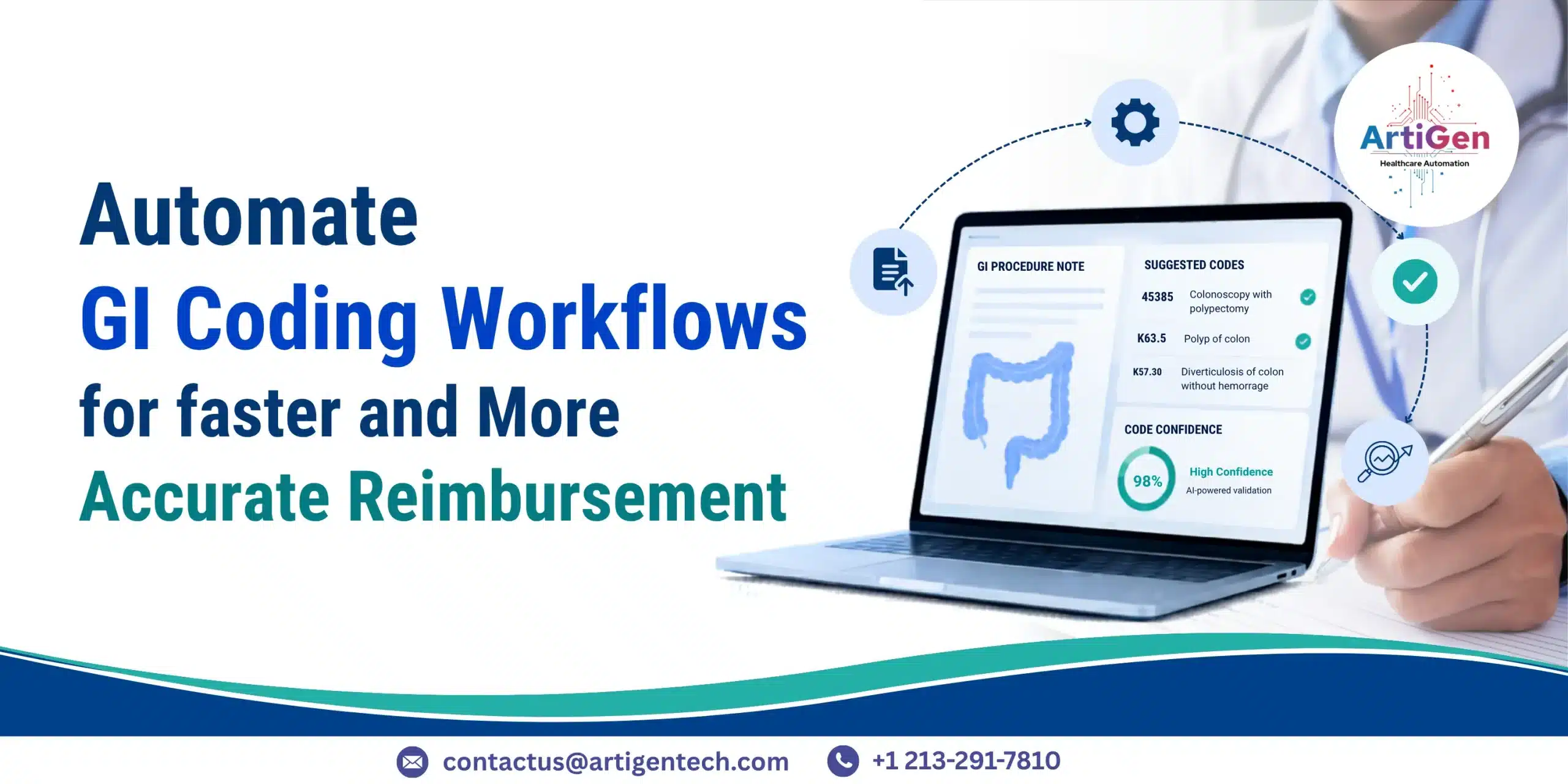
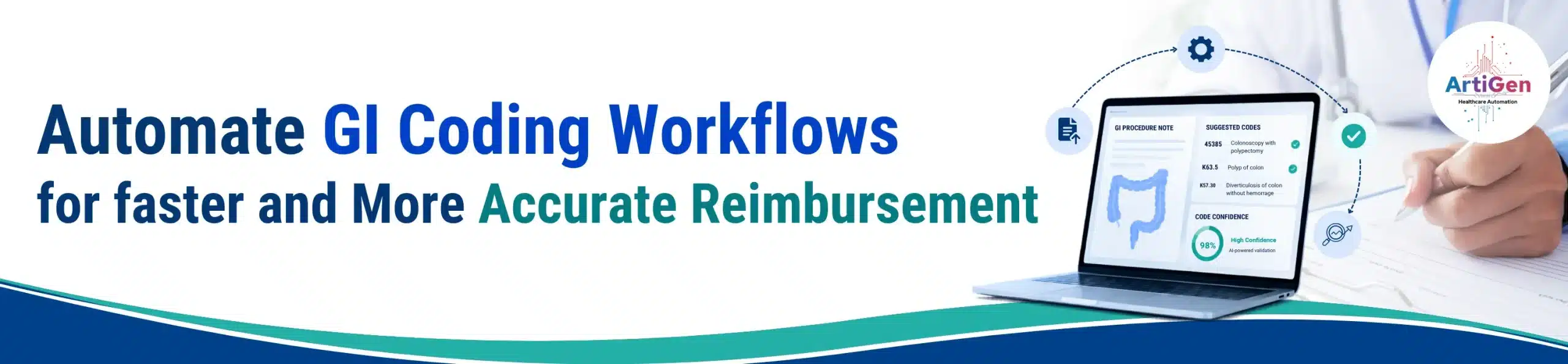
AI-powered computer-assisted coding software scans physician documentation and procedure details and automatically identifies applicable procedure codes.
For example, AI can distinguish between:
- Screening colonoscopy procedures
- Diagnostic colonoscopy procedures
- Therapeutic endoscopic interventions
- Biopsy-related services
- Advanced GI procedures
This will increase the consistency of coding and reduce the workload of coders.
Automated identification of gastroenterology cpt codes frees coders to focus on validation rather than manual code searches.
3. Automated Modifier Assignment
Proper use of gastroenterology modifiers is one of the keys to reimbursement and compliance.
Wrong use of modifiers is often responsible for:
- Claim rejections
- Payment delay
- Compliance risks
AI systems automatically identify procedural relationships and suggest appropriate gastroenterology modifiers based on documentation and payer requirements.
Medical coding automation improves claim accuracy and reduces denials by automating modifier validation.
4. Supporting Gastrointestinal Surgery Coding
Coding surgical GI procedures requires detailed documentation analysis and accurate code assignment.
AI solutions help identify:
- Procedure complexity
- Surgical approach
- Associated diagnoses
- Post-operative services
- Relevant gastrointestinal surgery cpt codes
Automated review of operative reports allows Automated Medical Coding systems to improve coding consistency in high-volume surgical workflows.
This is particularly advantageous for organizations involved in complex coding gastroenterology procedures.
5. Documentation Validation and Compliance Checks
Incomplete documentation is one of the leading causes of coding errors.
Modern AI coding software automatically validates documentation against established gastroenterology coding guidelines, and gastroenterology billing guidelines.
The system can detect:
- Missing diagnosis details
- Documentation gaps
- Incomplete procedure descriptions
- Unsupported code assignments
These validation checks improve clinical documentation improvement efforts and reduce compliance risks.
Common Gastroenterology Conditions, ICD-10 Codes, and Associated CPT Codes
Condition | ICD-10 Code | Common Procedure | CPT Code | Description |
Gastroesophageal Reflux Disease (GERD) | K21.9 | Diagnostic EGD | 43235 | Esophagogastroduodenoscopy, flexible, transoral; diagnostic, including collection of specimen(s) by brushing or washing, when performed (separate procedure) |
Barrett’s Esophagus | K22.70 | EGD with Biopsy | 43239 | Esophagogastroduodenoscopy, flexible, transoral; with biopsy, single or multiple |
Crohn’s Disease | K50.90 | Colonoscopy with Biopsy | 45380 | Colonoscopy, flexible; with biopsy, single or multiple |
Ulcerative Colitis | K51.90 | Colonoscopy with Biopsy | 45380 | Colonoscopy, flexible; with biopsy, single or multiple |
Irritable Bowel Syndrome (IBS) | K58.9 | Diagnostic Colonoscopy | 45378 | Colonoscopy, flexible; diagnostic, including collection of specimen(s) by brushing or washing, when performed (separate procedure) |
Diverticulosis of Colon | K57.30 | Diagnostic Colonoscopy | 45378 | Colonoscopy, flexible; diagnostic, including collection of specimen(s) by brushing or washing, when performed (separate procedure) |
Diverticulitis of Colon | K57.32 | Colonoscopy (Post-Treatment Evaluation) | 45378 | Colonoscopy, flexible; diagnostic, including collection of specimen(s) by brushing or washing, when performed (separate procedure) |
Colon Polyp | K63.5 | Colonoscopy with Polypectomy | 45385 | Colonoscopy, flexible; with removal of tumor(s), polyp(s), or other lesion(s) by snare technique |
Gastrointestinal Hemorrhage | K92.2 | Diagnostic EGD | 43235 | Esophagogastroduodenoscopy, flexible, transoral; diagnostic, including collection of specimen(s) by brushing or washing, when performed (separate procedure) |
Nonalcoholic Fatty Liver Disease (NAFLD) | K76.0 | Diagnostic EGD (if variceal evaluation needed) | 43235 | Esophagogastroduodenoscopy, flexible, transoral; diagnostic, including collection of specimen(s) by brushing or washing, when performed (separate procedure) |
Abdominal Pain | R10.9 | Diagnostic Colonoscopy | 45378 | Colonoscopy, flexible; diagnostic, including collection of specimen(s) by brushing or washing, when performed (separate procedure) |
Bile Duct Stones (Choledocholithiasis) | K80.50 | ERCP with Stone Removal | 43264 | Endoscopic retrograde cholangiopancreatography (ERCP); with removal of calculi/debris from biliary/pancreatic duct(s) |
Gastroenterology Coding Modifiers Frequently Used
Modifier | Description |
25 | Significant, separately identifiable E/M service |
26 | Professional component |
52 | Reduced services |
53 | Discontinued procedure |
59 | Distinct procedural service |
PT | Colonoscopy converted from screening to diagnostic |
33 | Preventive service |
TC | Technical component |
Modern AI medical coding software and automated medical coding platforms can automatically identify frequently used gastroenterology CPT codes, relevant ICD-10 diagnoses, and appropriate gastroenterology modifiers from physician documentation. This helps improve coding accuracy, reduce manual review time, and support compliance with current gastroenterology coding guidelines and gastroenterology billing guidelines.
How AI Improves Gastroenterology Billing Efficiency
AI-powered healthcare coding automation reduces manual coding bottlenecks and significantly improves billing performance.
Key improvements include:
Faster Coding Turnaround
Automated workflows process charts faster than traditional manual methods.
Reduced Coding Errors
AI consistently applies coding rules and identifies discrepancies.
Improved Revenue Capture
Accurate code assignment helps ensure appropriate reimbursement.
Lower Administrative Burden
Coders spend less time searching for codes and more time validating results.
Better Compliance
Built-in validation supports evolving gastroenterology coding guidelines and payer requirements.
These benefits are leading to AI in medical coding being an increasingly valuable investment for healthcare organizations.
Key Technologies behind Automated Medical Coding
Several technologies power modern automated medical coding platforms.
Natural Language Processing (NLP)
AI medical coding solutions use NLP to understand physician notes and extract relevant clinical information.
Machine Learning
Machine learning models continuously improve coding recommendations based on historical coding data.
Intelligent Workflow Automation
Medical Coding Automation platforms automate repetitive tasks such as:
- Clinical documentation review and analysis
- Extraction of diagnoses, procedures, and medical terms from patient records
- Identification of coding discrepancies and documentation gaps
- Compliance monitoring, audit flagging and quality assurance reviews
- Denial prediction and prevention
Predictive Analytics
AI predicts potential coding risks and identifies opportunities for coding improvement.
Combined, these technologies help deliver a highly efficient automated medical coding platform for specialty-specific workflows.
AI and Gastroenterology Coding Services
Many healthcare organizations are adopting AI-enhanced gastroenterology coding services to address staffing shortages and rising coding complexity.
AI helps coding teams:
- Process more charts
- Improve productivity
- Reduce burnout
- Increase coding consistency
- Improve reimbursement outcomes
AI medical coding software allows organizations to scale their operations without sacrificing quality, whether for outpatient procedures or complex GI procedures.
The Impact of AI on Medical Coding Teams
Contrary to common misconceptions, AI in medical coding is not replacing coders.
Instead, AI acts as a computer assisted coding software solution that supports coding professionals.
Coders continue to:
- Review AI recommendations
- Validate code selections
- Ensure compliance
- Handle complex scenarios
AI automates repetitive work while enabling coders to focus on higher-value decision-making activities.
This collaboration between human expertise and AI coding software creates more efficient coding workflows.
Future Trends in Gastroenterology Medical Coding
The future of Gastroenterology Medical Coding will be driven by greater automation and intelligence.
Emerging trends include:
Real-Time Coding Assistance
AI will provide coding recommendations during clinical documentation creation.
Advanced Clinical Documentation Improvement
AI will proactively identify missing documentation before chart completion.
Predictive Compliance Monitoring
Future systems will automatically identify compliance risks before claims submission.
Specialty-Specific AI Models
Dedicated gastroenterology-focused models will improve accuracy for gastroenterology coding software applications.
End-to-End Coding Automation
Organizations will evolve toward more fully integrated automated medical coding platforms that support documentation, coding, billing and compliance workflows.
How ArtigenTech Supports AI-Powered Medical Coding
At ArtigenTech, we help healthcare organizations accelerate digital transformation through intelligent medical coding solutions powered by AI and automation.
Our capabilities support:
- Clinical documentation improvement
- Medical Coding Automation
- Healthcare coding automation
- AI Medical Coding
- Automated Medical Coding
- Specialty-focused coding workflows
- Revenue cycle optimization
- Compliance-driven coding operations
Our intelligent solutions help organizations improve coding accuracy, reduce administrative burden and scale coding operations efficiently across specialties, including gastroenterology.
Conclusion
As coding complexity continues to grow, healthcare organizations need to find smarter ways to manage specialty coding workflows. AI medical coding, medical coding automation, computer assisted coding software are changing the way providers approach Gastroenterology Medical Coding.
AI automates chart review, code identification, modifier assignment, documentation validation, and compliance monitoring, significantly improving operational efficiency and coding accuracy.
Organizations that embrace Automated Medical Coding, healthcare coding automation and intelligent medical coding software will be better positioned to improve reimbursement outcomes, reduce denials, and strengthen compliance.
With advanced AI-driven solutions from ArtigenTech, healthcare providers can modernize gastroenterology coding workflows and build a more efficient, scalable, and future-ready coding ecosystem.