Anesthesia Coding Software: Key Features Healthcare Organizations Should Evaluate
Healthcare organizations have large volumes of anesthesia documentation, procedures and billing activity that require specialized knowledge of coding. Even minor errors in selecting anesthesia CPT coding, verifying documentation, calculating anesthesia time units, and using proper billing information can lead to re-work and claims problems.
That’s why anesthesia coding software is emerging as an essential aspect of modern healthcare revenue cycle management. By leveraging specialty-specific coding rules, AI, automation and validation, organizations can reduce repetitive manual tasks and enhance coding consistency.
The right anesthesia coding software for hospitals, ambulatory surgery centers, anesthesia groups and other healthcare organizations should support the entire workflow from clinical documentation through coding review and anesthesia medical billing.
What Is Anesthesia Coding Software?
Anesthesia coding software is a technological solution that is intended to facilitate the identification, validation, and processing of anesthesia coding information. A system focused on anesthesia must address specialty-specific requirements that include anesthesia procedure codes (ASA Crosswalk), anesthesia type & administration, time taken in units, anesthesia base units, anesthesia time units, modifiers and documentation not addressed by general medical coding software.
Modern platforms may also combine AI medical coding, automated medical coding, and medical coding automation to extract relevant information and prepare coding recommendations for professional review.
The goal is not simply to find a code. Effective anesthesia medical coding software should connect documentation, CMS coding guidelines, validation, and billing into one streamlined workflow.
Why Do Healthcare Organizations Need Anesthesia Coding Software?
Anesthesia coding has several components that must work together. CMS describes anesthesia payment as being based on the applicable conversion factor multiplied by allowable base and time units, with one anesthesia time unit equal to 15 minutes and modifying units.
The standard billing and reimbursement formula for anesthesia services is (Base Units + Time Units + Modifying Units) × Conversion Factor = Anesthesia Fee Amount.
CMS also identifies anesthesia time as the period when the anesthesia practitioner is present with the patient and furnishing anesthesia services. Its 2026 NCCI manual specifically addresses anesthesia coding and the reporting of time units.
This makes accurate anesthesia coding is more than simply selecting the right code. Organizations require technology that can connect documentation, procedure information, ASA Crosswalk, Anesthesia type & administration, time, units, modifiers, and billing.
10 Key Features to Evaluate in Anesthesia Coding Software
1. Accurate Anesthesia CPT Code Identification
One of the primary functions of anesthesia coding software is the exact identification of anesthesia CPT coding from clinical and procedural documentation.
The system should able to understand the medical terminology used in anesthesia and relate the procedure documented to suitable anesthesia procedure codes. This can reduce manual searches for codes and lead to more consistent anesthesia CPT coding.
With AI medical coding, the platform can identify relevant terms and provide coding suggestions for review. This allows coding professionals to concentrate on validation instead of repetitive information retrieval.
2. Automated Anesthesia Time-Unit Calculation
Accurate anesthesia time units are essential due to the fact that anesthesia reimbursement is structured around time. For purposes of reimbursement and payment, CMS calculates one anesthesia time unit is 15 minutes.
A secure anesthesia coding software platform should record documented start and end times and facilitate automatic calculation of anesthesia time units.
This feature is especially important for anesthesia coding automation, since manual calculations can take a lot of coder time. Automated processing can help foster more consistent anesthesia medical coding, while still allowing coders to review unusual cases.
3. Anesthesia Base-Unit Validation
Another significant consideration is the anesthesia base units. CMS says its anesthesia base units will stay the same for calendar year 2026.
Therefore, healthcare organizations should consider whether their anesthesia coding software is keeping up-to-date with current reference information and validating anesthesia base units against the applicable anesthesia code.
Integrating anesthesia base units with anesthesia CPT coding and anesthesia time units within the same workflow can reduce manual look ups and improve coding efficiency.
4. Support for Anesthesia Coding Guidelines
An effective anesthesia coding system should be able to accommodate current anesthesia coding guidelines and specialty-specific coding rules.
The CMS 2026 NCCI Policy Manual has a separate chapter on anesthesia services. It explains that generally one anesthesia code is reported for Medicare purposes unless the anesthesia code is an add-on code.
Technology should help identify potential coding inconsistencies and route exceptions for professional review. Medical coding software can be even more valuable when it’s configured for anesthesia workflows.
5. Modifier and Provider Validation
Anesthesia claims may require specific provider and service modifiers. CMS guidance includes modifiers such as AA, QX, QY, and QZ.
A reliable anesthesia coding software solution should check the modifier information against the documentation and provider relationships.
This can help strengthen anesthesia medical coding, reduce avoidable billing issues, and support more accurate anesthesia medical billing. Automated validation can also contribute to broader medical coding automation.
6. Clinical Documentation Intelligence
Documentation is the foundation of accurate coding. Anesthesia records may include data on procedures, timing, providers, patient status, CRNA, Anesthesiologist and other clinical information.
AI medical coding can help to analyze this documentation and find coding-relevant information. An anesthesia medical coding software platform can surface key data for coder validation instead of only manual review.
This allows for automated medical coding but still maintains a human review in the workflow for ambiguous or complex documentation.
7. Intelligent Edit Validation
Healthcare organizations should also evaluate the edit capabilities of their anesthesia coding software.
CMS updates the Medicare NCCI Policy Manual annually, and the 2026 manual will be effective on January 1, 2026.
Prior to billing, a smart system can evaluate coding combinations, relationships in documentation, modifiers, and other possible issues and flags the discrepancies to coder attention.
This type of validation strengthens compliance to anesthesia coding guidelines and aids in the automation of anesthesia coding by allowing for early identification of common problems.
8. End-to-End Anesthesia Workflow Automation
The value of anesthesia coding automation is enhanced when technology supports the entire coding workflow.
A typical automated workflows can follow:
Clinical Documentation → Data Extraction → Procedure Identification → Anesthesia CPT coding → Base Units → Time Units → Modifier Validation → Coder Review → Billing
A specialized anesthesia coding software platform can automate repeatable steps, while allowing coding professionals to resolve exceptions.
This blend of automation with human validation results in a scalable approach to anesthesia medical coding.
9. Integration with Billing and Revenue Cycle Systems
Coding does not operate independently from the broader revenue cycle. The output from anesthesia medical coding software ultimately supports billing and reimbursement activities.
Organizations should verify that medical coding software can be integrated with electronic health records (EHRs), practice management systems, billing platforms or revenue cycle management solutions.
Strong integration can reduce duplicate data entry and create a more connected workflow between anesthesia coding services and anesthesia medical billing.
10. Audit Trails, Reporting, and Scalability
A mature anesthesia coding system should provide visibility into coding recommendations, edits, coder changes, exceptions and workflow performance.
Reporting can help organizations understand coding turnaround times, documentation issues, recurring edits and productivity.
Scalability is important, too. Larger healthcare organizations need anesthesia coding software which can handle high volumes without a corresponding increase in manual effort.
Anesthesia Coding Software vs. Manual Coding
Capability | Manual Coding | Anesthesia Coding Software |
CPT identification | Manual lookup | Automated AI assistance |
Time calculation | Manual | Automated calculation |
Base-unit validation | Manual reference | System validation |
Documentation review | Time-intensive | AI-assisted |
Modifier checks | Manual review | Automated AI suggestion |
Audit visibility | Limited | Centralized |
Scalability | Resource-intensive | Highly scalable |
The major advantage is not removing coders from the process. It is allowing coding professionals to spend less time on repetitive tasks and more time on complex validation.
How AI Improves Anesthesia Medical Coding Accuracy
The combination of AI medical coding and medical coding automation has the potential to improve the management of anesthesia documentation.
AI is able to read unstructured documentation, extract relevant clinical terminology, locate procedure information and make coding recommendations. Then, automated medical coding can carry structured information through the workflow.
For healthcare organizations, this means anesthesia coding software can serve as an intelligent workflow tool, rather than just a digital codebook.
However, oversight by humans still plays an important role as the coding decisions can involve ambiguous documentation, payer rules and specialty judgment.
How SedoDEX AI Supports Anesthesia Coding Automation
Technology designed around the realities of anesthesia workflows is what healthcare organizations need to modernize anesthesia medical coding.
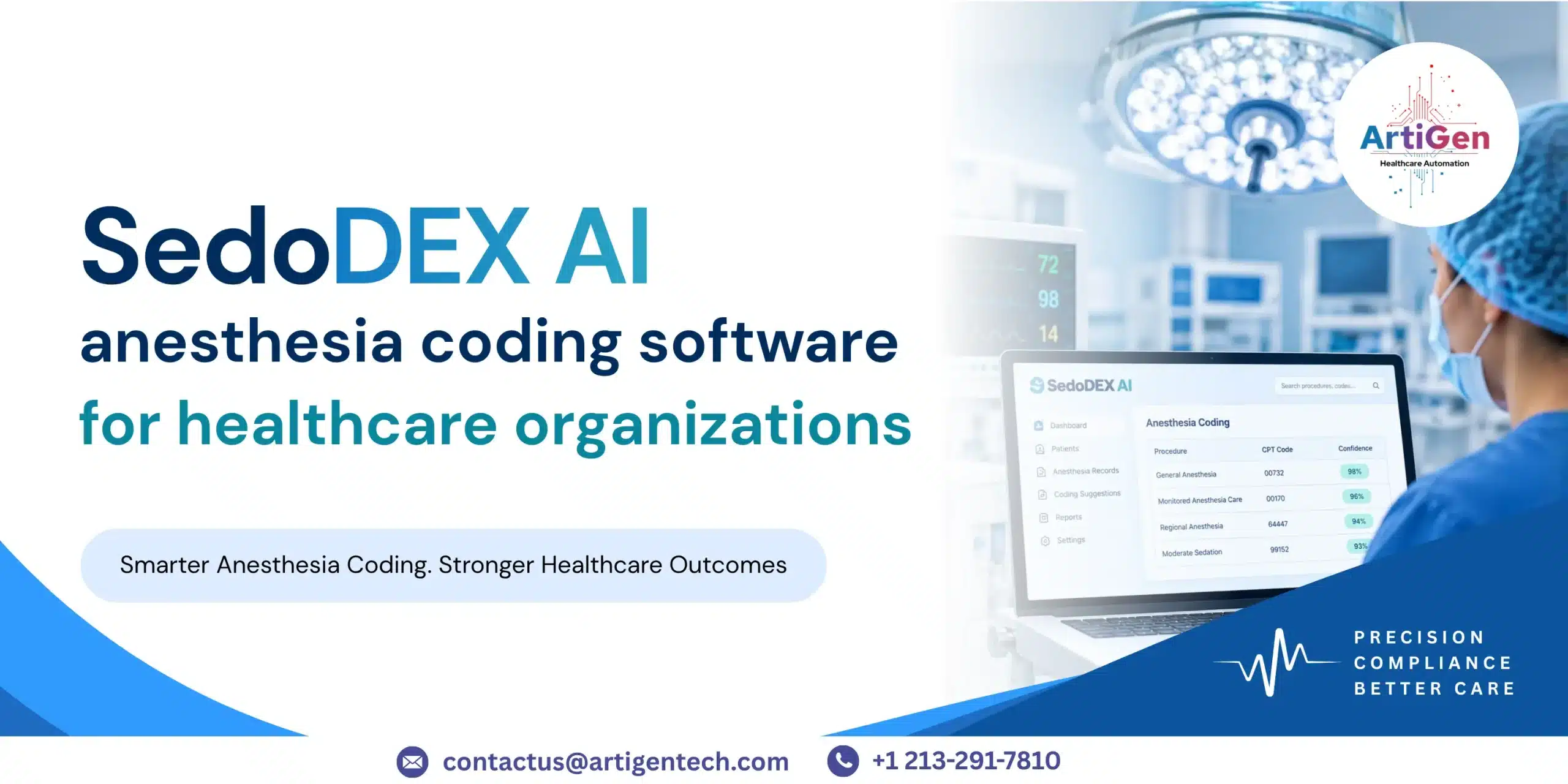
SedoDEX AI is designed to help organizations streamline documentation analysis, coding workflows, and validation to support AI-powered anesthesia coding.
SedoDEX AI allows organizations to transition to a more connected process for reviewing anesthesia CPT coding, anesthesia procedure codes, anesthesia time units and other coding information.
The platform can reduce repetitive manual activities associated with anesthesia coding automation while keeping professional coders involved in review and decision-making.
For healthcare organizations seeking to evaluate anesthesia coding software, SedoDEX AI offers an opportunity to incorporate AI medical coding, automated medical coding, and specialty-specific workflow automation into the anesthesia coding process.
Ready to Modernize Your Anesthesia Coding Workflow?
Manual coding processes can result in unnecessary rework, slow turnaround times and add pressure on coding teams. SedoDEX AI helps healthcare organizations to deploy a more intelligent and scalable approach to anesthesia coding automation.
Improve documentation review. Streamline coding. Validate critical coding elements. Support your revenue cycle with AI-powered anesthesia coding.
Explore SedoDEX AI and see how intelligent automation can transform your anesthesia coding workflow.
Frequently Asked Questions
What is anesthesia coding software?
Anesthesia coding software is specialized technology that supports anesthesia documentation analysis, code identification, time and unit processing, validation, and billing workflows.
How does anesthesia coding software calculate time units?
The system can capture documented anesthesia start and end times and calculate anesthesia time units based on the applicable rules. For standard billing and reimbursement formula , CMS identifies one anesthesia time unit as 15 minutes.
Can AI automate anesthesia medical coding?
Yes. AI medical coding can extract coding-relevant information from anesthesia documentation and generate recommendations. Professional coders should continue to validate complex or ambiguous cases.
What features should healthcare organizations look for?
Organizations should evaluate anesthesia CPT coding identification, anesthesia time units, anesthesia base units, anesthesia coding guidelines, modifier validation, documentation intelligence, integrations, auditability, and scalability.
How can anesthesia coding software support revenue cycle management?
By connecting anesthesia medical coding with billing workflows, automation can reduce manual processing, improve data consistency, and help coding teams identify issues before claims move forward.
Key Takeaways
Healthcare organizations should evaluate anesthesia coding software as an end-to-end coding and workflow solution rather than simply a code lookup tool.
The most important capabilities include:
- Accurate ASA Crosswalk
- Anesthesia time units calculation
- Anesthesia base units validation
- Anesthesia coding guidelines support
- Modifier and documentation validation
- AI-assisted anesthesia medical coding
- Anesthesia workflow automation
- Billing and revenue cycle integration
- Audit trails, analytics, and scalability
The right anesthesia medical coding software can combine AI medical coding, automated medical coding and medical coding automation to reduce repetitive work while maintaining professional oversight.
With SedoDEX AI, healthcare organizations move to a smarter, scalable and more efficient anesthesia coding workflow.