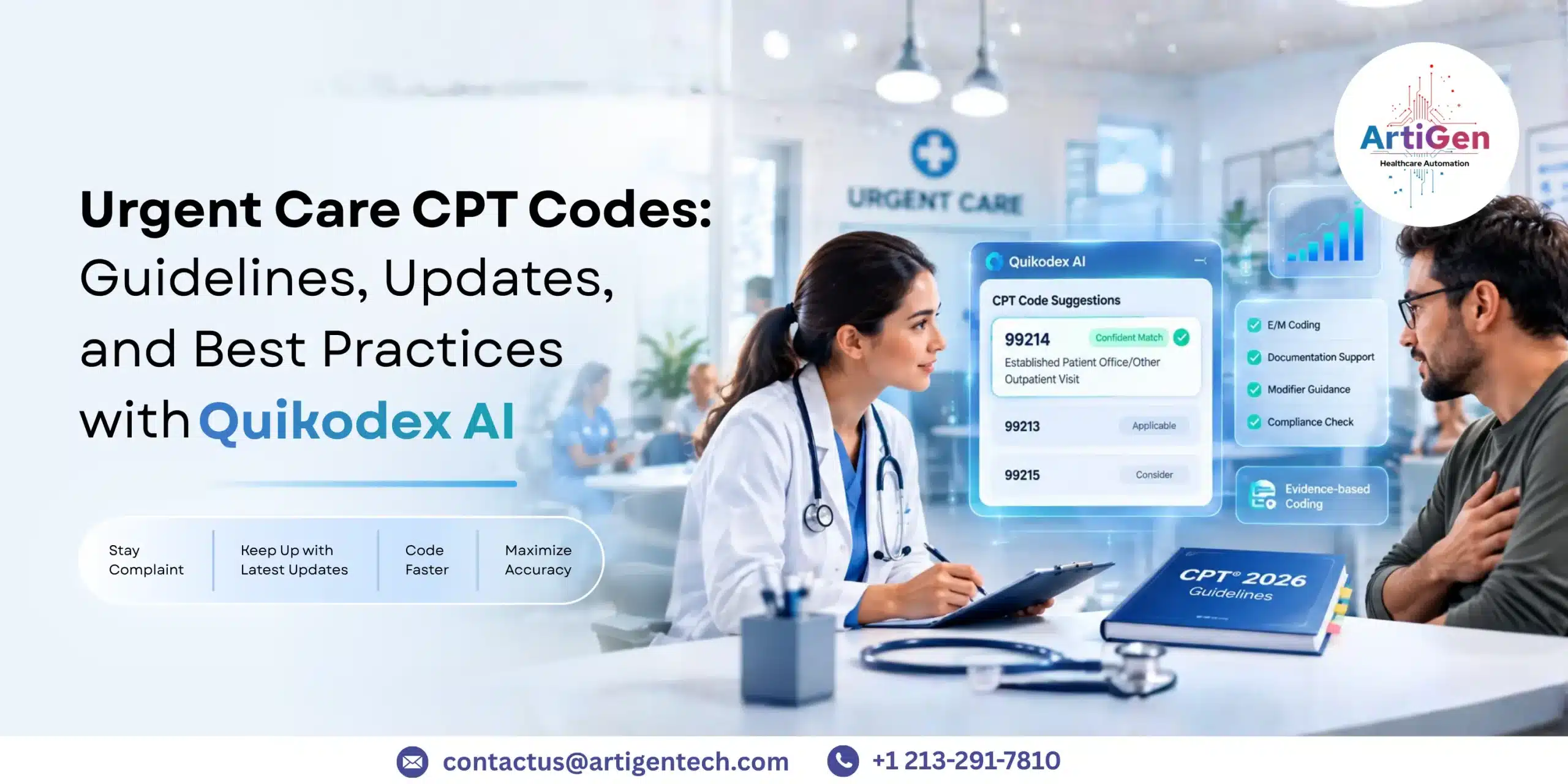
Urgent Care CPT Codes: Guidelines, Updates, and Best Practices
There is no single urgent care CPT code that applies to every patient visit. The appropriate CPT or HCPCS code depends on the service performed, E/M level determined, patient registration status, documentation, and medical decision-making (MDM) or total time, procedure, and payer requirements. For professional claims, urgent care encounters commonly use applicable office or other outpatient E/M codes 99202-99215, while CMS identifies Place of Service (POS) 20 as an urgent care facility when its definition applies.
Accurate urgent care coding therefore requires more than selecting a code associated with the facility. The coding team must connect the clinical documentation, diagnosis, E/M service, procedures, laboratory services, modifiers, and billing requirements into one compliant workflow.
For high-volume organizations, urgent care coding automation can help review documentation, identify relevant services, validate codes, and flag potential errors before claims are submitted. Artigentech’s Urgent care coding software – Quikodex AI brings this intelligent approach to urgent care coding by helping organizations streamline documentation-driven coding workflows.
Why Urgent Care Coding Is Different
Urgent care centers sit between traditional primary care CPT codes and emergency services. Patients typically seek unscheduled treatment for acute illnesses and minor injuries that require prompt attention but do not necessarily require hospital emergency care.
Common encounters include:
- Patient evaluation and E/M services
- Treatment of minor injuries and infections
- Medication administration and injections
- Minor fractures and sprains
- Laceration repair & wound care
- Laboratory testing and specimen collection
- Telemedicine Consultation
- Follow-up care and referrals to specialists
- Point-of-care diagnostic testing
An encounter can include an E/M service, lab testing, imaging, injections, wound repair, medication administration and other urgent care procedures.
This creates a heavy reliance on complete clinical documentation and accurate identification of services for coding and billing for urgent care.
What Is the CPT Code for an Urgent Care Visit?
There is no universal cpt code for urgent care. The correct code is based on what the clinician actually did and recorded.
For many professional urgent care encounters, the applicable office/outpatient E/M code family may be used. CMS guidance identifies 99202–99205 for new-patient office/outpatient E/M services and 99211–99215 established patient services with applicable documentation and coding requirements, CMS guidance identifies.
Therefore, terms such as cpt code for urgent care visit, cpt code urgent care, cpt code urgent care visit, and urgent care visit CPT code should not be treated as separate coding categories. They represent the search intent around identifying the correct E/M or procedure code for a specific encounter.
Urgent Care CPT Coding: Documentation Comes First
Effective urgent care CPT coding begins with the medical record.
For E/M services, coding teams should determine the level of service based on the documentation of medical decision-making or the time-based methodology, as appropriate, and not based on diagnosis alone.
Relevant documentation may include:
- Chief complaint and history
- Problems addressed
- Data reviewed or analyzed
- Risk of patient management
- Assessment and plan
- Medical Decision-Making
- Procedures and services
- Treatment decisions
- Follow-up instructions
- Procedures performed
Strong documentation supports accurate urgent care coding guidelines application and reduces the risk of upcoding, undercoding, and payer disputes.
Understanding Urgent Care Place of Service
Urgent care place of service is an important claim-level element.
CMS defines POS 20 — Urgent Care Facility as a location distinct from a hospital emergency room, office, or clinic whose purpose is to diagnose and treat unscheduled ambulatory patients seeking immediate medical attention.
For organizations performing urgent care billing, coders should validate:
- Location, date & place of service
- Professional versus facility billing
- Payer-specific requirements
- Documentation supporting each billed service
- Modifiers, NCCI edits and bundling rules
- Procedures and ancillary services
- Services reported with the encounter
Using an incorrect POS can create claim-processing issues even when the CPT coding itself is accurate.
Urgent Care Billing Codes: CPT, HCPCS, and Diagnosis Coding
A complete urgent care billing code workflow may involve several coding systems.
1. CPT Codes
CPT codes can represent:
- E/M services
- HCPCS Level II codes
- Procedures
- Imaging
- Injections
- Wound repair
- Other professional services
2. HCPCS
Urgent care HCPCS may be required for drugs, supplies, and other services. CMS maintains quarterly HCPCS updates, including the July 2026 update, making current-code maintenance essential.
3. ICD-10-CM
ICD-10-CM codes play a critical role in urgent care billing by accurately representing the patient’s diagnosis, symptoms, conditions, and medical necessity for the services provided.
Together, these elements create the foundation of urgent care billing codes and accurate claims.
4. Place of Service
The urgent care place of service must accurately reflect the location of the encounter.
Together, these elements form the foundation of urgent care billing codes and compliant claims.
Urgent Care Procedure Codes and Laboratory Services
Common urgent care procedure codes may include services for:
- Laceration repair
- Incision and drainage
- Foreign body removal
- Fracture or dislocation management
- Splinting and casting
- Injections
- After hours and supplies codes
- Diagnostic testing
The actual code is driven by the documented procedure, the anatomic site, complexity, technique and the coding rules that are applicable.
Moreover, urgent care labs need to document what test was performed, what methodology was used and how billing is arranged.
Artificial intelligence can help in extracting these services from clinical notes and connecting them to the appropriate coding workflow.
Common Urgent Care Coding and Billing Errors
Even experienced teams encounter recurring issues in urgent care coding.
E/M Upcoding
Selecting a higher E/M level than documentation supports can create compliance and audit risk.
Missed Procedures
Manually reviewing high-volume encounters can result in separately reportable procedures being overlooked.
Incorrect POS
Incorrect urgent care place of service reporting can affect payer processing.
Duplicate Charges
The same service may be captured through multiple systems.
Unsupported Diagnoses
Diagnosis coding must be supported by the clinical record and medical necessity.
Outdated Code Sets
CPT, HCPCS, NCCI edits, bundling rules, and payer policies change. CMS publishes NCCI edits quarterly, including the Quarter 3 2026 files effective July 1, 2026.
Urgent Care Billing Guidelines and Current Updates
CPT, HCPCS, NCCI, POS, payer edits, and documentation requirements need to be monitored in relation to current urgent care billing guidelines.
CMS 2026 NCCI edits include quarterly updates for procedure-to-procedure edits and medically unlikely edits. NCCI edits help to identify incorrect code combinations or units and should be part of pre-bill validation.
For urgent care organizations, this creates a practical challenge: Coding teams need to keep their workflows aligned with changing rules while processing high encounter volumes.
That is where urgent care coding automation becomes valuable.
How AI Improves Urgent Care Coding
AI-powered automation can connect clinical documentation with coding rules before a claim is released.
An intelligent urgent care coding automation workflow can:
- Capture the encounter documentation.
- Extract diagnoses, procedures, medications, and services.
- Identify potential E/M and procedure codes.
- Validate documentation support.
- Check applicable coding edits.
- Review POS and modifier requirements.
- Flag exceptions for coder review.
- Prepare validated coding information for billing.
This approach reduces repetitive manual work while supporting urgent care coding accuracy.
Quikodex AI: Intelligent Automation for Urgent Care Coding
Quikodex AI is designed to help healthcare organizations modernize urgent care coding through AI-powered documentation analysis and coding automation.
Instead of treating every code independently, Quikodex AI evaluates the encounter as a connected clinical workflow.
It can support:
- CPT code for urgent care visit review
- Urgent care E/M level coding
- Urgent care billing codes validation
- Urgent care procedure codes identification
- Urgent care HCPCS review
- Documentation analysis
- Diagnosis-to-service validation
- Coding edit detection
- Pre-bill quality checks
This enables coding professionals to spend less time searching through charts and more time reviewing complex clinical cases.
Frequently Asked Questions
What is the CPT code for an urgent care visit?
There is no single universal CPT code for urgent care. The appropriate E/M or procedure code depends on the services performed, patient status, documentation, and payer requirements.
What place of service is urgent care?
CMS defines POS 20 as Urgent Care Facility for the professional claim setting it describes.
Are urgent care CPT codes the same as primary care codes?
Some professional E/M code families may be used in both primary care and urgent care. The correct code depends on the actual service, patient status, documentation, place of service, and payer rules.
Best Practices for Accurate Urgent Care Coding
Healthcare organizations can strengthen urgent care coding by following a few fundamentals:
- Code from complete provider documentation.
- Select E/M services based on the applicable current methodology.
- Validate urgent care CPT codes against the actual services performed.
- Review urgent care procedure codes separately.
- Confirm urgent care place of service.
- Maintain current CPT, HCPCS, NCCI edits and codes.
- Validate urgent care labs and other ancillary services.
- Use pre-bill automation to identify potential coding errors.
- Keep urgent care coding guidelines current across coding teams.
Key Takeaways
Accurate coding and billing for urgent care depends on connecting documentation, diagnosis, procedures, E/M services, POS, and payer requirements.
There is no single urgent care CPT code. Each encounter requires service-specific coding based on the clinical record.
Current urgent care billing guidelines also require ongoing monitoring because CMS updates HCPCS and NCCI resources throughout the year.
Quikodex AI allows organizations to add urgent care coding automation to the coding workflow, helping teams identify the services that are relevant, validate documentation, and reduce avoidable coding rework.
Conclusion
Urgent care coding is becoming increasingly complex as centers expand the range of services they provide. Accurate E/M reporting, urgent care procedure codes, laboratory services, HCPCS reporting, diagnosis coding, and urgent care place of service all contribute to a compliant claim.
The best way is to integrate existing coding knowledge with intelligent technology like Artigen Global Tech Solutions.
Quikodex AI helps healthcare organizations move toward a more connected urgent care coding workflow. It uses AI to analyze documentation, find coding opportunities, and support pre-bill validation.
The result is a cleaner coding process, better visibility of documentation, more accurate billing and coding for urgent care and a scalable foundation for modern urgent care revenue cycle operations.