Top 10 Nuclear Medicine CPT Codes for Imaging, Diagnosis, and Billing
Nuclear medicine coding describes the clinical indication, the radiotracer administration, the imaging technique, the anatomic coverage, and the final claim. Unlike a simple radiology procedure, many nuclear medicine studies have an imaging CPT code and a separately identifiable radiopharmaceutical or HCPCS code.
Nuclear medicine CPT Codes are important for coding teams to properly perform nuclear medicine coding, nuclear medicine billing . The same study can include planar imaging, SPECT, SPECT/CT, PET/CT or whole body imaging and therefore the appropriate code depends on what is documented as the service.
This guide covers 10 commonly used nuclear medicine procedure Codes, including practical billing, documentation, and medical necessity and automation considerations.
What Are CPT Codes for Nuclear Medicine?
Nuclear medicine CPT Codes are a group of Codes for diagnostic imaging procedures that use radiopharmaceuticals to evaluate organ function, tracer distribution, disease activity, or anatomical abnormalities.
Common nuclear medicine procedure Codes include thyroid imaging, parathyroid imaging, bone scans, liver and spleen studies, SPECT and PET/CT. The Coder must confirm body system, imaging technique, scan coverage, and documentation for proper nuclear medicine CPT coding.
For radiology coding teams, the trick is to separate the imaging service from the radiopharmaceutical service. This enhances nuclear medicine reimbursement, lowers claim errors and promotes cleaner radiology billing and coding.
Top 10 Nuclear Medicine CPT Codes
CPT Code | Exact CPT Descriptor | Common Coding Use |
78013 | “Thyroid imaging (including vascular flow, when performed)” | Thyroid imaging |
78014 | “Thyroid imaging (including vascular flow, when performed); with single or multiple uptake(s) quantitative measurement(s)” | Thyroid imaging with uptake measurement |
78070 | “Parathyroid planar imaging (including subtraction, when performed)” | Parathyroid planar imaging |
78071 | “Parathyroid planar imaging (including subtraction, when performed); with tomographic (SPECT)” | Parathyroid SPECT |
78072 | “Parathyroid planar imaging (including subtraction, when performed); with tomographic (SPECT), and concurrently acquired computed tomography (CT) for anatomical localization” | Parathyroid SPECT/CT |
78102 | “Bone marrow imaging; limited area” | Limited-area bone marrow imaging |
78215 | “Liver and spleen imaging; static only” | Liver and spleen imaging |
78306 | “Bone and/or joint imaging; whole body” | Whole-body bone scan |
78803 | “Radiopharmaceutical localization of tumor, inflammatory process or distribution of radiopharmaceutical agent(s) …; tomographic (SPECT), single area …, single day imaging” | Single-area SPECT localization |
78815 | “Positron emission tomography (PET) with concurrently acquired computed tomography (CT) for attenuation correction and anatomical localization imaging; skull base to mid-thigh” | PET/CT from skull base to mid-thigh |
The descriptors above are supported by current coding references for the respective code families.
1. CPT 78013: Thyroid Imaging
CPT 78013 is used for thyroid imaging, including vascular flow when performed.
Nuclear Medicine Coding Documentation must confirm that thyroid scan was performed and specify the clinical indication for the scan. When using nuclear medicine CPT Codes, coders need to distinguish between a thyroid imaging service and an uptake-specific study.
Proper selection of thyroid nuclear medicine CPT Codes leads to accurate nuclear medicine billing and cleaner claims. It also helps nuclear medicine medical coding teams connect the documented examination to the right diagnosis.
2. CPT 78014: Thyroid Imaging With Uptake
CPT 78014 combines thyroid imaging including vascular flow, with quantitative single or multiple uptake(s) measurement including stimulation, suppression, or discharge.
This distinction is important in nuclear medicine CPT coding because a report documenting both imaging and uptake should be evaluated against the applicable combined service rather than treated as an imaging-only examination.
For nuclear medicine coding, coders will want to review the technique, uptake measurements and report content prior to finalizing nuclear medicine procedure Codes.
These documentation checks and are helpful for nuclear medicine reimbursement and for decreasing errors in nuclear medicine claim billing.
3. CPT 78070: Parathyroid Planar Imaging
CPT 78070 describes parathyroid planar imaging, including subtraction when performed.
The coder should determine whether the examination was planar or tomographic imaging. This is important because SPECT CPT Codes are only appropriate when the service meets the definition of SPECT imaging.
Mixing up planar and SPECT services in nuclear medicine coding can lead to incorrect nuclear medicine CPT Codes and possible nuclear medicine claim denials.
4. CPT 78071: Parathyroid SPECT
CPT 78071 adds tomographic SPECT imaging to parathyroid planar imaging (including subtraction).
For nuclear medicine CPT coding the report must clearly support the SPECT component. This is the reason why documentation is important for radiology coding particularly in coding combined planar and tomographic services.
The correct use of SPECT CPT Codes also ensures compliance with nuclear medicine billing guidelines and prevents inappropriate code selection.
5. CPT 78072: Parathyroid SPECT (single-photon emission computed tomography) / CT (computed tomography)
CPT 78072 includes parathyroid planar imaging with SPECT and concurrently acquired CT for anatomical localization.
This is a valuable example of why nuclear medicine procedures must be coded from the actual technique performed.
When reviewing nuclear medicine medical coding documentation, the coder should differentiate SPECT alone versus SPECT/CT. Correct technique identification is useful for radiology CPT Codes, nuclear medicine CPT coding and overall radiology billing and coding accuracy.
6. CPT 78102: Limited-Area Bone Marrow Imaging
CPT 78102 is used for limited-area bone marrow imaging.
The anatomical scope matters. Coders should check if documentation supports limited area imaging or if multiple areas or whole body imaging was done.
This is an important point in nuclear medicine coding guidelines because the scan extent can impact which nuclear medicine procedure Codes are appropriate.
The diagnosis should support the service and meet the nuclear medicine medical necessity criteria to properly code nuclear medicine services.
7. CPT 78215: Liver and Spleen Imaging
CPT 78215 describes liver and spleen imaging with static imaging only.
When evaluating this service, coders should identify whether vascular-flow imaging was performed as related code options exist for various techniques.
Nuclear medicine billing relies on the proper documentation of the procedure here. Using the correct nuclear medicine CPT Codes leads to accurate nuclear medicine reimbursement and less rework.
8. CPT 78306: Whole-Body Bone Imaging
CPT 78306 represents whole-body bone and/or joint imaging.
Whole-body bone scans are also common in oncology and other medical conditions in which skeletal involvement needs to be evaluated.
For radiology billing and coding, coders should verify that the documentation supports whole-body imaging. In nuclear medicine CPT coding, the difference between limited, multiple-area, and whole-body examinations is important.
Proper diagnosis coding is also critical to establish nuclear medicine medical necessity and support payer adjudication.
9. CPT 78803: Single-Area SPECT Imaging
CPT 78803 is used for tomographic SPECT imaging of a single area on a single day, with radiopharmaceutical localization of tumor or distribution as described in the code.
This is one of the important SPECT CPT Codes because scan extent and timing are central to code selection.
A coder should confirm:
Single area → single day → tomographic SPECT
This prevents incorrect use of other nuclear medicine procedure Codes.
CMS’s 2026 OPPS (Out-Of-Phase imaging) materials specifically identify CPT 78803 and its SPECT description, making it a relevant code to monitor in current nuclear medicine billing workflows.
10. CPT 78815: PET/CT from Skull Base to Mid-Thigh
CPT 78815 describes PET with concurrently acquired CT for attenuation correction and anatomical localization from the skull base to mid-thigh.
This is one of the most important PET CT CPT Codes for oncology related imaging.
The report should clearly document the extent of the scan. Other PET CT CPT Codes may apply if the study is limited to a smaller region or extended to a true whole body field.
During nuclear medicine CPT coding, coders also need to be able to distinguish the integrated CT component for attenuation correction/localization from a separately ordered diagnostic CT.
Radiopharmaceutical Billing: CPT Is Only Part of the Claim
One of the most important concepts in nuclear medicine billing is that the imaging procedure and radiopharmaceutical may be different code components.
Radiopharmaceutical HCPCS Codes identify the tracer that is supplied or administered and CPT identifies the imaging procedure. Examples are A9503 for technetium Tc-99m medronate and A9552 for fluorodeoxyglucose F-18 FDG. CMS publishes quarterly HCPCS updates and billing should be done with the appropriate code and unit definition.
In radiopharmaceutical billing, coders should look more closely at the HCPCS descriptor as the code can dictate the unit as a study dose or by millicurie.
CMS’s 2026 NCCI manual also indicates that certain radiopharmaceutical HCPCS Codes could be bundled into nuclear medicine procedure Codes, and modifier review may be necessary for specific situations involving separate procedures.
This makes nuclear medicine HCPCS Codes an essential part of nuclear medicine claim billing.
Nuclear Medicine Medical Necessity and Claim Denials
Even correct nuclear medicine CPT Codes can result in denials when documentation does not establish medical necessity.
A complete claim should connect:
Clinical indication → Diagnosis → Medical necessity → Nuclear medicine procedure → Radiopharmaceutical → Claim
For nuclear medicine medical coding, coders should ensure the diagnosis accurately reflects why the study was performed.
Nuclear medicine claim denials may be associated with incomplete documentation, unsupported indications, incorrect procedure selection, missing or inconsistent radiopharmaceutical information, or payer-specific coverage requirements.
This is why nuclear medicine billing guidelines, nuclear medicine coding guidelines, and payer medical policies should be reviewed together.
2026 Trend: Smarter Radiopharmaceutical Billing
Radiopharmaceutical billing is becoming more specialized due to CMS updates to HCPCS and outpatient payment policies.
For CY 2026, CMS assigned HCPCS code C9176 for an add-on payment for qualifying Tc-99m derived from domestically produced non-HEU Mo-99. CMS describes the code as an add-on per study dose and states that its purpose is to cover additional costs related to domestically produced material.
This points out the need to keep CPT and HCPCS information current, and is becoming progressively more important in nuclear medicine reimbursement.
Coding teams need to keep up with nuclear medicine HCPCS Codes, radiopharmaceutical HCPCS Codes and nuclear medicine billing guidelines to prevent avoidable nuclear medicine claim denials.
How RadioNEX AI Supports Nuclear Medicine Coding
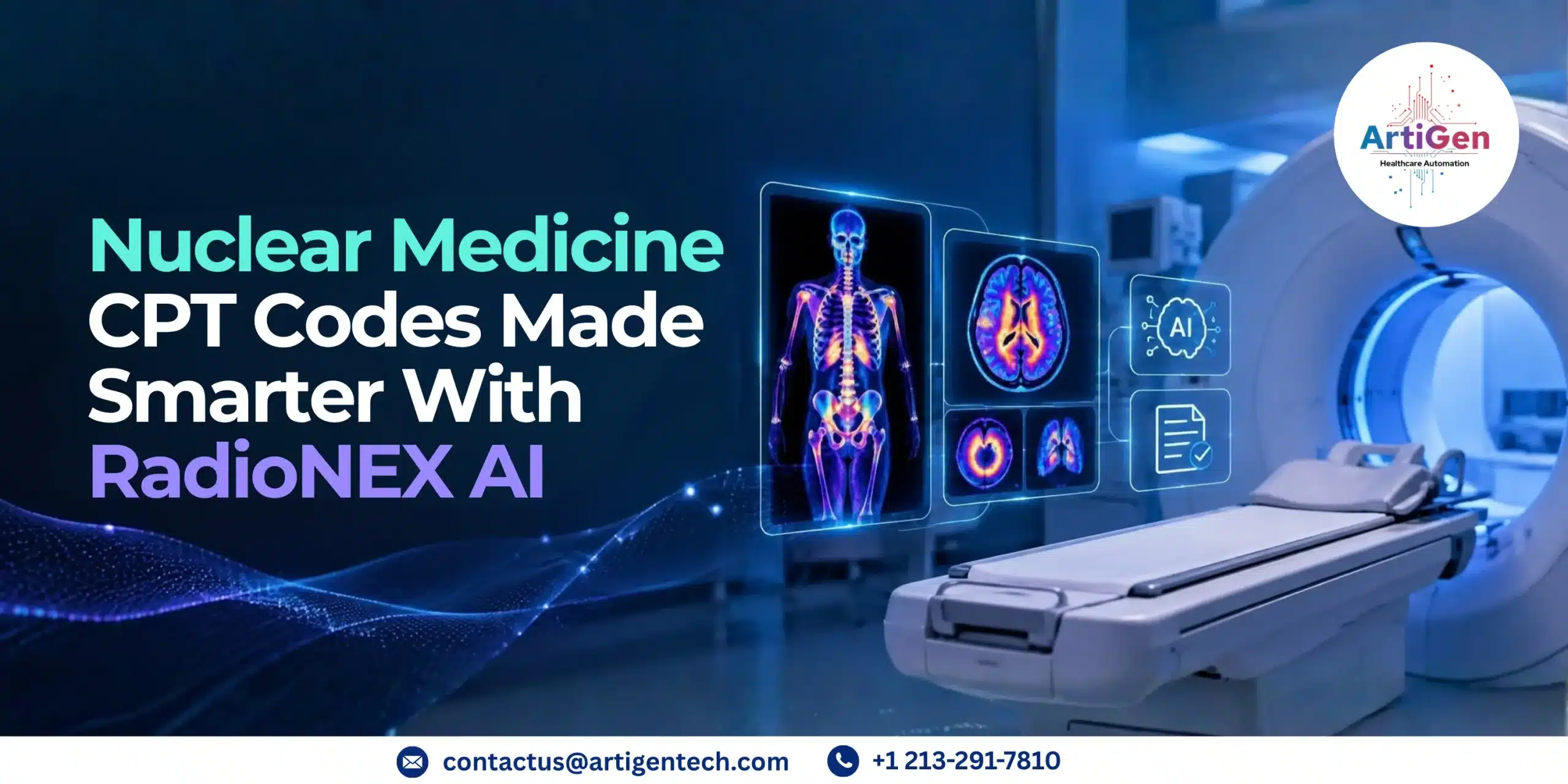
RadioNEX AI helps healthcare organizations streamline complex nuclear medicine coding workflows by supporting documentation review, procedure identification, radiology CPT codes, and coding validation. By applying AI-driven radiology coding automation, the solution can help coding teams review imaging documentation more efficiently across nuclear medicine and other radiology services.
For workflows involving nuclear medicine CPT codes, SPECT, PET/CT, and related radiology procedures, RadioNEX AI can help surface relevant documentation for professional coder validation. This approach supports radiology medical coding, nuclear medicine CPT coding, and more consistent nuclear medicine billing.
Key Takeaways
Accurate nuclear medicine CPT coding starts with the procedure actually documented.
Coders should verify:
- Imaging technique
- Anatomical scope
- Planar versus SPECT imaging
- SPECT versus SPECT/CT
- PET/CT scan extent
- Radiopharmaceutical and HCPCS information
- Diagnosis and nuclear medicine medical necessity
- Applicable nuclear medicine coding guidelines
Understanding nuclear medicine CPT Codes, nuclear medicine procedure Codes, and radiopharmaceutical billing helps support accurate claims.
The connection between nuclear medicine billing, nuclear medicine medical coding, and radiology billing and coding becomes especially important as imaging workflows become more automated and payer rules continue to evolve.
ArtigenTech’s intelligent coding approach can help healthcare organizations strengthen radiology coding, streamline nuclear medicine medical coding, and support radiology coding automation across high-volume imaging workflows.
Code the documented procedure. Validate the tracer. Confirm medical necessity. Then submit the claim.