CVA ICD-10 Coding Guide for Ischemic and Hemorrhagic Stroke
A CVA (cerebrovascular accident) is commonly used to describe a stroke, occurs when the blood supply to a part of the brain is interrupted or when a blood vessel ruptures, resulting in brain tissue damage. The correct ICD-10-CM code depends on the type of cerebrovascular event documented by the provider. A CVA ICD-10 code may represent a cerebral infarction, intracranial hemorrhage, an unspecified stroke or a neurologic condition that is not resolved following a stroke.
For medical coders, identifying the correct ICD-10-CM code for CVA requires more than recognizing the word “stroke” in the medical record. The documentation may specify ischemic stroke, cerebral infarction, intracerebral hemorrhage, subarachnoid hemorrhage, a history of stroke, or a neurological deficit resulting from an earlier cerebrovascular event.
So, it is imperative to know the anatomical location, underlying cause, and associated neurological complications is critical to selecting the most accurate ICD-10-CM diagnosis code for CVA, ischemic stroke ICD-10-CM, hemorrhagic CVA ICD-10-CM, and other cerebrovascular categories involved to process the claims correctly.
I63.9 may be used to denote an unspecified stroke documented without identification of hemorrhage or infarction. Ischemic stroke is generally coded within the I63(*) category. Non-traumatic intracranial hemorrhage is represented within I60(*)–I62(*).
I69(*) includes residual effects(sequelae) of cerebrovascular disease where applicable. The final code should always be chosen from the current ICD-10-CM code set based on provider documentation.
What Is the CVA ICD-10-CM Code?
There is not one universal CVA ICD-10-CM code for every stroke diagnosis. The appropriate code depends on what the provider documents about the cerebrovascular event.
For example:
Clinical documentation | ICD-10-CM category to consider |
Ischemic stroke / cerebral infarction | I63.- |
Stroke not specified as hemorrhage or infarction | I63.9 |
Nontraumatic subarachnoid hemorrhage | I60.- |
Nontraumatic intracerebral hemorrhage | I61.- |
Other nontraumatic intracranial hemorrhage | I62.- |
Other cerebrovascular diseases | I67.- |
Sequelae (Residual effects) of cerebrovascular disease | I69.- |
Personal history of TIA/cerebral infarction without residual deficits | Z86.73 |
Therefore, if one searches for an ICD-10-CM code for CVA without reviewing the stroke clinical documentation, it can result in an incorrect code assignment.
The same principle applies when trying to find an ICD-10-CM diagnosis code for CVA. The coder must determine if the documentation relates to an active stroke, the type of stroke or a residual effect of a prior cerebrovascular accident.
Coding Tip
I69(*) is a category, not a billable code by itself. The specific I69(*) code should be selected based on the original cerebrovascular condition and the documented residual deficit. For example, coding may identify hemiplegia, hemiparesis, cognitive deficits, or speech and language deficits.
Ischemic Stroke ICD-10: Understanding Cerebral Infarction
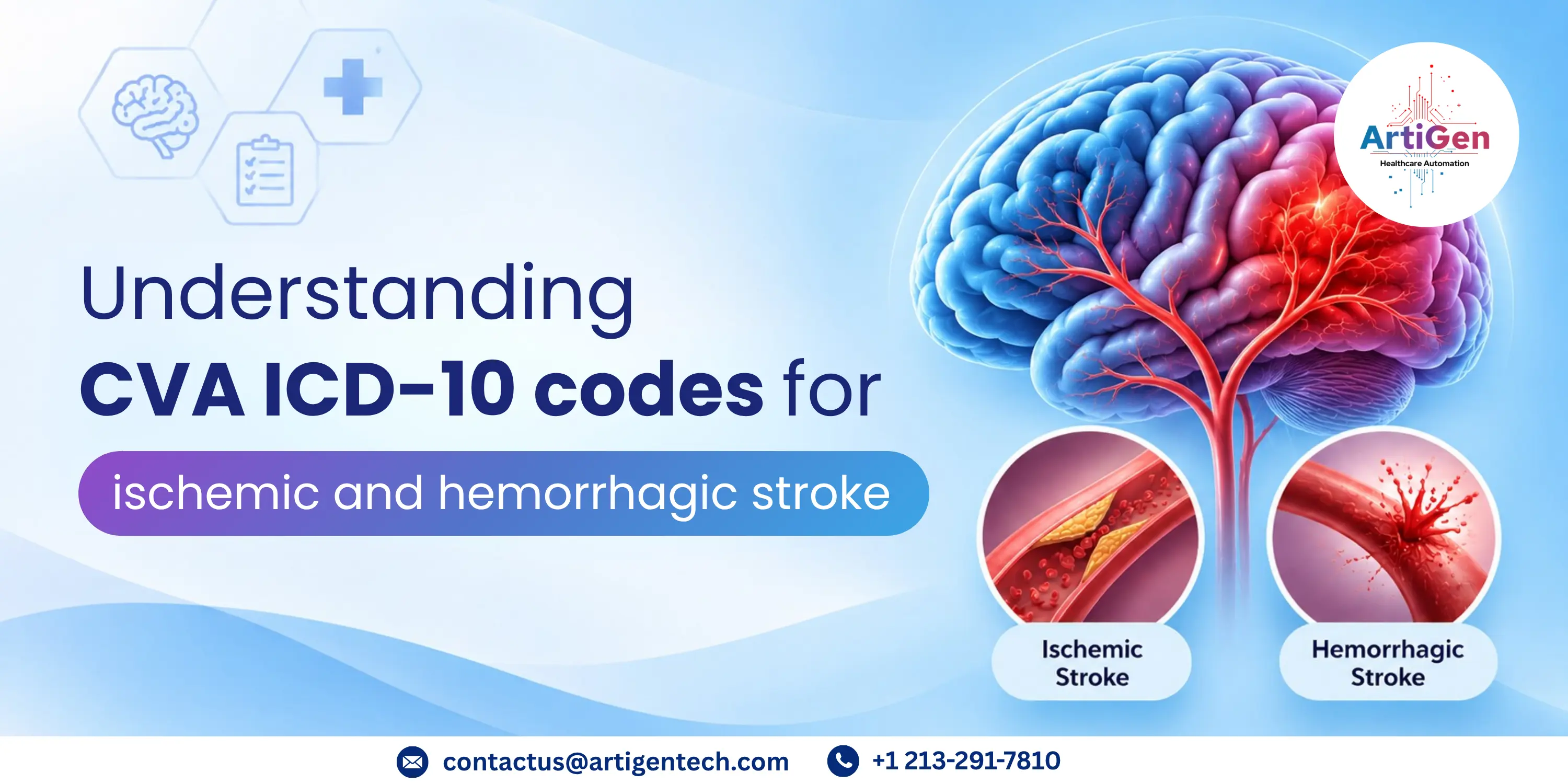
Ischemic stroke occurs when blood flow to a portion of the brain is obstructed, leading to cerebral infarction. In ICD-10-CM, ischemic stroke is typically coded to category I63(*).
The ischemic stroke ICD-10-CM category contains more specific codes based on the documented cause and affected vascular structure. The choice of the ischemic CVA ICD-10-CM code may depend on documentation stating thrombosis, embolism, occlusion, stenosis, the affected artery and other necessary details.
The cerebral infarction ICD-10-CM category is therefore broader than simply assigning one generic stroke code. Common I63(*) groupings include cerebral infarction due to:
- Thrombosis of precerebral arteries
- Embolism of precerebral arteries
- Unspecified occlusion or stenosis of precerebral arteries
- Thrombosis of cerebral arteries
- Embolism of cerebral arteries
- Unspecified occlusion or stenosis of cerebral arteries
- Other cerebral infarction
- Cerebral infarction, unspecified
CMS identifies I63(*) as the category for cerebral infarction and provides more specific code options based on documented mechanism and vascular involvement.
Acute Ischemic Stroke ICD-10-CM Coding
If documentation states acute ischemic stroke, the coder is to review the record looking for the physician’s final diagnosis to identify the specific artery, laterality, and documented mechanism of cerebral infarction mechanism and other details needed to determine the appropriate ICD-10-CM code.
If the provider documented more specific information, the term acute ischemic stroke ICD-10-CM should not default to an unspecified code.
Similarly, an ischemic stroke ICD-10-CM code should be assigned based on the documented diagnosis of the clinician and not only on the imaging findings.
E.g the docs might say:
“Acute cerebral infarction embolus in the left middle cerebral artery.”
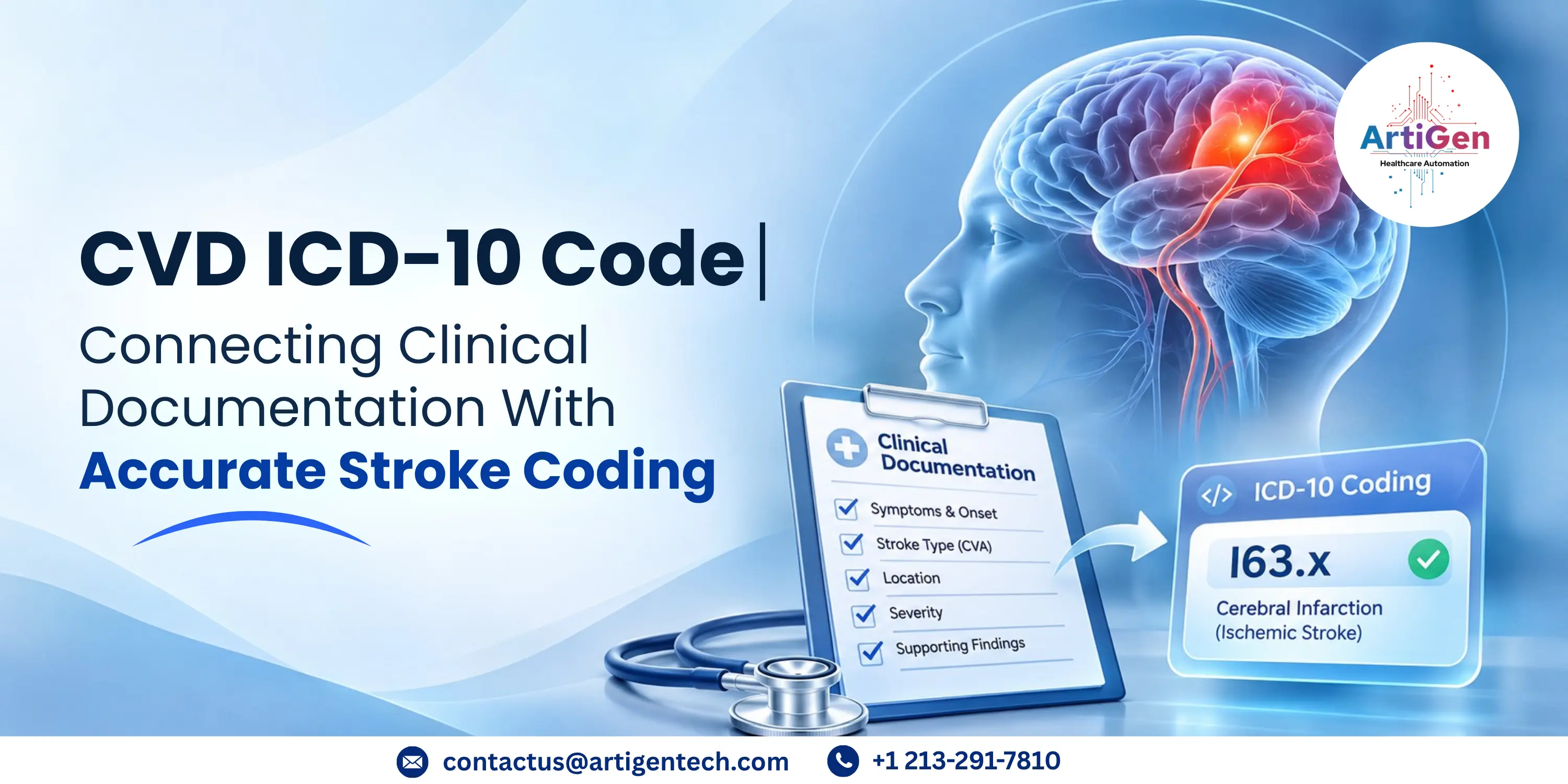
The stroke clinical documentation provides you with more than just saying “CVA. The coder must use the appropriate specific I63(*) code that is supported by the documentation and the current coding framework.
The same technique is used for an ischemic CVA ICD-10-CM search. The clinical description should guide the code selection rather than the abbreviation alone.
Hemorrhagic CVA ICD-100-CM Codes
A hemorrhagic stroke occurs when a blood vessel in or around the brain weakens ruptures (or leaks) causes bleeding. ICD-10-CM separates different types of nontraumatic intracranial hemorrhage.
The hemorrhagic CVA ICD-10 category may involve I60(*), I61(*), or I62(*) depending on the documented type of hemorrhage.
I60(*): Nontraumatic Subarachnoid Hemorrhage
I60(*) represents nontraumatic subarachnoid hemorrhage. More specific codes identify the documented artery or other relevant details.
I61(*): Nontraumatic Intracerebral Hemorrhage
I61(*) represents nontraumatic intracerebral hemorrhage. The documentation may identify the hemorrhage as occurring in the cortical region, subcortical hemisphere, brain stem, cerebellum, intraventricular area, or another documented location.
I62(*): Other Nontraumatic Intracranial Hemorrhage
I62(*) covers other nontraumatic intracranial hemorrhage categories, including nontraumatic subdural hemorrhage and other specified or unspecified intracranial hemorrhage.
Therefore, the correct hemorrhagic CVA ICD-10-CM selection requires the coder to determine exactly what type of hemorrhage the provider documented.
ICD-10-CM Code CVA Unspecified: When Is I63.9 Used?
One of the most commonly used terms is ICD-10-CM code CVA unspecified.
ICD-10-CM code I63.9 represents “Stroke, not specified as haemorrhage or infarction” (also commonly referred to as a cerebrovascular accident [CVA] NOS or unspecified stroke)
This makes the ICD-10-CM code CVA unspecified different from a documented ischemic stroke or a documented hemorrhagic stroke.
A coder should not automatically use an unspecified code when the medical record contains enough provider documentation to support a more specific diagnosis.
For example:
Documentation: “Stroke.”
The ICD-10-CM code CVA unspecified may be appropriate when no further distinction is documented.
However:
Documentation: “Acute ischemic stroke due to cerebral artery embolism.”
The coder should look up the correct category I63(*) instead of using an unspecified stroke code.
Same principle applies to ICD-10-CM code for CVA and ICD-10-CM diagnosis code for CVA. Code selection should be based on current ICD-10-CM guidelines and documentation.
Cerebral Vascular Accident ICD-10-CM and Documentation
The term cerebral vascular accident ICD-10-CM is often used interchangeably with stroke or CVA in clinical conversations. However, the coding process still depends on the specific diagnosis documented.
A physician may document:
- CVA
- Stroke
- Acute ischemic stroke
- Cerebral infarction
- Intracerebral hemorrhage
- Subarachnoid hemorrhage
- History of stroke
- Residual hemiparesis following stroke
These statements do not necessarily lead to the same code.
When reviewing a cerebral vascular accident ICD-10-CM diagnosis, coders should examine the complete stroke clinical documentation rather than relying only on the abbreviation “CVA.”
This is especially true when some of the imaging reports, discharge summaries, progress notes, and physician assessments are different levels of specificity.
ICD-10-CM for Stroke History: Active Stroke vs. Previous Stroke
A major coding difference is whether the patient has a history of stroke or has an active cerebrovascular condition.
There may be significant differences between the ICD-10-CM for history of stroke and the code for an ongoing stroke.
When a patient previously had a stroke, the term hx of stroke ICD-10-CM is frequently used in documentation. However, the coder is responsible for determining if the patient has any residual neurological deficits.
Z86.73 is utilised in patients with a history of transient ischemic attack and cerebral infarction without residual deficits and previous stroke without residual deficits.
A suitable I69(*) sequela code might be used when the patient has ongoing neurologic deficits from a prior cerebrovascular event. The official guidelines differentiate between a simple history with no residual deficits and residual effects.
Therefore, the ICD-10-CM code for hx of CVA should not be chosen just because the record contains the phrase “history of CVA.”
The coder should ask:
Is there an active stroke?
Is there a previous stroke without residual deficits?
Are there current neurological deficits resulting from the previous stroke?
These distinctions can change the coding pathway.
ICD-10-CM for TIA vs. Stroke
A TIA, or transient ischemic attack, does not automatically mean that you have had an ischemic stroke.
A different coding pathway is used to assign the ICD-10-CM for a TIA than for a confirmed stroke. Documentation should clearly distinguish a transient ischemic attack from a completed cerebral infarction.
This distinction is important because TIA and ischemic stroke may present with similar neurological symptoms; however, they are different clinical entities that have been reported.
Instead of assigning a stroke code based solely on symptoms, coders reviewing the ICD-10-CM for TIA should follow the provider’s final diagnosis and the applicable ICD-10-CM guidelines.
Similarly, ICD-10-CM for cerebrovascular disease should not be used in place of a more specific documented diagnosis.
ICD-10-CM for Cerebrovascular Disease
ICD-10-CM cerebrovascular disease is a broader term than just stroke.
The ICD-10-CM for cerebrovascular disease may include categories for haemorrhage, cerebral infarction, arterial occlusion or stenosis, other cerebrovascular disorders, and sequelae.
The in-depth ICD-10-CM cerebrovascular disease classification is useful for reviewing the overall coding structure, but the final code should accurately reflect the specific condition as documented by the provider.
For example, I63(*) stands for cerebral infarction and I69(*) for sequelae of cerebrovascular disease. I65 and I66(*) are specific for certain occlusions and stenosis without cerebral infarction.
Common CVA ICD-10-CM Coding Scenarios
Scenario 1: Acute Ischemic Stroke
Documentation:
“Acute ischemic stroke due to embolism of cerebral artery.”
Coding approach:
Review the I63(*) category and select the most specific code supported by the documentation.
This is an acute ischemic stroke ICD-10-CM situation rather than an unspecified CVA.
Scenario 2: Stroke without Further Specification
Documentation:
“Acute stroke.”
No hemorrhage or infarction is documented.
Coding approach:
Review whether I63.9 is applicable based on the complete provider documentation and current coding guidelines.
This represents a potential ICD-10-CM code CVA unspecified situation.
Scenario 3: Intracerebral Hemorrhage
Documentation:
“Nontraumatic intracerebral hemorrhage.”
Coding approach:
Review the I61(*) category and select the most specific documented code.
This is a hemorrhagic CVA ICD-10-CM coding scenario.
Scenario 4: Previous Stroke with No Residual Deficit
Documentation:
“History of CVA, no residual deficits.”
Coding approach:
Review the personal-history pathway, including Z86.73 when applicable.
This is different from coding an active cerebral vascular accident ICD-10-CM diagnosis.
Scenario 5: Previous Stroke with Residual Deficit
Documentation:
“History of ischemic stroke with persistent hemiparesis.”
Coding approach:
Review the I69(*) sequela category and select the code supported by the documented residual deficit and affected side.
The official ICD-10-CM guidelines explain that I69(*) is used for neurological deficits or other sequelae resulting from cerebrovascular disease.
Common Coding Mistakes with CVA and Stroke
Several documentation and coding problems can create avoidable claim issues.
1. Treating Every CVA as I64 I63.9
A CVA ICD-10-CM code should not be randomly encoded as I64 I63.9. If the provider documents cerebral infarction or a specific haemorrhage, a more precise classification may be applicable.
2. Confusing History with Active Stroke
An ICD-10-CM for history of stroke is not interchangeable with an active stroke diagnosis.
3. Missing Residual Neurological Deficits
When a previous stroke has caused persistent deficits, the I69(*) category may need to be considered. I69(*) codes should not be assigned when there is no documented neurological deficit.
4. Coding From Imaging Alone
Coders should not independently convert imaging findings into a diagnosis when provider documentation does not establish the diagnosis. The coding decision should follow applicable ICD-10-CM guidelines and provider documentation.
5. Using Outdated Code Sets
ICD-10-CM codes are updated annually. CMS publishes current code files and guidelines by fiscal year, so organizations should verify the code set applicable to the date of service.
How AI Can Support CVA Coding Workflows
Documentation of stroke may be found in emergency department notes, physician assessments, radiology reports, discharge summaries, and other clinical records.
This makes AI radiology coding a useful workflow-support capability for the review of large volumes of documentation.
For example, an AI-assisted coding workflow can help extract relevant clinical terminology for coder review, flag documentation in need of attention, and help organise information prior to final coding decisions.
ArtigenTech can assist healthcare organisations with technology-assisted medical coding workflows that reduce repetitive review and enhance consistency.
RadioNEX AI is able to assist in reviewing pertinent radiology documentation, and connect imaging information to downstream coding processes for radiology-related workflows. The goal is not to replace human coding judgement, but to help coding teams work more efficiently.
Such an approach can be very valuable when healthcare organisations manage high volumes of stroke related imaging such as CT and MRI examinations.
Frequently Asked Questions about CVA ICD-10 Codes
1. What is the ICD-10-CM code for CVA?
There is no single ICD-10-CM code for CVA for every clinical situation. I64 I63.9 may apply to a stroke not specified as hemorrhage or infarction, while I63.(*) covers cerebral infarction and I60.(*)–I62.(*) cover specific nontraumatic intracranial hemorrhages. The final code depends on provider documentation and the applicable code set.
2. What is the ischemic stroke ICD-10-CM category?
The ischemic stroke ICD-10-CM category is generally I63.(*), which represents cerebral infarction. More specific codes within I63.(*) are selected according to documented mechanism and vascular involvement.
3. What is the acute ischemic stroke ICD-10-CM code?
The acute ischemic stroke ICD-10-CM selection depends on the specific documentation. I63.(*) contains multiple more-specific code options, so coders should review the documented mechanism, artery, and other required details rather than automatically using an unspecified code.
4. What is the ICD-10-CM code CVA unspecified?
The ICD-10-CM code CVA unspecified may refer to I64 I63.9 when the documentation identifies a stroke but does not specify it as hemorrhage or infarction.
5. What is the ICD-10-CM code for a history of CVA?
The appropriate ICD-10-CM code for hx of CVA depends on whether the patient has residual deficits. For a personal history of TIA or cerebral infarction without residual deficits, Z86.73 may apply. Residual neurological deficits may require an I69.(*) sequela code.
6. What is the ICD-10-CM for TIA?
The ICD-10-CM for TIA should be selected based on the documented TIA diagnosis and current ICD-10-CM code set. TIA should not automatically be coded as cerebral infarction.
7. What is the hemorrhagic CVA ICD-10-CM category?
The hemorrhagic CVA ICD-10-CM pathway may involve I60.(*), I61.(*), or I62.(*) depending on the documented type of nontraumatic intracranial hemorrhage.
8. What is the ICD-10-CM for cerebrovascular disease?
The ICD-10-CM for cerebrovascular disease spans multiple categories, including I60.(*)–I67.(*) for different cerebrovascular conditions and I69.(*) for their sequelae. The appropriate code depends on the documented diagnosis.
Key Takeaway
Accurate CVA ICD-10-CM code selection begins with accurate documentation.
A simple reference to “CVA” does not always provide enough information to determine whether the patient has an ischemic stroke, hemorrhagic stroke, unspecified stroke, previous stroke, TIA, or residual neurological impairment.
For coding teams, the most important workflow is to distinguish:
Active ischemic stroke → I63.(*) category
Stroke not specified as hemorrhage or infarction → I64 I63.9
Nontraumatic intracranial hemorrhage → I60.(*)–I62.(*)
Other cerebrovascular disease → I67.(*) and related categories
Residual effects of previous cerebrovascular disease → I69.(*)
History of TIA/cerebral infarction without residual deficits → Z86.73 when applicable
Always confirm the exact ICD-10-CM diagnosis code for CVA, ischemic stroke ICD-10-CM, hemorrhagic CVA ICD-10-CM, or hx of stroke ICD-10-CM with the provider’s documentation and the ICD-10-CM code set in effect on the date of service.
For radiology and coding operations that see high volume, ArtigenTech can help bring more structure to documentation review and coding operations through technology supported workflows and solutions such as RadioNEX AI.
Accurate coding is not only about selecting a code. It is about connecting stroke clinical documentation, coding accuracy, claim quality, and revenue-cycle performance.