
Understanding the CMS HCC Coding Model for Accurate Risk Adjustment
Healthcare reimbursement has evolved significantly over the years, and today, accurate documentation and coding play a critical role in ensuring providers receive fair compensation for patient care. One of the most important frameworks used in value-based reimbursement is the CMS HCC risk adjustment model. Understanding the hierarchical condition category framework is essential for healthcare providers, coders, and organizations that rely on accurate risk scoring to improve reimbursement and patient outcomes.
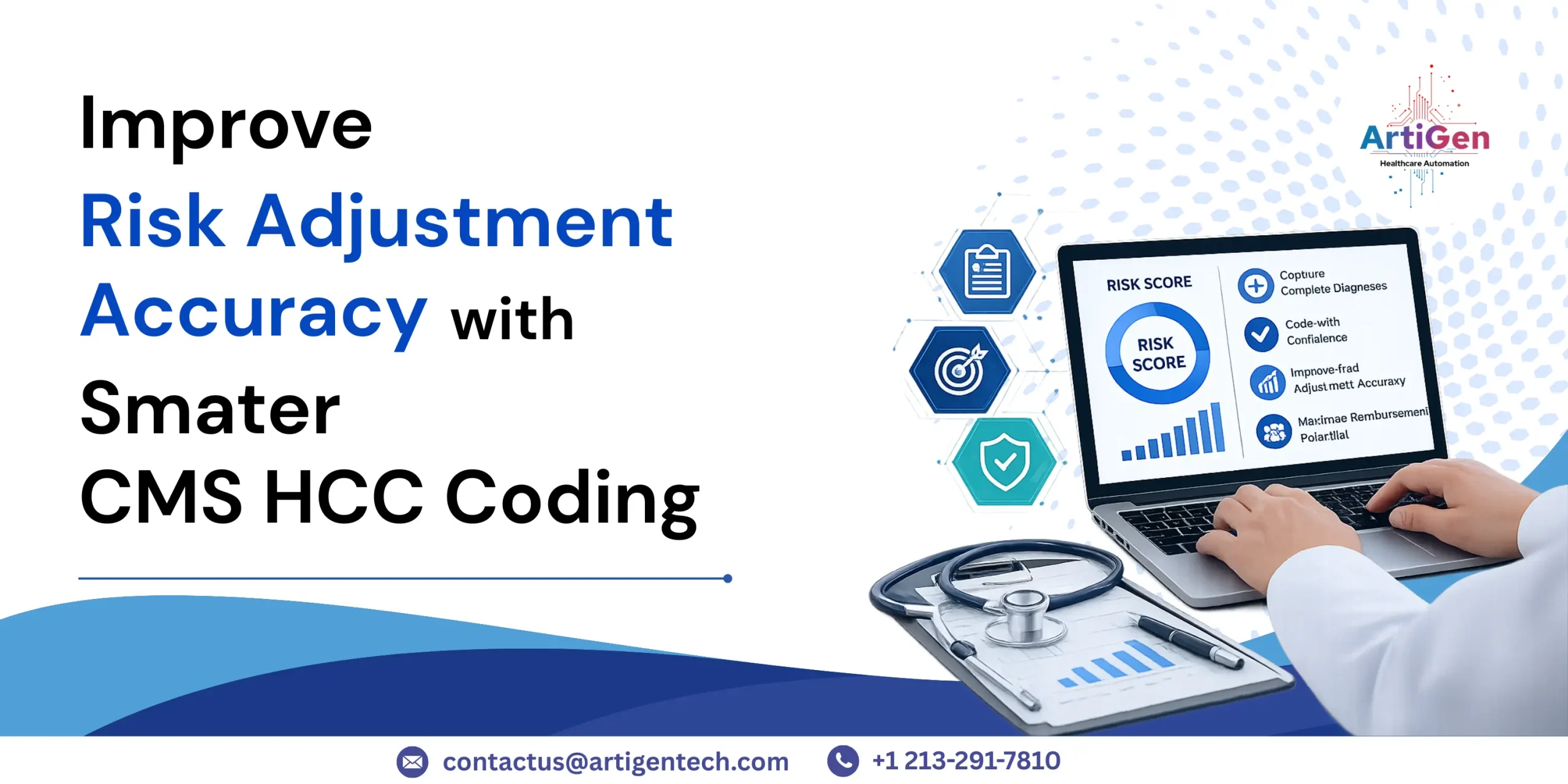
The CMS HCC risk adjustment model helps healthcare organizations assess patient complexity by assigning risk scores based on documented diagnoses. These scores influence reimbursement under Medicare Advantage and other value-based care programs. For organizations focused on risk adjustment coding, mastering HCC medical coding has become essential.
At ArtigenTech, our intelligent AI HCC coding tools, HCC coding automation platform, and automated HCC coding solutions are designed to improve coding accuracy, strengthen clinical documentation improvement, and streamline risk adjustment workflows.
What is the CMS HCC Coding Model?
The CMS HCC risk adjustment model is a payment model developed by the Centers for Medicare & Medicaid Services. It uses hierarchical condition categories to forecast future patient health care costs based on chronic conditions and demographic data.
What does HCC mean in medical terms and what does HCC mean in medical terms, HCC stands for Hierarchical Condition Category, a risk adjustment model that groups related diagnosis codes into clinically meaningful categories. The hierarchical condition category structure assists in assessing patient complexity and reimbursement accuracy.
The model calculates a Risk Adjustment Factor (RAF) score based on diagnosis documentation. This score reflects the expected healthcare costs of a patient. Accurate HCC diagnosis codes, complete documentation and compliant coding practices directly affect reimbursement results.
For healthcare coders learning HCC in medical terms, then recognizing how CMS HCC diagnosis mapping works is essential for effective risk adjustment coding.
Why HCC Coding Matters in Healthcare
The importance of HCC medical coding extends beyond reimbursement. It helps create an accurate representation of patient health conditions while supporting better care planning.
Accurate Medicare risk adjustment requires complete and compliant coding. Missing chronic conditions result in reduced reimbursement and inaccurate coding creates compliance risk. That’s why clinical documentation improvement and stronger HCC coding software systems are a focus for healthcare providers.
Proper HCC coding guidelines ensure:
- Accurate reimbursement under Medicare risk adjustment
- Must meet the MEAT criteria during encounter
- RAF Calculation
- Better patient risk stratification
- Improved care coordination
- Stronger compliance reporting
- Better population health management
Increasingly, organizations are relying on risk adjustment coding software and AI HCC coding tools to help ensure consistent coding performance.
Understanding Hierarchical Condition Categories
Hierarchical condition categories (HCCs) are groups of diagnoses that categorize diseases of similar clinical significance and expected treatment costs.
In the hierarchical condition category system, more severe diagnoses take preference over less severe related diagnoses. This means that, only the most complex condition contributes to the patient’s risk score.
For instance:
If a patient has multiple diabetes-related diagnosis codes, the final Risk Adjustment Factor (RAF) calculation will only reflect the most severe of the conditions.
This hierarchy ensures proper classification of CMS HCC diagnosis and avoids double counting of risk scores.
Understanding HCC identifier logic is critical for coders working with HCC coding software and modern automated HCC coding solutions.
What is HCC in Medical Terms?
Many healthcare professionals ask, what is HCC in medical terms and why does it matter?
Hierarchical Condition Category (HCC) is a term that describes the grouping of similar diagnosis into one related category (an HCC) to be used in a risk adjustment payment model. Risk adjustment payment models are regulated by the federal government to reimburse participating health insurance plans for the medical care of enrollees.
In simple terms, HCC in medical coding refers to assigning diagnosis codes that map to specific hierarchical condition categories for reimbursement risk adjustment.
An HCC dx code identifies chronic or serious conditions such as:
- Diabetes with complications
- Chronic kidney disease
- Congestive heart failure
- Chronic obstructive pulmonary disease
Proper documentation substantiates each HCC diagnosis code, which contributes to patient complexity scoring.
Familiarity with ICD-10 to HCC mapping is also critical in understanding HCC medical coding as diagnosis codes are converted to risk adjustment categories.
The Role of Clinical Documentation Improvement
Strong clinical documentation improvement drives accurate risk adjustment coding.
When documentation is incomplete or non-specific, valid chronic conditions may not be mapped to the correct hierarchical condition categories. This impacts the accuracy of RAF medical acronym scoring and reimbursement.
Effective clinical documentation improvement supports:
- Accurate diagnosis capture
- Better HCC identifier accuracy
- Stronger coding compliance
- Improved CMS HCC risk adjustment model performance
Healthcare organizations have turned to AI HCC coding tools and risk adjustment coding software to automatically identify documentation gaps.
At ArtigenTech, we utilize automated HCC coding solutions that utilize intelligent AI-assisted review to improve clinical documentation improvement.
ICD-10 to HCC Mapping Explained
ICD-10 to HCC mapping is one of the most important processes in HCC medical coding.
This process maps diagnosis codes to associated hierarchical condition categories Without accurate ICD-10 to HCC mapping, patient risk scores may be incomplete or incorrect.
For instance:
The ICD-10 diagnosis for chronic kidney disease is associated with a specific CMS HCC diagnosis category that factors into the patient’s Risk Adjustment Factor (RAF) score.
HCC coding automation platform solutions make it easy to map ICD-10 to HCC, automating the identification of qualifying diagnoses and highlighting missed opportunities.
This reduces the time spent on manual review and improves accuracy of prospective HCC coding.
Understanding RAF Scores
Patient complexity is measured with the Risk Adjustment Factor (RAF) score.
Healthcare professionals often ask : What does the RAF medical acronym stand for ? RAF is an acronym for Risk Adjustment Factor and is used to determine expected costs of care based on documented chronic conditions.
The higher the HCC raf score, the patient is more complex and requires more care resources.
Accurate HCC raf scores depend on:
- Complete diagnosis capture
- Proper HCC coding guidelines adherence
- Accurate CMS HCC coding workflows
- Strong clinical documentation improvement
Risk adjustment coding software helps organizations to capture all valid annual diagnoses and improve HCC raf scores.
Common HCC Coding Examples in Risk Adjustment
Here are some commonly used HCC diagnosis codes that illustrate how the hierarchical condition category system supports accurate risk adjustment coding:
Description | ICD-10 Code | CMS-HCC Model Category V28 |
Diabetes with Chronic Complications | E11.22 | HCC 37 |
Chronic Kidney Disease Stage 3 | N18.30 | HCC 329 |
Heart failure, unspecified | I50.9 | HCC 226 |
Chronic Obstructive Pulmonary Disease, unspecified | J44.9 | HCC 280 |
Major Depressive Disorder, recurrent moderate | F33.1 | HCC 155 |
Morbid Obesity, due to excess calories | E66.01 | HCC 48 |
Example of ICD-10 to HCC Mapping
A patient diagnosed with:
- E11.22 – Type 2 diabetes mellitus with diabetic chronic kidney disease
- N18.30 – Chronic kidney disease stage 3
These diagnoses map through ICD-10 to HCC mapping into relevant hierarchical condition categories, contributing to the patient’s Risk Adjustment Factor (RAF) score and impacting Medicare risk adjustment reimbursement.
MEAT Documentation Example for HCC Coding
For valid HCC medical coding, documentation should support MEAT criteria:
- Monitor – Reviewing patient labs
- Evaluate – Assessing disease progression
- Assess/Address – Clinical decision-making
- Treat – Medication or treatment adjustments
Example:
“Type 2 diabetes with CKD stage 3 reviewed. HbA1c evaluated. Metformin dosage adjusted. Follow-up in 3 months.”
This strengthens clinical documentation improvement and supports compliant CMS HCC diagnosis capture.
Prospective HCC Coding and Chronic Condition Management
Prospective HCC coding focuses on identifying chronic conditions before claim submission to ensure complete risk capture.
This is especially important for managing HCC chronic conditions, which must be documented annually for accurate Medicare risk adjustment.
Examples of HCC chronic conditions include:
- Diabetes
- Hypertension
- Chronic heart disease
- COPD
Modern AI HCC coding tools assist with prospective HCC coding by identifying undocumented opportunities and validating diagnosis specificity.
ArtigenTech’s HCC coding automation platform supports proactive coding accuracy for better reimbursement outcomes.
How AI is Transforming HCC Coding
The growing complexity of risk adjustment coding has accelerated adoption of intelligent automation.
Modern AI HCC coding tools improve coding efficiency by automating:
- HCC diagnosis codes identification
- ICD-10 to HCC mapping
- Documentation gap analysis
- HCC identifier validation
- Compliance checks
Our automated HCC coding solutions reduce manual workload while improving coding precision.
ArtigenTech’s risk adjustment coding software leverages artificial intelligence to strengthen CMS HCC risk adjustment model performance and simplify HCC medical coding operations.
Why Healthcare Organizations Need HCC Coding Automation
Manual CMS HCC coding processes are time-consuming and prone to oversight.
Healthcare organizations implementing HCC coding software benefit from:
- Faster coding workflows
- Better clinical documentation improvement
- Improved Risk Adjustment Factor (RAF) accuracy
- Reduced compliance risk
- Better reimbursement outcomes
An intelligent HCC coding automation platform helps healthcare teams manage complex hierarchical condition categories efficiently.
The Future of Accurate Risk Adjustment
As healthcare becomes increasingly value-based, proper risk adjustment coding will be even more important.
Future-ready healthcare organizations must invest in:
- Advanced AI HCC coding tools
- Intelligent risk adjustment coding software
- Automated documentation review
- Predictive coding intelligence
Automation and strong clinical documentation improvement will change the way that organizations approach Medicare risk adjustment.
Conclusion
Understanding the CMS HCC risk adjustment model is important for proper reimbursement and improved patient care management.
From learning what HCC means in medical terms to improving ICD-10 to HCC mapping, healthcare organizations must prioritize coding accuracy at every step of the workflow.
Strong HCC medical coding, efficient clinical documentation improvement and sophisticated automated HCC coding solutions lead to better HCC raf scores, better compliance and improved reimbursement performance.
At ArtigenTech, our intelligent AI HCC coding tools, HCC coding software and risk adjustment coding software simplify the complexity of coding for healthcare organizations and delivers more accurate risk adjustment at scale.