
Pulmonary Nodule ICD-10-CM Coding: R91.1, Documentation & Code Selection
A pulmonary nodule may appear as an incidental finding during a chest X-ray or CT examination, but choosing the right diagnosis code requires more than recognizing the words “lung nodule.” Accurate ICD-10-CM coding depends on what the radiologist documents, whether the finding is solitary or multiple, and whether a definitive disease has been established.
For radiology teams, pulmonary nodule coding is very much tied to clinical documentation improvement, as well as radiology coding guidelines and radiology coding accuracy. This is especially important in the determination of the R91.1 icd-10-cm code for a documented solitary pulmonary nodule.
What Is the ICD-10-CM Code for a Solitary Pulmonary Nodule?
The ICD-10-CM code for lung nodule documented as a solitary pulmonary nodule is R91.1. In ICD-10-CM, R91.1 is classified as “Solitary pulmonary nodule” under abnormal findings on diagnostic imaging of the lung.
The ICD-10-CM code for pulmonary nodule is therefore chosen based on the provider’s documented diagnosis or finding rather than just the radiology procedure performed out. The pulmonary nodule diagnosis code must accurately represent the findings that have been documented.
The lung nodule diagnosis code R91.1 is correct to use when documentation supports a solitary pulmonary nodule. Follow-up of the nodule is needed, but it should not be automatically replaced by a diagnosis of neoplasm.
What Does R91.1 Mean in ICD-10-CM Coding?
The lung nodule ICD-10-CM code R91.1 represents a solitary pulmonary nodule. The official long description includes “Solitary pulmonary nodule,” as well as related descriptors such as coin lesion of lung.
- In medical coding for radiology, the coder should find out what the radiologist actually concluded. A CT scan for chest report may include details about size, location, appearance, prior comparison or follow up recommendations but those things do not necessarily mean malignant cells. For example: A lung lesion that appears as a round coin-shaped shadow in the chest radiographs.
This is where radiology documentation requirements and clinical documentation improvement come into play. Clear documentation minimizes coder assumptions and supports accurate in diagnostic radiology coding.
What Documentation Is Needed for Pulmonary Nodule Coding?
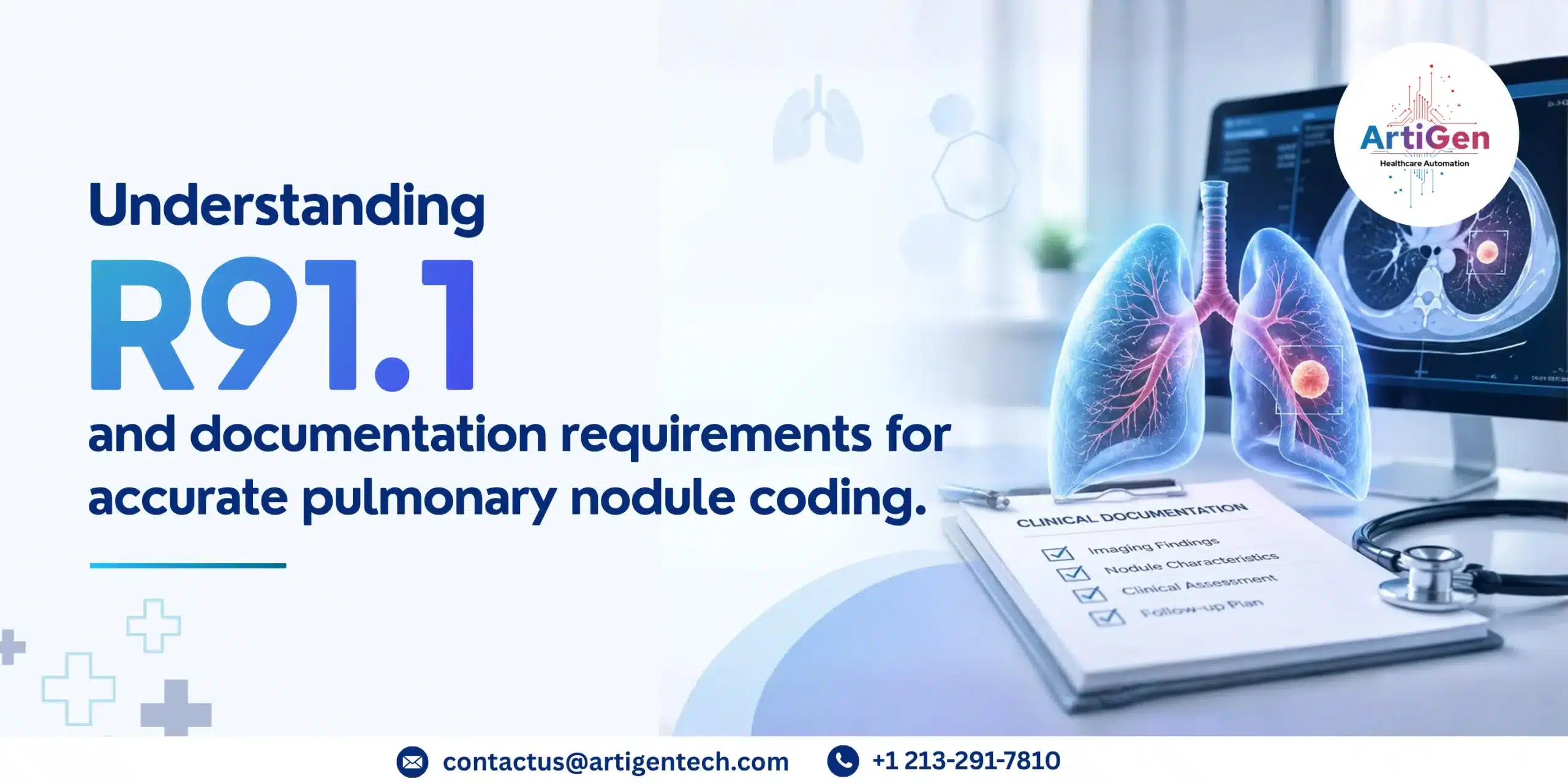
Strong radiology documentation requirements make pulmonary nodule coding more reliable. Depending on the study and clinical situation, documentation may identify:
- Whether the nodule is solitary or multiple
- Nodule size and location
- Solid, subsolid, or ground-glass appearance
- Comparison with prior imaging
- Evidence of stability or interval change
- Associated imaging findings
- Recommended follow-up
These details support clinical documentation improvement and help radiology coding services teams distinguish a specific pulmonary nodule from a nonspecific lung finding.
For radiology medical coding, the final impression is particularly important because it communicates the radiologist’s overall interpretation.
The purpose of radiology documentation requirements is not to have the coder infer a diagnosis. Instead, good documentation gives the coder enough information to apply the correct pulmonary nodule coding guidelines.
R91.1 vs. Other Lung Findings
One common mistake in lung nodule coding is treating every abnormal lung finding as R91.1.
When a radiologist diagnoses a solitary pulmonary nodule, the pulmonary nodule diagnosis code R91.1 may be appropriate. But a report may describe an opacity, mass, scar, infiltrate, or multiple nodules.
The lung opacity ICD-10-CM selection therefore requires attention to the documented interpretation. A lung opacity should not automatically be assigned the lung nodule icd-10-cm code.
Similarly, the ICD-10-CM for multiple pulmonary nodules should be evaluated based on the documented findings and the applicable ICD-10-CM code set rather than automatically assigning R91.1.
This distinction is important for radiology coding accuracy and is especially important in high volume diagnostic radiology coding environments.
Common ICD-10-CM Codes Used in Pulmonary Nodule Documentation
When reviewing a radiology report, coders should distinguish a documented solitary nodule from multiple nodules or other nonspecific lung findings. The exact code should always be verified against the ICD-10-CM code set applicable to the date of service. CMS publishes annual diagnosis-code files and updates them by effective date.
ICD-10-CM Code | Description | Typical Documentation Context |
R91.1 | Solitary pulmonary nodule | A single pulmonary nodule is documented on diagnostic imaging |
R91.8 | Other nonspecific abnormal finding of lung field | Other abnormal lung findings; may also be used in certain multiple-nodule scenarios depending on the documentation and applicable guidance |
R91(*) | Abnormal findings on diagnostic imaging of lung | Parent category for abnormal lung-imaging findings |
R91.1 – Solitary Pulmonary Nodule
This is the key code for the topic of this article. The ICD-10-CM classification identifies R91.1 as “Solitary pulmonary nodule.” The index also directs solitary lung and solitary pulmonary nodules to R91.1.
R91.8 – Other Nonspecific Abnormal Finding of Lung Field
R91.8 covers other nonspecific abnormal findings of the lung field. CMS billing guidance has also described situations in which R91.8 may be used when a patient has multiple lung nodules with a single nodule of concern, subject to the specific Medicare policy and billing requirements involved.
Coding Reminder
Do not select a diagnosis code solely because the radiology procedure was a chest CT or because the report contains the word “nodule.” The coder should review the findings and final impression, determine whether the documentation describes a solitary or multiple nodule, and then verify the current ICD-10-CM coding guidance for the date of service.
For example:
“8 mm solitary pulmonary nodule in the right upper lobe” → R91.1
“Multiple pulmonary nodules” → review the documentation and applicable current coding guidance before selecting the diagnosis code; do not automatically assign R91.8
This documentation-first approach supports pulmonary nodule coding, radiology coding accuracy, and consistent diagnostic radiology coding.
How Radiology CPT Coding and ICD-10-CM Coding Work Together
Different functions are performed by radiology CPT coding and ICD-10-CM coding.
CPT describes the procedure or service provided ICD-10-CM describes the diagnosis, symptom or finding that supports the service.
For example, R91.1 could represent a solitary pulmonary nodule identified on a chest CT and billed with a radiology CPT code. The procedure and diagnosis should be consistent with a clinical story.
This relationship is a core element of radiology medical coding and medical coding for radiology.
A radiology coding software platform can help compare procedure and diagnosis information to identify potential inconsistencies. Such validation may improve radiology coding accuracy and support radiology coding automation.
Pulmonary Nodule Coding Workflow
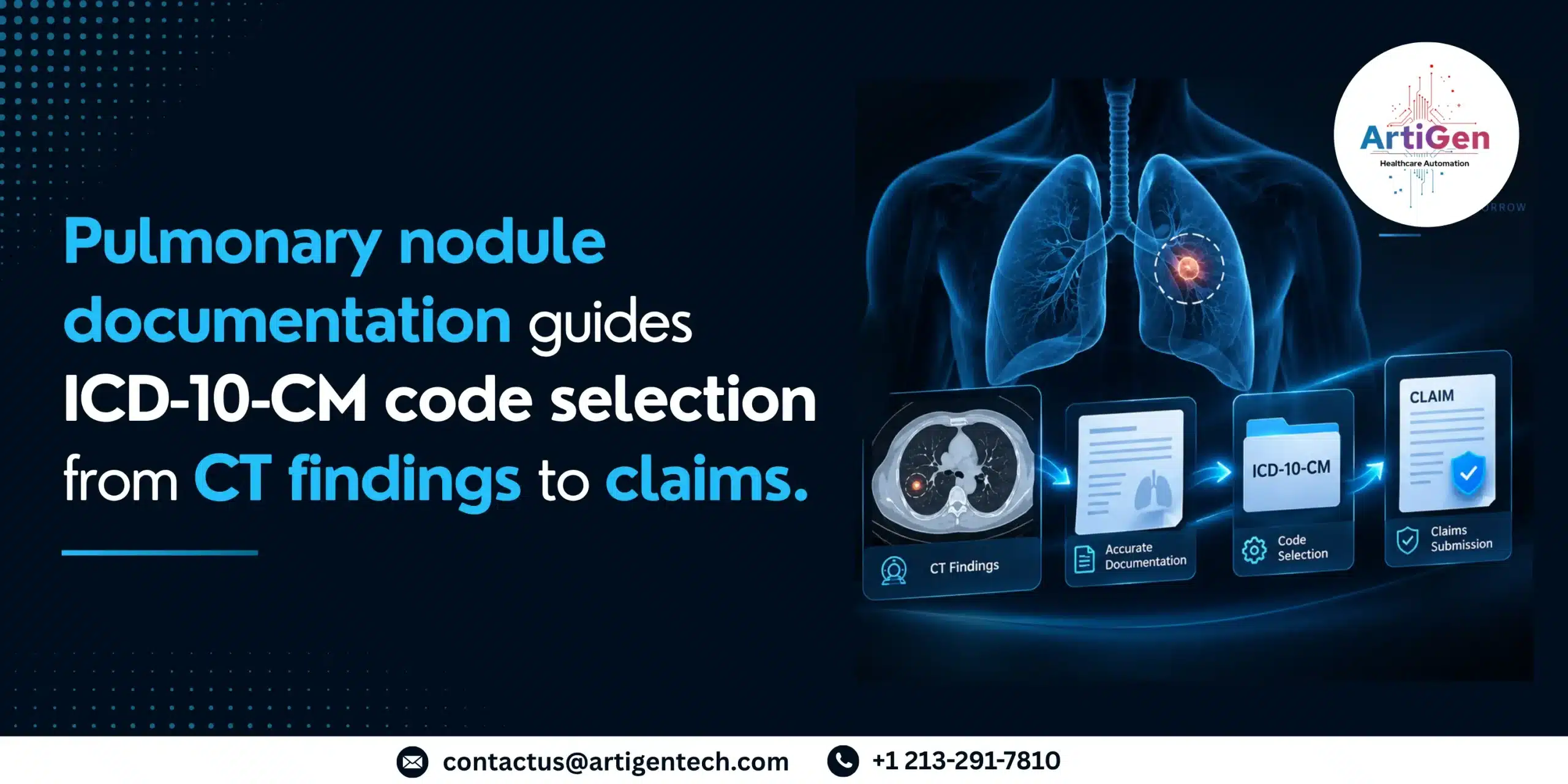
A consistent pulmonary nodule coding workflow can follow these steps:
1. Review the clinical indication
Understand why the imaging study was performed.
2. Review the findings
Identify whether the report describes a nodule, opacity, mass, or another abnormality.
3. Read the final impression
Use the radiologist’s final interpretation as a key source during medical coding for radiology.
4. Determine whether the finding is solitary or multiple
This is important when evaluating the R91.1 ICD-10-CM code.
5. Validate diagnosis and procedure together
Review the radiology CPT coding information alongside the documented diagnosis.
6. Apply the appropriate coding guidance
Use the latest applicable ICD-10-CM coding guidelines to ensure appropriate specificity when coding pulmonary nodules.
CMS maintains separate ICD-10-CM files by effective period, so organizations should verify the code set applicable to the date of service. CMS lists FY 2027 ICD-10-CM files for encounters beginning October 1, 2026.
Real-World Example: Solitary Pulmonary Nodule
Consider a patient who is referred for chest CT after an abnormal chest X-ray. The radiologist reports an 8 mm solitary pulmonary nodule in the right upper lobe and recommends follow-up imaging.
The documented finding should be assessed for the ICD-10-CM code for pulmonary nodule. R91.1 ICD-10-CM is the correct diagnosis category when the provider documents a solitary pulmonary nodule.
The coder should not automatically assign a malignant neoplasm code when the lesion is suspicious or needs surveillance. The pulmonary nodule diagnosis code should be based on the documented condition unless a definitive diagnosis has been established.
This supports accurate lung nodule coding, radiology medical coding, and diagnostic radiology coding.
Common Pulmonary Nodule Coding Errors
Coding cancer without a confirmed diagnosis
A suspicious imaging finding is not automatically a cancer diagnosis. The lung nodule diagnosis code should follow provider documentation.
Using R91.1 for every lung abnormality
The pulmonary nodule ICD-10-CM code R91.1 identifies a solitary pulmonary nodule. Other findings may require different ICD-10-CM codes.
Ignoring multiple nodules
When documentation identifies multiple lesions, the coder should review the ICD-10-CM for multiple pulmonary nodules and the applicable coding guidance rather than automatically applying R91.1.
Confusing a lung opacity with a nodule
A documented opacity may require a different lung opacity ICD-10-CM selection. The coder should follow the documented interpretation.
Coding the appropriate procedure interlinking to the diagnosis
Radiology CPT coding describes the imaging service. ICD-10-CM coding describes the diagnosis, symptom, or finding supporting that service.
How Radiology Coding Software Supports Pulmonary Nodule Coding
When technology is built on documentation and coding rules, it can make pulmonary nodule coding more consistent.
Modern radiology coding software platforms can recognize terms such as “solitary pulmonary nodule,” “multiple pulmonary nodules,” “lung opacity,” and similar findings. This can support radiology coding automation while keeping professional coders involved in final validation.
Automation can assist in the comparison of the radiology report with specific diagnosis and procedure information for radiology coding services.
This is particularly valuable in medical coding for radiology, where imaging volumes can make manual review time-consuming.
AI-enabled radiology coding software can also assist with clinical documentation improvement by identifying unreliable documentation for review rather than allowing the system to make an unsupported inference.
How ArtigenTech Supports Radiology Medical Coding
Accurate radiology medical coding requires a link between clinical documentation, diagnosis selection, procedure coding and validation.
ArtigenTech’s AI-driven approach can help healthcare organizations modernize diagnostic, screening, intervention and Telemedicine radiology coding, improve radiology coding accuracy, and reduce repetitive manual review.
Radiology coding automation may help organizations develop a more formalized workflow for the review of pulmonary nodule coding, lung nodule coding and other radiology findings.
The aim is not to replace qualified coding professionals. Intelligent radiology coding software can help radiology coding services team to process the documentation more efficiently and not have to rely on the radiology coding guidelines and pulmonary nodule coding guidelines.
Key Takeaways
Accurate pulmonary nodule coding starts with accurate documentation. R91.1 is the pulmonary nodule diagnosis code for a documented solitary pulmonary nodule, while other abnormal findings may require different coding.
For healthcare organizations, strong radiology coding guidelines, clear radiology documentation requirements, and consistent medical coding for radiology workflows are essential.
The combination of radiology CPT coding, radiology medical coding, and appropriate ICD-10-CM coding creates a clearer connection between the imaging procedure and documented diagnosis.
With intelligent radiology coding software and radiology coding automation, organizations can strengthen radiology coding accuracy, streamline radiology coding services, and improve the consistency of lung nodule coding and pulmonary nodule coding.
ArtigenTech helps healthcare organizations modernize radiology coding through intelligent automation, documentation-driven workflows, and AI-supported coding validation.
Frequently Asked Questions
What is the R91.1 ICD-10-CM code used for?
R91.1 icd-10-cm represents a solitary pulmonary nodule. The ICD-10-CM code for lung nodule should be selected when provider documentation supports that finding.
What is the ICD-10-CM code for a pulmonary nodule?
The icd-10-cm code for pulmonary nodule is R91.1 when the documented finding is a solitary pulmonary nodule. The lung nodule ICD-10-CM code should not be automatically applied to every abnormal lung finding.
Is R91.1 used for multiple pulmonary nodules?
R91.1 specifically describes a solitary pulmonary nodule. When multiple lesions are documented, coders should evaluate the ICD-10-CM R91.8 for multiple pulmonary nodules and current pulmonary nodule coding guidelines rather than assuming R91.1 applies.
Is a lung opacity the same as a pulmonary nodule?
Not necessarily. A documented opacity may require a different lung opacity ICD-10-CM selection. The correct code depends on the provider’s documentation and the applicable ICD-10-CM coding rules.
How can automation improve radiology coding accuracy?
Radiology coding automation can help identify documentation elements, validate diagnosis severity, specificity, hierarchy and interlinks procedure relationships, and flag cases requiring coder review. When combined with radiology coding software and professional oversight, automation can support stronger radiology coding accuracy.