Radiology Coding: Complete vs. Limited Ultrasound CPT Codes
Ultrasound coding can become complex when coders are required to determine whether the documentation supports a complete examination, a limited examination, or a procedure performed with ultrasound guidance. This differentiation has a direct impact on ultrasound CPT codes, radiology CPT codes, radiology billing and coding and reimbursement accuracy.
Complete vs. limited ultrasound selection is the most prevalent problem. A coder should not select a code simply because the physician ordered an “abdominal ultrasound” or the report lists multiple organs. The code selected must be supported by the documented scope of the exam.
Accurate radiology medical coding within healthcare organizations is a combination of documentation review, CPT coding guidelines, radiology coding guidelines and consistent validation.
What Is the Difference Between Complete and Limited Ultrasound?
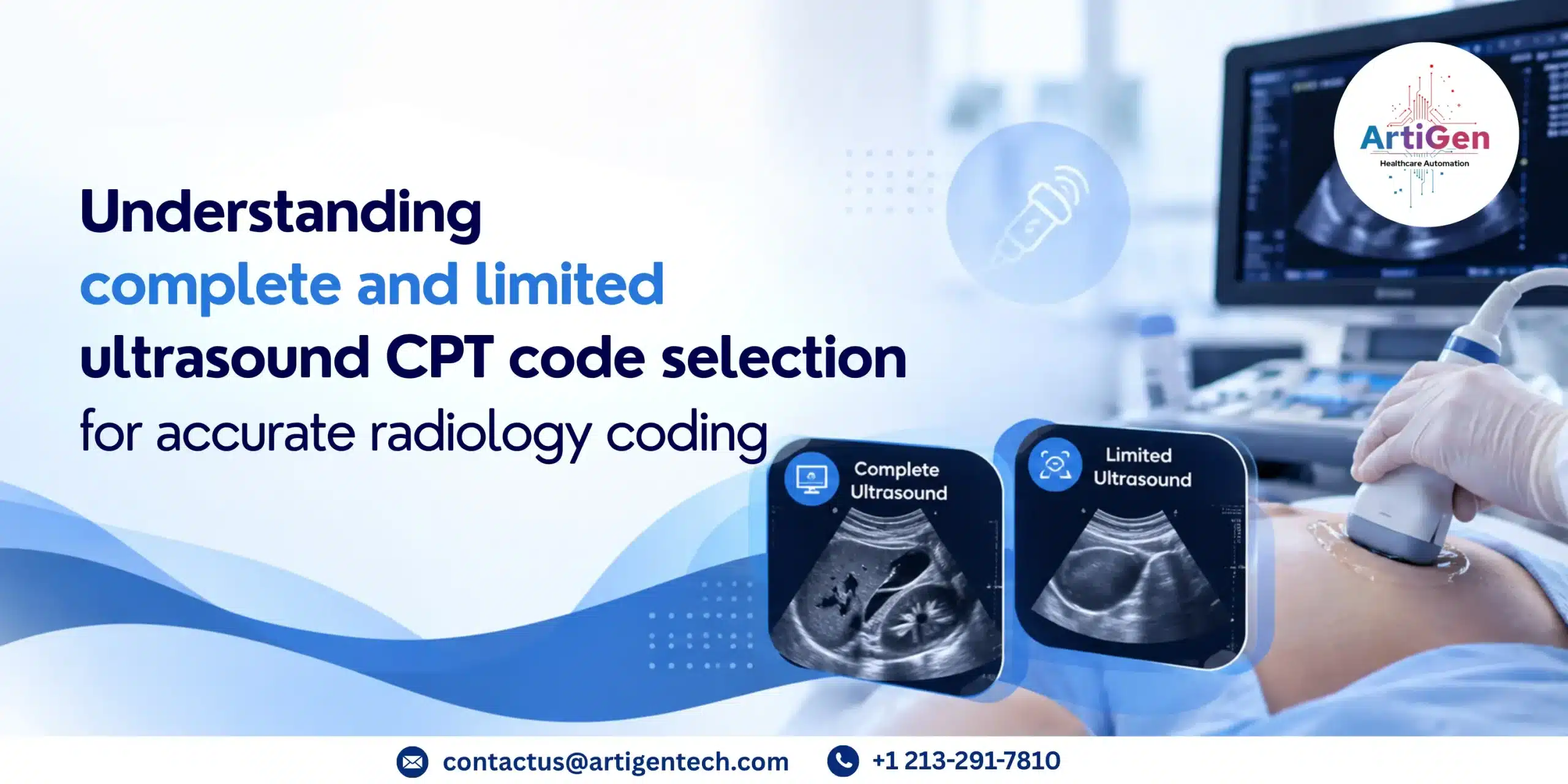
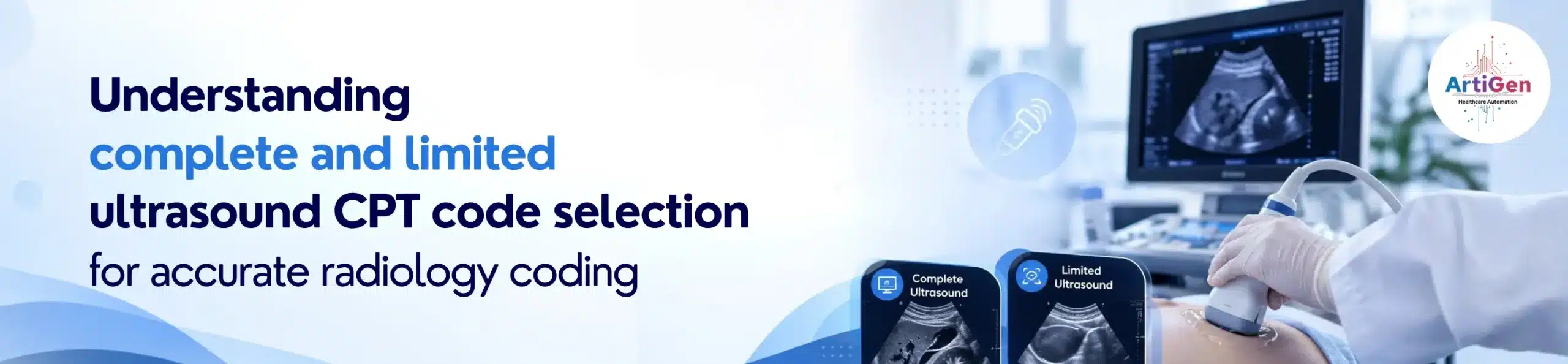
The difference between a complete and limited ultrasound is a function of how much and how well the specific family of CPT codes requires it to be documented.
For abdominal examinations, CPT 76700 represents a complete abdominal ultrasound, while CPT 76705 represents a limited abdominal ultrasound. AAPC describes 76700 as a complete abdominal examination and 76705 as a limited study of a single organ, quadrant, or focused clinical question.
So, the difference between complete Vs limited ultrasound is not simply the number of images taken. The coder must decide whether the examination meets the definition of the selected service.
This allows limited ultrasound coding, diagnostic ultrasound coding, and ultrasound medical coding documentation driven processes.
Common Ultrasound CPT Codes for Radiology Coders
Examination | CPT Code | Coding Focus |
Complete abdomen | 76700 | Complete abdominal study |
Limited abdomen | 76705 | Focused abdominal study |
Complete retroperitoneum | 76770 | Complete retroperitoneal examination |
Limited retroperitoneum | 76775 | Limited retroperitoneal examination |
Complete extremity joint | 76881 | Complete nonvascular joint |
Limited extremity/soft tissue | 76882 | Limited anatomic-specific study |
These ultrasound CPT codes are often involved in radiology medical coding and radiology billing and coding workflows. AAPC indicates 76881 as a complete joint ultrasound and 76882 is a limited anatomic-specific nonvascular extremity exam.
Abdominal Ultrasound Coding: 76700 vs. 76705
Abdominal ultrasound CPT codes are one of the most audited codes in diagnostic imaging.
76700 – Complete Abdominal Ultrasound 76705 – Limited Abdominal Ultrasound
For abdominal ultrasound coding, the coder should go over the documented structures and scope of the examination. A report evaluating the abdomen generally may support the whole service. A focused examination of a single organ or a specific clinical question may provide support for limited ultrasound coding.
Therefore, CPT code for abdominal ultrasound and CPT code for ultrasound abdomen are only to be selected after reviewing the final documentation.
A search for the ultrasound abdomen CPT code should not be used instead of code verification. The same ultrasound abdomen CPT code may have different coding decisions depending on if the exam is complete or limited.
Complete vs Limited Ultrasound: What Coders Should Check
When reviewing complete vs limited ultrasound documentation, coders should ask:
- What anatomical region was examined?
- What structures were evaluated?
- Was the examination comprehensive or focused?
- Does the report support the selected code?
- Do the CPT coding guidelines and radiology coding guidelines support the reported service?
The final report for diagnostic ultrasound coding should support the service billed. Limited ultrasound coding may be appropriate when the documentation describes a focused study.
This increases accuracy in radiology coding, ultrasound billing and ultrasound medical coding.
Organs evaluated in completed abdominal Ultrasound Coding
Coders frequently search for the following organs in abdominal ultrasound CPT code
Complete ultrasound examination of the abdomen 76700 consists of gallbladder, common bile duct, pancreas, spleen, kidneys, upper abdominal aorta and inferior vena cava.
When any one organ is missing or only one organ is examined in the abdominal study then the study is limited.
Complete ultrasound examination of the retroperitoneum 76770 consists of kidneys, urinary bladder, abdominal aorta, common iliac, artery origins, and inferior vena cava including any demonstrated retroperitoneal abnormality.
But there is not a universal stand-alone CPT code that is the “liver ultrasound CPT code.” The coder must determine whether the exam is a complete abdominal service or a limited abdominal study.
The same goes for a gallbladder ultrasound CPT code. CPT 76705 can include a focused gallbladder exam if the service documented is limited.
Therefore, the liver ultrasound CPT code, CPT code ultrasound of liver, and gallbladder ultrasound CPT code should be compared to the actual service, report, and the CPT coding guidelines.
Renal Ultrasound CPT Coding
Renal imaging creates another common coding question.
When kidney imaging is described in the documentation, coders may look for a renal ultrasound CPT code. If the examination is performed as a retroperitoneal study, CPT 76770 can be the entire examination and 76775 the limited examination, depending on the documented scope.
CMS states that retroperitoneal ultrasound codes should be reported only for retroperitoneal structures; if the ultrasound exam includes other structures in the abdomen, the appropriate abdominal ultrasound service should be reported.
This means the renal ultrasound CPT code, and ultrasound abdomen CPT code should not be chosen from the order only.
In radiology billing and coding, coders need to distinguish a dedicated renal or retroperitoneal service from a more general abdominal exam.
Ultrasound Soft Tissue CPT Coding
The term ultrasound soft tissue CPT code can refer to different clinical situations.
The limited, anatomically-specific code for nonvascular extremity structures is CPT 76882. CPT 76881 is for partial nonvascular joint examination.
This distinction is important for limited ultrasound coding because a focused exam of a tendon, muscle, nerve or soft tissue structure does not necessarily constitute a complete joint exam.
In the diagnostic ultrasound coding, the coder should review the exact anatomy evaluated, and ensure the documentation supports the ultrasound CPT codes selected.
This further supports radiology coding guidelines, radiology medical coding, and accurate ultrasound medical coding.
Ultrasound Guidance CPT Code: When Is 76942 Used?
The ultrasound guidance CPT code 76942 is different from a routine diagnostic ultrasound.
CPT 76942 is used for ultrasonic guidance for needle placement, including procedures such as biopsy, aspiration, injection, or localization.
Therefore, coders should not treat ultrasound guidance CPT code selection as another version of complete vs limited ultrasound.
The procedure documentation should establish that ultrasound guidance was performed, and the related procedure should also be reviewed.
This distinction is important for radiology CPT codes, radiology billing and coding, and radiology medical coding.
Common Ultrasound Coding Errors
Several errors repeatedly affect ultrasound billing:
Billing complete when documentation supports limited:
This is one of the most important complete vs limited ultrasound errors.
Billing limited when the examination supports complete:
This can result in undercoding and missed reimbursement.
Choosing the code from the order:
The order may say “abdominal ultrasound,” but the final report determines whether abdominal ultrasound CPT codes requirements met.
Confusing diagnostic and guidance services:
A diagnostic ultrasound and the ultrasound guidance CPT code represent different services.
Ignoring code-family definitions:
The requirements for abdominal, renal, and soft-tissue ultrasound can differ.
These issues affect radiology coding services, radiology coding accuracy, and overall radiology billing and coding performance.
A Practical Radiology Coding Workflow
A consistent workflow helps coders apply radiology coding guidelines and CPT coding guidelines correctly.
Step 1: Review the order
Understand the clinical question.
Step 2: Review the procedure documentation
Determine what was actually examined.
Step 3: Read the final report
Confirm which structures were evaluated.
Step 4: Determine complete or limited
Verify and validate all the organs or any one organ is missing to determine complete vs limited ultrasound CPT.
Step 5: Validate the CPT code
Select the appropriate Limited or Completed ultrasound CPT codes.
Step 6: Validate diagnosis and billing information
Complete the appropriate ICD-10-CM for screening/diagnostic/follow-up imaging examination studies radiology medical coding and for ultrasound billing workflow.
This approach can improve diagnostic ultrasound coding while reducing avoidable coding rework.
How Radiology Coding Automation Improves Accuracy
Large imaging departments process significant volumes of studies, making manual verification difficult to scale.
Radiology coding automation can help identify documentation patterns and flag potential discrepancies between the report and the selected code.
Modern automated radiology coding can review terms such as “complete,” “limited,” “liver,” “gallbladder,” “renal,” or “soft tissue” and route cases that need coder attention.
A radiology coding software platform can also compare the report with the selected procedure, helping coding teams identify whether an ultrasound CPT codes selection is consistent with the documentation.
The goal is not to replace coders. Radiology coding automation should support professional review, especially for complex cases.
For radiology coding services, this approach can improve turnaround time, consistency, and radiology coding accuracy.
What Should Coders Remember?
The number one rule is simple: code the documented ultrasound service, not just the ordered exam.
When the relevant conditions are fulfilled, 76700 is the full service for abdominal studies, and 76705 is the limited. For retroperitoneal imaging, coders need to differentiate between full and limited services. 76881 and 76882 differ in their requirements for imaging the extremity. 76942 should be considered separately for guidance on needle placement.
This rule also extends to CPT code for abdominal ultrasound, CPT code for ultrasound abdomen, ultrasound abdomen CPT code, renal ultrasound CPT code, liver ultrasound CPT code, and gallbladder ultrasound CPT code.
How ArtigenTech Supports Automated Radiology Coding
ArtigenTech is transforming radiology medical coding in healthcare organizations with intelligent technology and workflow automation.
AI-powered radiology coding software can assist teams in reviewing documentation, deciding on the correct coding pathway and flagging potential complete-versus-limited discrepancies.
By combining automated radiology coding with professional validation, organizations can take their diagnostic ultrasound coding, abdominal ultrasound coding, limited ultrasound coding, and ultrasound medical coding workflows to the next level.
This approach can help to improve radiology coding automation, support radiology coding guidelines and reduce repetitive manual work in high volume imaging operations.
Key Takeaways
Accurate ultrasound medical coding relies on documentation, code-family requirements and correct service selection.
Abdominal ultrasound CPT codes, however, require coders to differentiate between complete and limited exams.
The documentation at the end should support the specific service that is reported for radiology CPT codes.
The selected code should correspond to the examination performed for radiology billing and coding.
The coder must use the applicable CPT coding guidelines and radiology coding guidelines for diagnostic ultrasound coding.
And for high-volume organizations, radiology coding automation, and specialized radiology coding software can help support consistent coding decisions while keeping professional coders in control.