
The Impact of MRI Complexity on Coding and Reimbursement
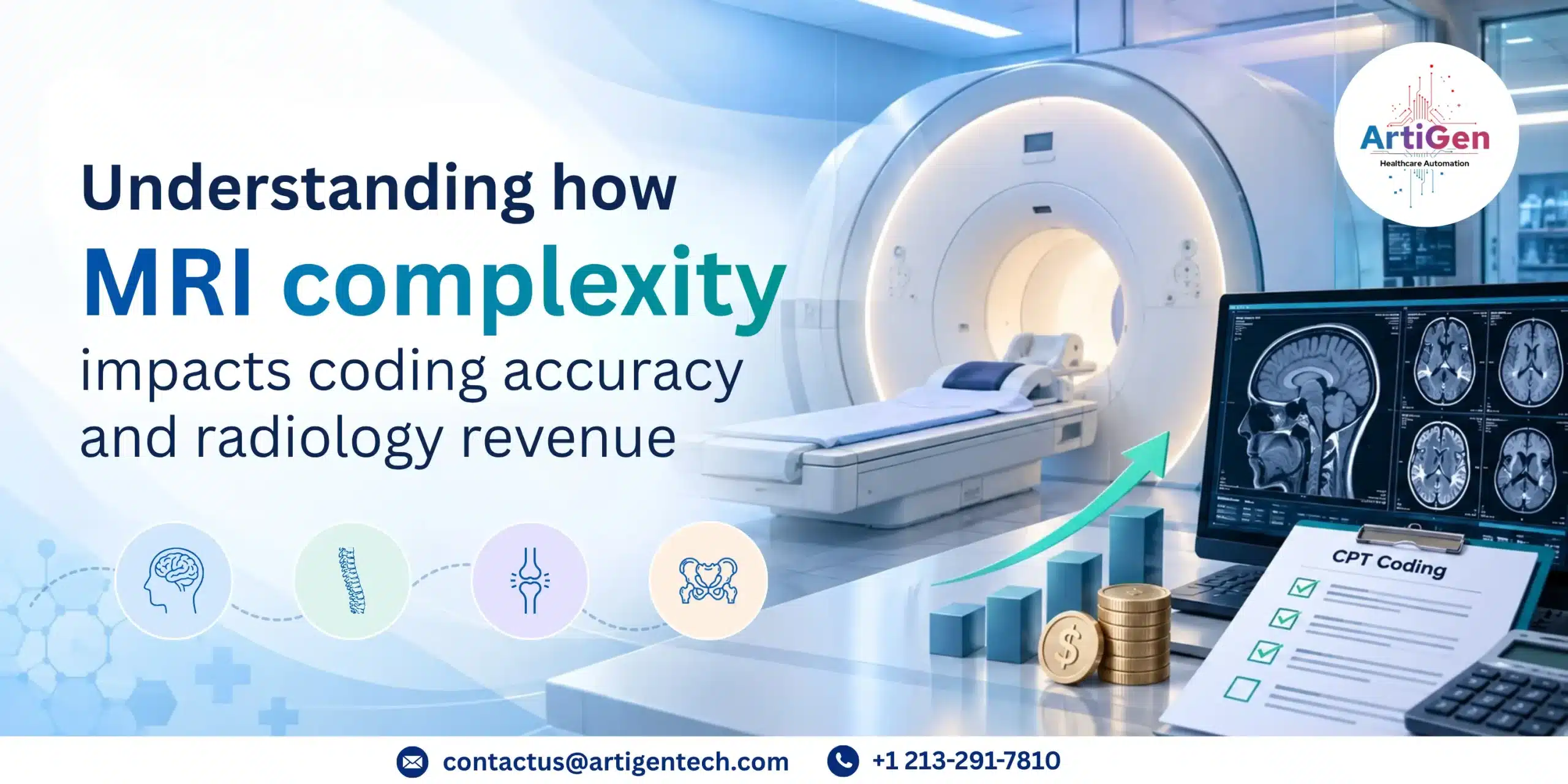
Magnetic Resonance Imaging (MRI) has become an indispensable tool of modern radiology. But as the MRI examinations become more specialised, MRI coding becomes more and more complicated. Anatomical region, contrast administration, imaging protocol, duration of examination, implanted devices, and documentation requirements can impact MRI CPT Codes, claim accuracy, and MRI reimbursement.
For radiology organisations, accurate coding is more than just choosing a procedure code. It involves linking clinical documentation to MRI coding guidelines, payer requirements, medical necessity and reimbursement policies. When these factors are misaligned, organisations can experience radiology coding errors, claim delays and needless revenue loss.
What Makes MRI Coding Complex?
The complexity of an MRI examination begins with the procedure itself. MRI CPT Codes are selected based on factors such as the anatomical region examined, whether contrast is administered, and the type and extent of the study performed.
A brain MRI, spine MRI, joint MRI and extremity MRI may require different CPT codes. Therefore, coders must carefully examine physician order, imaging protocol and radiology report before assigning the correct code.
Contrast administration adds another layer of complexity. An MRI may be performed without contrast, with contrast, or initially without contrast followed by contrast. Understanding the appropriate MRI with and without contrast CPT code is essential because selecting the wrong code can affect both claim accuracy and reimbursement.
Following the current MRI coding guidelines, the coding teams are able to identify such types of examinations and report the service provided correctly.
Contrast, Protocols, and MRI Billing Codes
MRI examinations can be complex depending on the clinical indication and imaging protocol. Standard examinations may be performed following established workflows but abbreviated, rapid, extended or specialised protocols may involve additional review.
The differences affect the MRI billing codes and the reporting of services to payers. For example, a study may include a reduced or modified service and coders may need to determine if an applicable modifier should be reported.
MRI modifiers require particular attention because payer policies may differ in how certain modifiers are interpreted and reimbursed. Incorrect modifier selection can result in payment discrepancies, claim edits, or denials.
This makes accurate MRI billing and coding an important part of radiology revenue cycle management. Coding teams need to ensure that the code and modifiers submitted are reflective of the service documented and not just what is inferred from the exam.
The Role of Documentation and Medical Necessity
One of the most important factors affecting MRI coding and reimbursement is accurate documentation. Payers may review the clinical indication, diagnosis, physician order, examination performed, and supporting documentation to decide if a service meets their requirements.
MRI medical necessity is especially critical when payers require pre-authorization or supporting clinical information. If the documentation does not clearly state the reason for the MRI, the claim may be denied or require additional review.
MRI billing guidelines enable an organization to determine documentation requirements prior to claim submission. This proactive approach can help reduce radiology coding errors and prevent avoidable rework.
For instance, coding teams shouldn’t assume the use of contrast or exam details based solely on the diagnosis. The physician order, the imaging protocol and the final report should contain the information necessary to support accurate coding.
How MRI Complexity Affects Reimbursement
The relationship between MRI reimbursement and coding complexity is particularly significant for high-volume radiology operations. Final payment is determined by CPT code, modifiers, documentation, payer policies, and any applicable reimbursement rules.
The accurate representation of the service performed is essential for accurate radiology reimbursement. Payment may be delayed or denied if coding is not consistent with clinical service or documentation does not support submitted code.
Complex MRI examinations can therefore create significant MRI billing challenges. A coding issue affecting one examination may appear minor, but repeated errors across hundreds or thousands of studies can have a substantial cumulative impact on revenue.
For this reason, radiology coding and reimbursement should be viewed as closely connected processes rather than separate administrative functions.
Common MRI Billing Challenges and Claim Denials
There are few common reasons for MRI claim denials and radiology claim denials. These include incorrect CPT code selection, unsupported modifiers, incomplete documentation, medical-necessity issues, and inconsistencies between the order and final radiology report.
Another major issue is the failure to distinguish between different types of MRI examinations. An incomplete review of contrast information or anatomical region may result in an incorrect MRI billing code being selected, which can affect the accuracy of the claim.
Additional MRI billing challenges can arise from payer specific requirements. Reimbursement can be a challenge even with the right clinical service, with differences in payer policies, authorization requirements, and documentation expectations.
These are issues that can be resolved by consistently applying MRI coding guidelines, regularly reviewing payer policies, and communicating effectively between radiologists, coders, billing teams, and clinical staff.
Reducing Radiology Coding Errors through Better Workflows
As MRI procedures become more complex, manual coding workflows may place more pressure on coding teams. The process of reviewing comprehensive radiology documentation, identifying contrast information, validating medical necessity, and verifying payer requirements can be time-consuming.
Structured workflows can assist organizations in identifying potential radiology coding errors prior to submission of claims. Standardized documentation and coding audits can also help teams find discrepancies between the procedure performed and the code selected.
Technology can provide an added layer of support. Computer-assisted coding and AI-enabled systems can help organize clinical information, identify elements relevant to coding, and help coding professionals review complex cases.
The aim is not to eliminate human expertise. Technology can, instead, eliminate repetitive manual work and allow coding professionals to focus on cases requiring greater clinical and coding judgement.
How ArtigenTech Supports Radiology Coding
Radiology departments are facing greater numbers of evaluations and more complex imaging workflows. AI-assisted technology can help make MRI coding and radiology operations more efficient.
ArtigenTech provides AI-powered medical coding solutions to help healthcare organisations manage complex clinical documentation and coding workflows. RadioNEX AI is built for radiology to assist with radiology coding automation by reading clinical documentation to find relevant coding information from patient records.
RadioNEX AI is able to improve coding team’s ability to manage complex radiology cases by integrating clinical documentation and coding workflows. AI-assisted workflows can also offer extra support to identify coding-relevant information, reduce repetitive manual review, and improve consistency.
In terms of managing the complex documentation and coding needs of MRIs, combining competent coding professionals with AI-enabled workflows can provide organisations seeking to optimize radiology coding and reimbursement with a scalable approach.
Building a More Accurate MRI Revenue Cycle
The complexity of MRI will keep evolving as imaging protocols, clinical applications and patient needs are more sophisticated. This makes accurate MRI coding, documentation, and reimbursement processes increasingly important for radiology organizations.
Following MRI coding guidelines, verifying MRI medical necessity, confirming contrast and protocol details, applying MRI modifiers accurately, and monitoring payer requirements can assist radiology teams reduce avoidable errors and improve claim accuracy.
In the end, successful MRI billing and coding is about linking clinical documentation with financial performance. Accurate coding that reflects services delivered enables organisations to better support appropriate MRI reimbursement, reduce MRI claim denials, and reduce unnecessary radiology claim denials.
As technology increasingly enables the workflow of radiology, organisations may utilise skilled coders, standardized processes, and AI-assisted solutions to navigate complex MRI coding, and build a more accurate and efficient revenue cycle.