Screening vs Diagnostic Services in Urgent Care Medical Coding
Urgent care centers handle a high volume of patients every day, treating everything from minor injuries and infections to preventive health screenings. Urgent care coding is equally important to ensure accurate claims, regulatory compliance and timely reimbursement. However, the primary focus is patient care.
One of the most common challenges for coders and billing professionals is differentiating screening vs diagnostic coding. These include medical tests and procedures but are performed for different clinical reasons and need to be coded differently. Using the wrong diagnosis code or procedure code can result in claim denials, compliance risks, delayed payments, and inaccurate reporting.
With the growing adoption of AI medical coding and medical coding automation, healthcare organizations are now improving coding accuracy while reducing manual efforts. Advanced automation platforms like Artigen’s Quikodex AI enable urgent care providers to find the correct diagnosis codes, confirm documentation, and streamline coding workflows.
Learn the difference between screening and diagnostic services in urgent care, the proper coding of these services, and how automation can help improve coding quality.
What Is Screening in Urgent Care Coding?
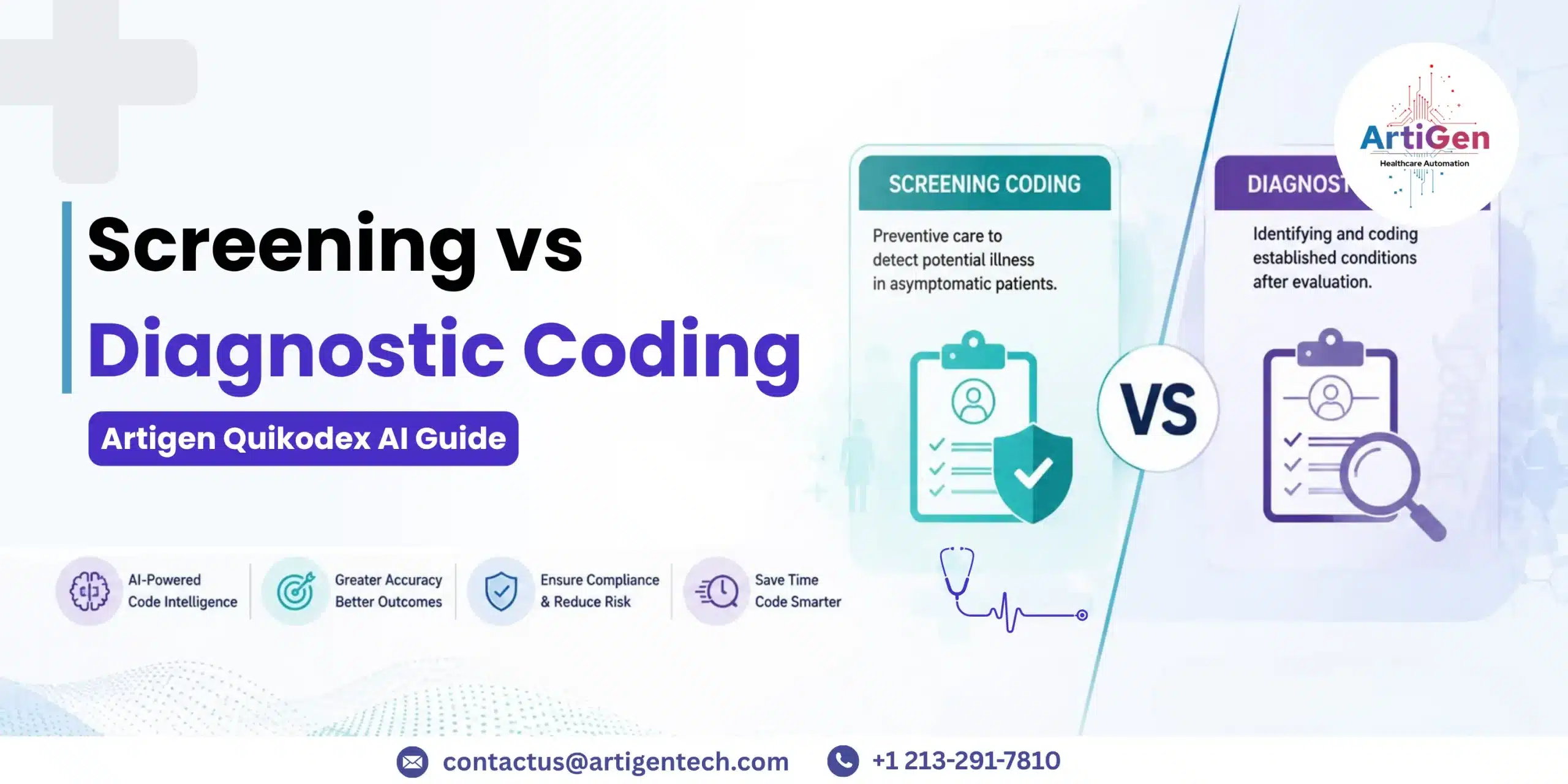
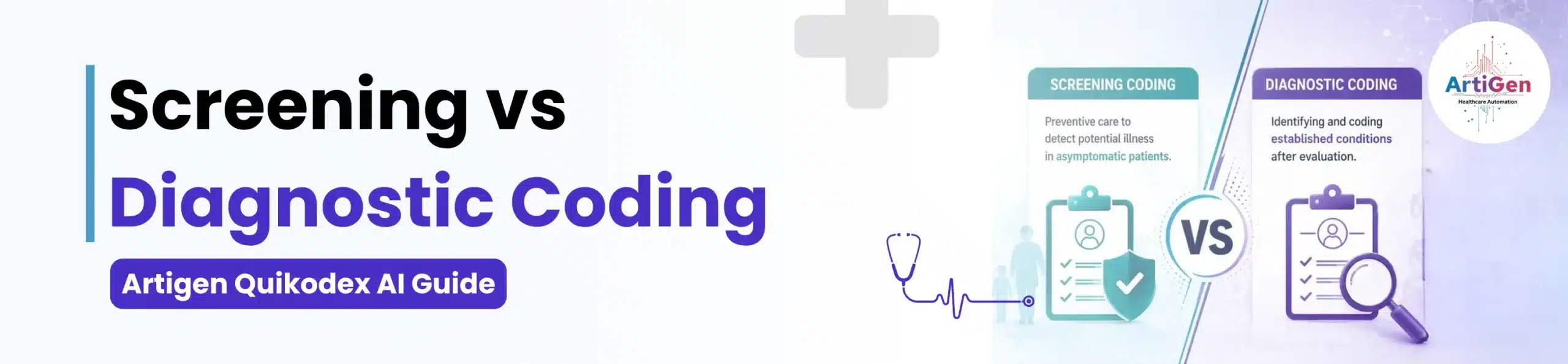
Screening refers to medical tests or examinations performed on patients who do not have signs, symptoms, or a confirmed diagnosis. The objective is to detect diseases or health conditions at an early stage before symptoms develop.
These preventive services generally use ICD-10-CM screening codes, which fall under the “Z” code category.
Common examples include:
- Diabetes screening
- Blood pressure screening
- Cholesterol screening
- Colorectal cancer screening
- Tuberculosis screening
- Depression screening
- Vision and hearing screening
These services require correct screening diagnosis codes that indicate the patient is asymptomatic and receiving preventive evaluation.
Accurate ICD-10-CM screening code assignment is critical to proper urgent care billing, payer compliance, and preventive care reimbursement.
What Are Diagnostic Services in Urgent Care?
Diagnostic services are performed when a patient shows signs and symptoms, abnormal findings or a suspected medical condition. Diagnostic testing is medically necessary to help determine what is the cause of patient’s complaint, whereas screening is not.
Examples include:
- Chest X-ray for persistent cough
- Rapid influenza testing
- COVID-19 testing for symptomatic patients
- Urinalysis for painful urination/Dysuria
- Blood glucose testing for dizziness
- Electrocardiogram (ECG) for chest pain
These services require accurate ICD-10-CM diagnostic codes that reflect the patient’s symptoms or confirmed diagnosis.
Accurate diagnostic services coding supports claim approval by demonstrating why the service was clinically required.
Screening vs Diagnostic Coding: Understanding the Key Difference
The difference between screening vs diagnostic coding is based on the clinical condition of the patient and the intent of the test.
Screening Services | Diagnostic Services |
Patient has no symptoms | Patient has symptoms or known condition |
Preventive purpose | Investigates illness or symptoms |
Uses ICD-10 screening codes | Uses ICD-10 diagnostic codes |
Often preventive benefit | Requires documented medical necessity |
Uses Z series codes only | Uses other series signs, symptoms or disease diagnosis |
For example:
Scenario 1
A healthy 45-year-old patient visits for routine cholesterol screening.
- Z13.220 only
- Appropriate coding uses screening diagnosis codes
- Preventive service
- No symptoms documented
Scenario 2
The patient reports dizziness and blurred vision, prompting blood glucose testing.
- R42, H53.8, Z13.1
- Uses ICD-10-CM specific diagnostic codes
- Diagnostic evaluation for diseases/conditions documented
- Symptoms justify medical necessity
This difference is critical to proper urgent care medical coding and accurate reimbursement.
The decision to screen or use a diagnostic code should always be driven by the provider’s documented clinical intent, not the test performed. Proper documentation and diagnosis selection remain key to compliant reimbursement.
Why Medical Necessity Documentation Matters
Insurance payers will only pay for diagnostic services if there is enough clinical information to support the need for testing. This makes medical necessity documentation one of the most critical parts of urgent care coding.
Documentation should clearly include:
- Patient’s presenting complaint or HPI (History of Present Illness)
- Signs and symptoms
- Physician assessment & ROS (Review of systems)
- Clinical reasoning
- Tests/labs/imaging studies ordered by provider
- Final diagnosis or findings
Even though the correct CPT code is reported, the payer edits may reject the diagnostic claims for lack of proper medical coding documentation.
Strong medical necessity documentation also helps to reduce audits, improve coding quality and support regulatory requirements.
The Role of ICD-10 Diagnostic Codes
Selecting accurate ICD-10 diagnostic codes directly impacts reimbursement.
Rather than assigning a screening code, coders should capture the patient’s documented symptoms or confirmed diagnosis.
Examples include:
- Fever
- Abdominal pain
- Cough
- Dysuria
- Acute sinusitis
- Influenza
- Urinary tract infection
These diagnosis codes establish medical necessity and support diagnostic testing under payer policies.
Proper sequencing of ICD-10 diagnostic codes is equally important when multiple conditions are documented during the encounter.
Choosing the Correct Urgent Care CPT Codes
In addition to diagnosis coding, selecting the correct urgent care CPT codes is essential for complete claim submission.
Frequently reported urgent care procedures include:
- Accurate E/M level
- Office visits
- Laboratory testing
- Rapid antigen testing
- ECG interpretation
- Wound repair
- Incision and drainage
- X-ray interpretation
- Vaccination administration
Following current CPT coding guidelines ensures accurate representation of the services provided.
Mis-matching of diagnosis codes with procedure codes remains one of the biggest causes of claim denials in urgent care billing.
Evaluation and Management Coding in Urgent Care
Every urgent care visit begins with provider evaluation.
Proper evaluation and management coding depends on:
- Medical decision making
- Complexity of presenting problem
- Data reviewed
- Risk level
- Physician documentation
Accurate evaluation and management coding helps to ensure that providers receive appropriate reimbursement for clinical services, whether the patient is being screened for prevention or tested for diagnosis.
Automation platforms are now analyzing provider documentation to recommend proper E/M levels and reduce coding inconsistencies.
Common Coding Errors in Screening and Diagnostic Services
Several mistakes frequently occur during urgent care medical coding, including:
Using Screening Codes for Symptomatic Patients
Once symptoms are documented, preventive screening codes should generally no longer be used.
Missing Medical Necessity
Incomplete provider documentation weakens diagnostic claims.
Incorrect CPT Pairing
Failure to align diagnosis codes with procedure codes often results in payer edits.
Outdated Coding References
Ignoring updated urgent care coding guidelines or revised CPT coding guidelines increases compliance risks.
Inadequate Documentation
Incomplete medical coding documentation creates coding uncertainty and may trigger audits.
Avoiding these issues helps improve urgent care reimbursement and coding accuracy.
Medical Coding Compliance in Urgent Care
Maintaining medical coding compliance requires adherence to payer policies, ICD-10 updates, CPT revisions, and documentation standards.
Healthcare organizations should routinely:
- Audit coding accuracy
- Review provider documentation
- Train coding staff
- Monitor payer updates
- Validate diagnosis selection
- Review modifier usage
Strong compliance programs minimize financial risk while improving coding consistency.
To maintain medical coding compliance, it is essential to follow payer policies, bundling rules, NCCI edits, LCD/NCD coverage ICD-10 updates, CPT revisions, and documentation standards.
How AI Medical Coding Improves Urgent Care Coding
The rising complexities of coding regulations have resulted in the rapid implementation of AI medical coding solutions.
AI looks at documentation, clinical notes, diagnosis history and coding rules in seconds instead of manually reviewing each patient chart.
Benefits include:
- Faster chart review
- Improved diagnosis selection
- Reduced coding errors
- Better documentation validation
- Increased coding consistency
- Faster claim submission
- Lower denial rates
Unlike traditional coding software, AI learns from coding patterns and payer requirements every time.
That is why today’s healthcare organizations are finding that urgent care coding automation is an increasingly valuable investment.
How Quikodex AI by Artigen Simplifies Urgent Care Coding
Coding teams are overwhelmed by thousands of urgent care encounters to manually manage. Artigen created Quikodex AI to speed up urgent care coding automation without sacrificing accuracy or compliance.
Quikodex AI automatically reviews the provider’s documentation to determine the correct ICD-10 diagnostic codes, cross checks the medical necessity documentation, recommends the appropriate urgent care CPT codes and helps you ensure proper evaluation and management coding.
Key capabilities include:
- Automated chart analysis
- Intelligent diagnosis recommendations
- Screening versus diagnostic identification
- Documentation validation
- CPT and ICD-10 code suggestions
- Coding quality checks
- Compliance monitoring
- Workflow automation
- Reduced manual review time
- Faster reimbursement cycles
Quikodex AI combines AI and coding expertise to help healthcare organizations increase operational efficiency and enable high-quality urgent care billing.
Best Practices for Accurate Urgent Care Coding
Organizations can strengthen coding quality by following these best practices:
- Clearly distinguish preventive screening from diagnostic services.
- Verify patient symptoms before assigning diagnosis codes.
- Apply the latest urgent care coding guidelines and CPT coding guidelines.
- Maintain complete medical coding documentation for every encounter.
- Support all diagnostic testing with proper medical necessity documentation.
- Use accurate ICD-10 screening codes and ICD-10 diagnostic codes based on clinical intent.
- Validate procedure coding for all urgent care procedures.
- Conduct regular coding audits to improve medical coding compliance.
- Adopt medical coding automation to reduce manual errors and improve coding efficiency.
Conclusion
Understanding the difference between screening vs diagnostic coding is key to accurate urgent care medical coding. Screening services relate to the preventive care of patients without symptoms, while diagnostic services deal with patients who present symptoms or medical conditions that need clinical investigation.
To reduce denials and maximize urgent care reimbursement, it is important to choose the correct diagnosis codes, use the proper urgent care CPT codes, maintain detailed medical coding documentation, and adhere to urgent care coding guidelines.
With coding requirements constantly changing, manual processes alone can increase the risk of errors and compliance issues. AI-driven tools like Artigen’s Quikodex AI streamline urgent care coding automation by validating documentation, supporting medical necessity documentation, suggesting appropriate codes, and improving medical coding compliance.
Integrating intelligent automation into coding workflows can help urgent care organizations improve efficiency, strengthen coding accuracy, and ensure sustainable revenue cycle performance while providing high-quality patient care.
FAQs
What is the difference between screening and diagnostic coding?
Screening coding is used when a patient has no symptoms and undergoes preventive testing to detect disease early. Diagnostic coding is used when a patient presents with symptoms, abnormal findings, or a known condition requiring evaluation. Screening uses ICD-10 Z codes, while diagnostic services use symptom- or disease-specific ICD-10 diagnosis codes.
Can screening become diagnostic coding?
Yes. If a patient initially comes for preventive screening but reports symptoms during the visit, the encounter may require diagnostic coding. The provider documentation determines whether screening diagnosis codes or ICD-10 diagnostic codes should be assigned.
Why do insurance companies deny screening claims?
Claims are commonly denied because:
- Incorrect ICD-10 screening codes
- Symptoms documented with screening diagnosis
- Missing medical necessity documentation
- CPT and diagnosis mismatch
- Incorrect urgent care CPT codes
When should ICD-10 screening codes be used?
ICD-10 screening codes should only be used when the patient has no signs or symptoms and receives preventive testing for early disease detection.