How AI Separates Drug, Administration, and E/M Coding in Urgent Care
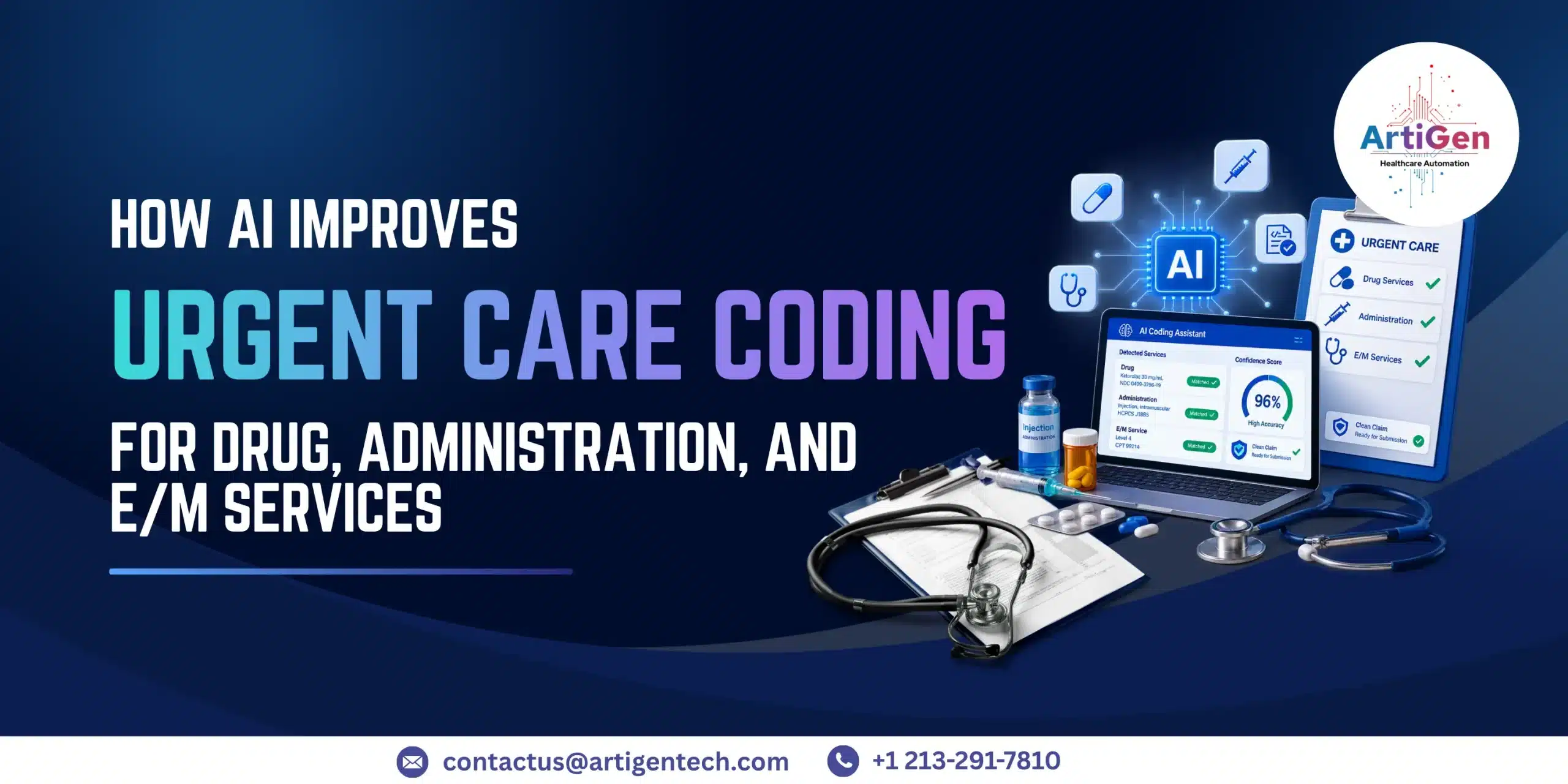
Urgent care encounters often combine a drug, its administration, and a separate evaluation and management service in the same visit. Correct coding requires the documentation to clearly support each service and distinguish the clinical work performed. ArtigenTech’s Quikodex AI can analyze the encounter as a connected clinical story, identify the drug and route, separate administration activities from the E/M service, evaluate modifier requirements, and check coding edits before claim submission.
This matters because urgent care billing and coding often means a multitude of CPT, HCPCS and documentation elements in a single encounter. An AI-enabled medical coding automation workflow can support medical coding documentation and compliance, and can help coding teams consistently apply drug administration CPT codes, HCPCS J codes, CPT E/M codes, and applicable modifiers.
Current CPT Injection codes, drug administration CPT codes, HCPCS J codes, CPT E/M codes, modifier rules and NCCI edits all need to be assessed in a context of the actual encounter. CMS continues to update its E/M and NCCI resources, so current rule validation is a key part of an efficient coding process.
Why Drug, Administration, and E/M Coding Are Often Confused
Urgent care visits are designed to deliver rapid diagnosis and treatment. A patient may arrive with an infection, receive an injectable medication, undergo an evaluation, and leave with a treatment plan during one encounter.
From a clinical perspective, this is a single patient visit.
From a coding perspective, it may contain several distinct services.
For example, a patient could receive:
- A physician or qualified healthcare professional evaluation
- A therapeutic or diagnostic injection
- A separately reportable drug
- Additional diagnostic testing
- Follow-up instructions
Separating these elements correctly is the foundation of accurate urgent care medical coding.
It is even more difficult when the documentation uses similar terminology for the medication, the injection procedure and the clinical evaluation. An administration service can be missed, a service can be incorrectly grouped, or an E/M modifier can be added without adequate support via manual review.
An intelligent AI medical coding software platform takes a different approach to the encounter. It reviews the entire record to identify clinically distinct documented services and then provides coding recommendations for human review.
The Three Coding Components in an Urgent Care Encounter
1.The E/M Service
The evaluation and management component is the clinical work of the provider in evaluating and managing the patient’s condition.
For many E/M families, current evaluation and management coding is based on the appropriate methodology, which may include medical decision-making or, if allowed, total time. CMS continues to be the go-to source for current E/M guidance through its Medicare Learning Network materials and Physician Fee Schedule resources.
To bill for urgent care, the coder must review the provider documentation and select the appropriate CPT E/M codes that match the service that was actually performed.
The diagnosis alone does not justify a particular E/M level. Documentation should be able to back up the service reported.
2. The Drug
The medication itself is a separate coding consideration.
Many injectable drugs are reported using HCPCS J codes, while other medications may use other HCPCS or CPT coding mechanisms depending on the product and setting.
A coding system must identify:
- Drug name
- Strength
- Dosage
- Route
- Units administered
- Wastage, when applicable
- NDC information when required by the payer
- Documentation supporting administration
It can also extract these details from medication administration records and clinical notes, which would eliminate the need to manually search for them during drug administration coding.
3. The Administration Service
The administration is the service of delivering the medication, such as an injection or infusion.
This is different from the drug itself.
That distinction is fundamental to drug administration CPT codes and CPT injection codes.
For example, a record may identify:
Drug: Injectable therapeutic medication
Administration: Intramuscular injection
E/M: Separate evaluation of a new or acute condition
A coding system must evaluate each component independently and then determine whether the services can be reported together.
This is where injection coding guidelines and applicable bundling edits become important.
How AI Separates the Three Services
Traditional coding often requires coders to search through multiple areas of the chart. AI can perform that evidence extraction automatically.
A modern AI medical coding engine can divide the encounter into three evidence layers:
Clinical Evidence | Coding Purpose |
Assessment, history, exam, MDM | E/M coding |
Medication name, dose, route, units | Drug coding |
Injection or infusion activity | Administration coding |
A coding system must evaluate each component independently and then determine whether the services can be reported together.
This is where injection coding guidelines and applicable bundling edits become important.
That’s one of the great benefits of automated medical coding, the system doesn’t simply scan for keywords such as “injection” or “medication.” It checks the surrounding context of the word.
For example, “patient received ceftriaxone 1 g IM” gives evidence of medication and administration. E/M evidence provided by “Patient evaluated for suspected bacterial infection and treatment plan established”
The AI links those facts together without necessarily assuming that each element is billable on its own.
Why Modifier 25 Requires Careful Validation
Modifier 25 coding is one of the most important issues in urgent care billing.
Modifier 25 can be appended to an E/M code when a significant, separately identifiable E/M service is performed on the same day as another procedure or service, when the clinical circumstances indicate it is appropriate. Additional guidance is provided in CMS’s NCCI FAQ and current NCCI manual.
This does not mean that a modifier 25 is automatically appended to an E/M code when an injection or other procedure is performed.
CMS explicitly warns against inappropriate reporting of modifier 25, and reminds providers that documentation must support a significant, separately identifiable E/M service.
This makes E/M modifier 25 validation a natural use case for AI.
An AI system can compare:
E/M evidence → Procedure evidence → Clinical relationship → Modifier requirement
and flag cases for coder review
How AI Handles NCCI Edits in Coding
Urgent care claims often involve multiple services that may interact with National Correct Coding Initiative rules.
CMS updates the Medicare NCCI Policy Manual annually and the current manual is effective January 1, 2026. The policy manual provides the rationale for NCCI edits and modifier use. Specific edit files determine code-pair relationships.
In practice, this means that an AI platform can check if:
- Drug is individually reportable.
- Administration is correctly coded
- E/M service is different
- Support for modifiers
- Edit triggered by code combination
- Exception supported by documentation where permitted
This means that rather than a problem being discovered after the claim is submitted, the NCCI edits in coding are built into the pre-bill validation process.
A Real-World Urgent Care Example
Consider a patient presenting with fever, cough, and worsening respiratory symptoms.
During the encounter, the provider:
- Evaluates the patient’s symptoms and medical history.
- Performs a focused examination.
- Reviews diagnostic results.
- Determines a treatment plan.
- Administers an injectable medication.
- Documents the medication, dosage, route, and administration.
The AI-assisted coding workflow identifies three separate evidence groups:
E/M Evidence
The documentation demonstrates the provider’s evaluation and management of the acute condition.
Drug Evidence
The medication record identifies the specific drug, dose, and route.
Administration Evidence
The record documents the administration procedure.
The platform then checks applicable E/M coding guidelines, urgent care coding guidelines, injection coding guidelines, and NCCI logic.
The coder receives a structured recommendation instead of manually reconstructing the entire encounter.
Why Documentation Is the Foundation
No AI system can legitimately create clinical services that were not documented.
Strong medical coding documentation should identify:
- What condition was evaluated
- What decisions were made
- What medication was administered
- How it was administered
- Dose and units
- Clinical reason for treatment
- Provider involvement
- Patient response when relevant
Better documentation improves urgent care coding and reduces uncertainty during drug administration coding.
It also helps support urgent care billing, payer audits, and internal quality review.
How ArtigenTech Uses Quikodex AI to Improve Urgent Care Coding
ArtigenTech’s intelligent coding approach can help healthcare organizations analyze the complete urgent care encounter rather than treating each code as an isolated task.
An AI medical coding software platform can identify:
- E/M evidence
- Drug information
- Administration details
- Procedure relationships
- Modifier opportunities
- NCCI edit relationships
- Documentation gaps
This enables medical coding automation across high-volume urgent care workflows while keeping qualified coders in control of final decisions.
The objective is not simply to automate code assignment. It is to create a more intelligent medical coding workflow in quikodex AI performs evidence extraction, validation, and prioritization while coding professionals handle clinical judgment and exceptions.
Key Benefits for Urgent Care Organizations
Intelligent automation can support:
Faster Coding
Automated medical coding reduces manual chart searching and repetitive data extraction.
Better Accuracy
AI cross-checks drug, administration, and E/M evidence to improve medical coding accuracy.
Stronger Compliance
AI validation helps teams apply medical coding documentation, urgent care coding guidelines, and current E/M coding guidelines consistently.
Fewer Denials
Pre-bill validation supports claim denial prevention by identifying unsupported code combinations and documentation gaps.
Better Scalability
Organizations can expand urgent care coding services without increasing manual review at the same rate as encounter volume.
The Future of Urgent Care Coding Automation
The next generation of urgent care coding automation will increasingly connect clinical documentation, code selection, edit validation, and billing into one workflow.
Instead of:
Documentation → Manual Review → Coding → Edit Correction → Billing
Organizations can move toward:
Documentation → AI Evidence Extraction → Intelligent Validation → Coder Review → Billing
That shift is particularly valuable for urgent care organizations that are providing high volumes of injections, medications, procedures, and E/M services.
AI may also assist with urgent care CPT codes validation by comparing documented services to current coding logic before claims leave the organization.
Frequently Asked Questions
How does AI separate drug and administration coding?
AI identifies the medication itself from the clinical record and separately identifies how the medication was administered. It then evaluates the documented services against applicable coding rules before presenting recommendations for coder review.
When can an E/M service be reported with modifier 25?
Modifier 25 can be used when the E/M service is significant and separately identifiable from another same-day procedure or service and the documentation supports that distinction. CMS specifically cautions against automatic use of modifier 25 simply because another service was performed.
How can AI improve urgent care billing and coding?
AI can extract drug, administration, E/M, diagnosis, and documentation evidence; validate code relationships and NCCI edits; and identify potential issues before claim submission. This supports faster and more accurate urgent care billing and coding.
Key Takeaways
- Drug, administration, and E/M services should be evaluated separately before determining whether they can be reported together.
- HCPCS J codes generally identify many injectable drugs, while administration services are coded separately when supported.
- E/M modifier 25 requires a significant and separately identifiable E/M service supported by documentation.
- NCCI edits in coding should be checked before claim submission.
- AI medical coding automation can extract clinical evidence and validate coding relationships at scale.
- Strong urgent care medical coding depends on complete documentation and current coding rules.
- ArtigenTech’s intelligent automation approach can help organizations streamline urgent care billing and coding, reduce rework, and improve coding consistency.
Conclusion
Urgent care coding is a challenge to separate the drug, the administration service, and the E/M component. The services may be performed in one visit, but they are separate coding elements that require separate documentation and validation.
At ArtigenTech, AI-powered medical coding automation provides these elements together. Intelligent automation may improve the efficiency and scalability of urgent care coding by analyzing clinical documentation, separating drug and administration evidence from E/M work, validating modifier use and reviewing coding edits.
This results in a more streamlined coding process with enhanced documentation review, more validation, fewer preventable mistakes, and quicker urgent care billing and coding with Artigentech’s intelligent platform quikodex AI.