How AI Maps Endoscopy Findings to CPT and ICD-10 Codes
Gastrointestinal (GI) procedures generate some of the most detailed clinical documentation in healthcare. Every endoscopy report contains valuable information about patient history, clinical indications, anatomical findings, diagnoses, biopsies when performed, pathology recommendations, and physician observations. While this level of detail supports quality patient care, it also makes endoscopy medical coding one of the most complex specialties in revenue cycle management.
For medical coders, translating these clinical findings into accurate ICD-10 coding and endoscopy CPT codes requires much more complexity than assigning diagnosis and procedure codes. Every chart must be reviewed carefully to ensure the documentation supports medical necessity, complies with payer requirements, follows CPT coding guidelines, and satisfies endoscopy medical coding guidelines. Even a small documentation gap can lead to coding inaccuracies, claim denials, delayed reimbursement, or compliance risks.
As healthcare organizations continue to face increasing patient volumes and staffing shortages, manual coding is becoming more difficult to sustain. This is why many hospitals, ambulatory surgery centers (ASCs), physician groups, and gastroenterology coding services are adopting medical coding automation powered by artificial intelligence.
Modern AI medical coding platforms can analyze physician documentation, interpret clinical findings, recommend appropriate diagnosis and procedure codes, validate coding logic, and identify documentation deficiencies before claims are submitted. Rather than replacing coders, AI acts as an intelligent coding assistant that improves productivity, accuracy, and compliance.
Solutions like Artigentech’s Gastrodex AI for gastroenterology coding are designed specifically for GI workflows, helping organizations automate repetitive coding tasks while ensuring coding decisions remain supported by clinical evidence.
Why Endoscopy Medical Coding Is More Complex Than Many Other Specialties
Unlike many outpatient encounters, endoscopy medical procedures involve multiple documentation sources that must be reviewed together before assigning codes.
A gastroenterology coder typically reviews:
- Physician referral documentation
- Patient history and symptoms
- Procedure indication
- Endoscopy procedure report
- Colonoscopy findings
- Esophagogastroduodenoscopy (EGD) report
- Operative documentation
- Pathology reports
- Biopsy findings
- Polypectomy documentation
- Imaging or laboratory reports
- Follow-up recommendations
Each document contributes important clinical evidence for selecting the correct diagnosis and procedure codes.
For example, a physician may document:
“Screening colonoscopy performed. Two polyps identified in the ascending colon. Cold snare polypectomy completed. Specimens sent to pathology.”
Although this appears straightforward, the coder must determine:
- Was the procedure preventive or diagnostic?
- Which endoscopy CPT codes apply?
- Which endoscopy ICD-10 codes support the medical necessity?
- Does the documentation support the procedure performed?
- Are modifier requirements met?
- Do any NCCI edits in endoscopy apply?
These questions illustrate why gastroenterology medical coding requires both clinical knowledge and coding expertise.
What Is AI-Powered Endoscopy Medical Coding?
AI-powered coding combines clinical natural language processing (NLP), machine learning, and medical coding intelligence to automate the interpretation of physician documentation.
Instead of manually reviewing every page of an endoscopy report, AI can extract key clinical information such as:
- Procedure performed
- Anatomical location
- Diagnosis
- Clinical indication
- Polyp characteristics
- Biopsy documentation
- Therapeutic interventions
- Physician assessment
- Pathology references
The platform then maps these findings to applicable endoscopy ICD-10 coding and gastroenterology CPT codes, while validating them against payer rules and coding guidelines.
Rather than replacing human expertise, automated endoscopy coding reduces repetitive manual work and allows coders to focus on complex coding scenarios that require clinical judgment.
Why Accurate CPT and ICD-10 Mapping Matters for Endoscopy Medical Coding
The success of every gastroenterology claim depends on correctly linking clinical documentation with diagnosis and procedure codes.
Incorrect mapping can result in:
- Claim denials
- Delayed reimbursement
- Coding audits
- Revenue leakage
- Compliance risks
- Increased coder rework
- Additional provider queries
Accurate medical coding documentation ensures that every reported service reflects the physician’s documented findings while meeting payer requirements.
For example, assigning a colonoscopy CPT code without sufficient documentation supporting the indication or procedure performed can trigger claim rejection, even when the service was clinically appropriate.
This is why organizations increasingly rely on gastroenterology coding automation to validate documentation before final code assignment.
The Traditional Endoscopy Medical Coding Workflow
Before understanding how AI transforms coding, it is helpful to review the traditional endoscopy medical coding workflow.
Step 1: Patient Encounter
The patient presents with symptoms such as abdominal pain, rectal bleeding, GERD, anemia, dysphagia, or undergoes routine colorectal cancer screening.
Step 2: Physician Documentation
The gastroenterologist documents:
- Chief complaint
- History of present illness
- Clinical indications
- Procedure performed
- Findings
- Impression
- Assessment
- Treatment
- Recommendations
Step 3: Procedure Review
The coder reviews the procedure report to determine:
- Type of endoscopy
- Diagnostic or therapeutic procedure
- Biopsy performed
- Polypectomy technique
- Multiple procedures
- Anatomical locations
Step 4: Diagnosis Selection
The documented findings & impression are translated into the appropriate endoscopy ICD-10 codes based on the physician’s documentation and applicable coding guidelines.
Step 5: CPT Assignment
Next, the coder identifies the correct endoscopy CPT codes by evaluating:
- Procedure technique
- Anatomical site
- Extent of examination
- Therapeutic intervention
- Device usage
- Number of lesions treated
Step 6: Documentation Validation
Before submitting the claim, coders verify:
- Documentation completeness
- Procedure support
- Diagnosis specificity
- Medical necessity
- Modifier usage
- Coding compliance
This manual process is accurate but time-consuming, particularly for organizations managing thousands of GI procedures every month.
Common Challenges in Endoscopy Medical Coding
Even experienced coders encounter several obstacles during gastroenterology CPT coding.
1. Unstructured Physician Documentation
Endoscopy reports are often written in narrative format.
Important coding information may be scattered throughout multiple sections, making it difficult to identify:
- Procedure details
- Anatomical locations
- Findings
- Therapeutic interventions
AI-powered documentation analysis can automatically organize this information into structured coding evidence.
2. Diagnosis-to-Procedure Mapping
One of the biggest challenges in endoscopy billing and coding is ensuring the documented diagnosis supports the reported procedure.
For example:
- Screening colonoscopy
- Diagnostic colonoscopy
- Colonoscopy with biopsy
Each scenario has different coding implications.
Selecting the wrong diagnosis may affect reimbursement and compliance.
3. Medical Necessity Documentation
Many GI procedures require sufficient medical necessity documentation before reimbursement is approved.
Coders must verify that:
- Symptoms support the procedure.
- Clinical indications are documented.
- Physician findings justify treatment.
- Documentation aligns with payer policies.
Missing medical necessity remains one of the leading causes of GI claim denials.
4. Procedure Complexity
A single colonoscopy may include:
- Biopsy
- Snare polypectomy
- Injection therapy
- Control of bleeding
- Foreign body removal
- Multiple lesions
Determining the appropriate CPT combination while following endoscopy coding guidelines can be challenging without automated validation.
5. NCCI Edit Validation
Applying NCCI edits in endoscopy requires careful review to prevent incorrect code combinations and unbundling issues.
Coders must determine:
- Which services are separately reportable
- Whether modifiers are required
- If procedures are bundled under National Correct Coding Initiative rules
This step is critical for compliance and reimbursement accuracy.
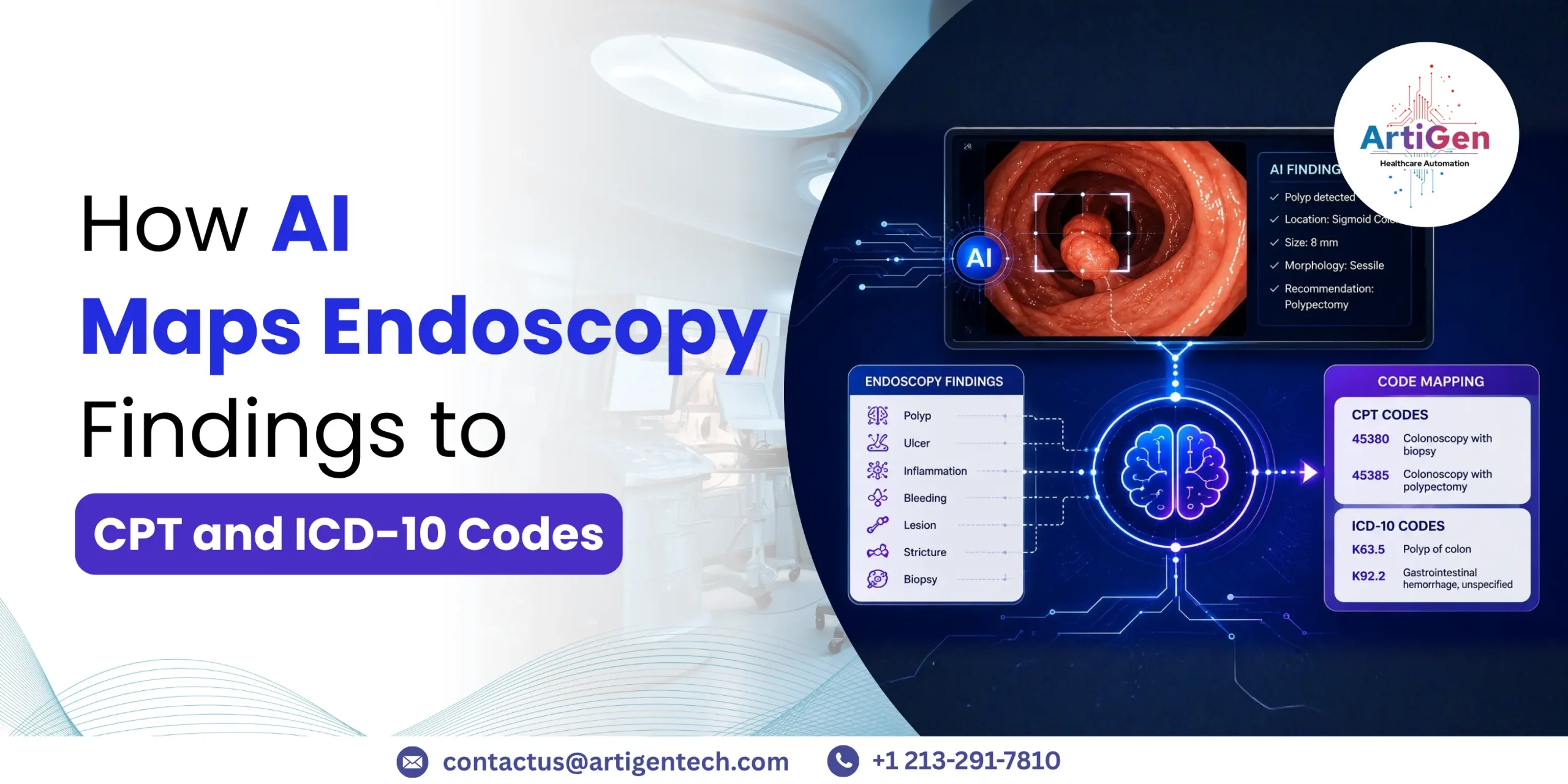
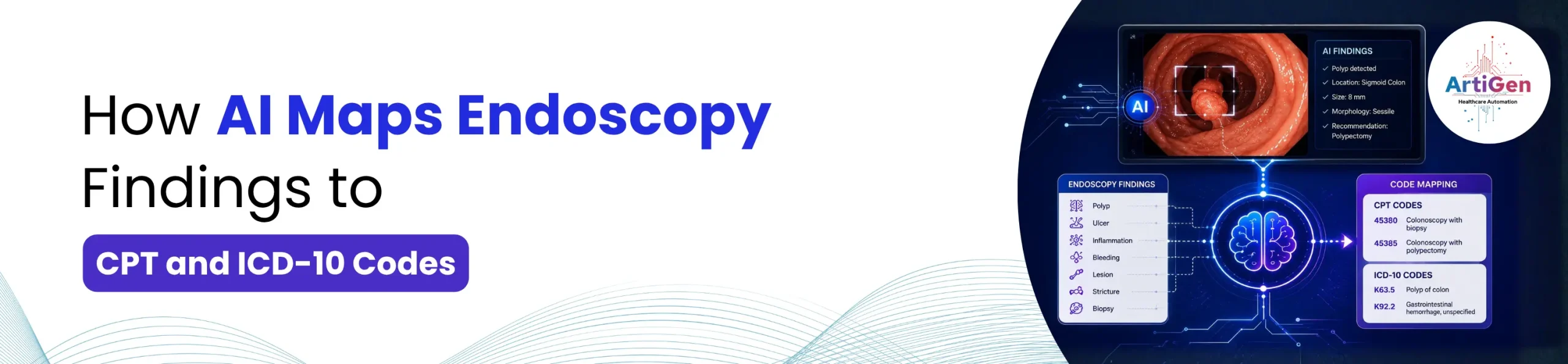
How AI Maps Endoscopy Findings to CPT and ICD-10 Codes
Artificial intelligence transforms the coding process by analyzing clinical documentation the same way an experienced coder reviews a chart—but at a much greater speed.
Using advanced natural language processing and clinical language models, AI reads:
- Endoscopy reports
- Physician procedure notes
- Assessment and plan
- Clinical indications
- Operative reports
- Pathology references
- Laboratory findings
- Previous medical history
The system identifies clinically relevant information and converts it into structured coding evidence.
For example, AI can automatically recognize:
- Procedure type (EGD, colonoscopy, sigmoidoscopy)
- Diagnostic vs Screening
- Anatomical site examined
- Polyps, ulcers, inflammation, bleeding, or lesions
- Biopsy or polypectomy techniques
- Therapeutic interventions
- Associated diagnoses
- Documentation supporting medical necessity
Based on these findings, the platform recommends the most appropriate endoscopy ICD-10 coding and gastroenterology CPT codes, while checking documentation completeness and coding logic before the chart reaches the coder.
Instead of spending significant time searching through lengthy reports, coders receive an organized summary of clinical evidence with AI-assisted code suggestions, enabling faster and more consistent decision-making.
In the next section, we’ll explore how AI validates medical necessity, applies CPT coding guidelines, handles NCCI edits, integrates pathology findings, and how Gastrodex AI streamlines the complete gastroenterology coding workflow from clinical documentation to claim-ready code assignment.
How AI Validates Medical Necessity Documentation
One of the most common reasons for claim denials in endoscopy billing and coding is insufficient medical necessity documentation. Even when a procedure is performed correctly, payers require clear clinical evidence that justifies why the service was medically necessary.
For example, a screening colonoscopy performed on an average-risk patient follows different reimbursement rules than a diagnostic colonoscopy performed for rectal bleeding or unexplained anemia. If the physician documentation does not clearly support the indication, the claim may be delayed or denied.
AI-powered medical coding automation addresses this challenge by analyzing the complete patient record and identifying documentation that supports medical necessity.
An intelligent coding platform can:
- Validate the documented indication against the performed procedure.
- Detect missing clinical justification before coding begins.
- Highlight inconsistencies between diagnosis and procedure.
- Identify documentation gaps that require provider clarification.
- Flag encounters that may not satisfy payer-specific requirements.
Instead of discovering documentation issues after claim submission, coders can resolve them proactively, reducing rework and improving first-pass claim acceptance.
Applying Gastroenterology Coding Guidelines with AI
Keeping up with changing gastroenterology coding guidelines can be challenging, especially for organizations processing hundreds of GI procedures each day.
Coders must consider:
- CPT® reporting rules
- ICD-10-CM Official Coding Guidelines
- Medicare coverage policies
- Commercial payer policies
- Documentation requirements
- Modifier usage
- Procedure sequencing
AI helps standardize these decisions by validating coding recommendations against established gastroenterology coding guidelines.
Rather than relying solely on manual interpretation, AI provides evidence-based suggestions that improve coding consistency across teams.
This is particularly valuable for healthcare organizations managing large volumes of outpatient endoscopy procedures.
Managing NCCI Edits in Endoscopy
Another challenge in gastroenterology medical coding is correctly applying NCCI edits in endoscopy.
The National Correct Coding Initiative (NCCI) helps prevent inappropriate code combinations and duplicate reimbursement. Coders must determine whether procedures are separately reportable, bundled, or require appropriate modifier usage.
Manual review of NCCI edits can be time-consuming, particularly when multiple therapeutic procedures are documented during the same encounter.
AI-powered validation helps by:
- Detecting potential bundling conflicts.
- Identifying modifier opportunities.
- Alerting coders to non-compliant code combinations.
- Reducing manual review time.
- Supporting cleaner claim submission.
This proactive approach minimizes compliance risks while improving coding efficiency.
Why Automated Endoscopy Coding Improves Accuracy
Healthcare organizations adopting automated endoscopy coding often experience improvements in both productivity and coding quality.
Key benefits include:
- Faster chart review.
- Consistent code selection.
- Reduced manual data entry.
- Improved coding standardization.
- Better documentation validation.
- Lower denial rates.
- Increased coder productivity.
- Faster reimbursement cycles.
- Automated audit trail and quality checks
By reducing repetitive administrative work, coders can focus on complex cases that require clinical expertise.
How Gastrodex AI Transforms Gastroenterology Coding
Gastrodex AI is ArtigenTech’s intelligent solution built specifically for gastroenterology coding automation.
Unlike generic coding tools, Gastrodex AI is designed around the unique workflow of GI coding teams.
It helps healthcare providers, hospitals, ambulatory surgery centers, and gastroenterology coding services automate complex coding activities while maintaining coding accuracy and compliance.
Gastrodex AI helps organizations:
- Analyze endoscopy reports using clinical AI.
- Extract procedure details from unstructured documentation.
- Recommend accurate gastroenterology CPT codes.
- Validate endoscopy ICD-10 codes against clinical documentation.
- Detect missing medical coding documentation & coding discrepancies.
- Support medical necessity documentation review.
- Validate NCCI edits in endoscopy.
- Improve coding quality through automated validation & compliance checks.
- Accelerate the complete endoscopy coding workflow.
With intelligent automation, organizations can reduce manual effort while maintaining high-quality coding outcomes.
Frequently Asked Questions
How does AI improve endoscopy medical coding?
AI analyzes physician documentation, identifies clinical findings, recommends ICD-10 and CPT codes, validates documentation completeness, and detects coding inconsistencies before claims are submitted.
What are NCCI edits in endoscopy?
NCCI edits help prevent inappropriate code combinations and duplicate reimbursement. AI can automatically identify potential NCCI conflicts and assist coders in applying the correct coding logic.
How does Gastrodex AI improve gastroenterology coding?
Gastrodex AI for gastroenterology coding uses AI and clinical NLP to automate documentation analysis, recommend codes, validate coding guidelines, support compliance, and streamline the entire coding workflow.
Conclusion
The future of endoscopy medical coding is not about replacing skilled coders—it is about equipping them with intelligent technology that improves speed, consistency, and accuracy.
As documentation becomes more complex and reimbursement requirements continue to evolve, relying solely on manual coding processes is no longer sustainable. AI-powered medical coding automation enables healthcare organizations to transform how endoscopy findings are interpreted, validated, and mapped to Endoscopy ICD-10 coding and endoscopy CPT codes.
Solutions like Gastrodex AI empower coding teams by automating documentation review, validating coding decisions, supporting gastroenterology coding guidelines, and reducing coding errors before claims reach the payer.
For hospitals, physician groups, ambulatory surgery centers, and gastroenterology coding services, adopting intelligent gastroenterology coding software is more than a technology upgrade—it’s a strategic investment in coding quality, operational efficiency, compliance, and long-term revenue integrity.