AI-Powered Endoscopy Coding: From Findings to Final Codes
Introduction
Endoscopy procedures play a critical role in diagnosing and treating gastrointestinal disorders, from acid reflux and ulcers to colorectal cancer and inflammatory bowel diseases. However, accurate coding of endoscopic procedures remains one of the most challenging areas in medical billing due to complex documentation requirements, multiple procedure variations, evolving payer regulations, and frequent updates to coding standards.
Traditional coding workflows require coders to review lengthy physician notes, operative reports, pathology findings, and procedure documentation to determine the appropriate gastroenterology CPT Codes, ICD-10, and modifier assignments. This manual process often increases coding turnaround times, introduces compliance risks, and contributes to claim denials.
Today, AI Medical Coding is transforming how healthcare organizations manage endoscopy coding workflows. Advanced AI coding software and AI Medical Coding software can analyze clinical documentation, identify procedure details, recommend appropriate Endoscopy CPT Codes, and ensure adherence to gastroenterology billing guidelines with greater speed and accuracy.
At ArtigenTech, we help healthcare organizations modernize coding operations through intelligent automation, enabling more efficient and compliant Healthcare coding automation workflows across gastroenterology and endoscopy services.
Why Endoscopy Coding Is So Complex
Endoscopy procedures often involve multiple findings, interventions, biopsies, and therapeutic services performed during a single encounter.
A coder may need to identify:
- Diagnostic procedures
- Biopsy procedures
- Polypectomy techniques
- Foreign body removal
- Hemostasis procedures
- Multiple anatomical sites
- Appropriate modifiers
- Supporting diagnoses
Even minor documentation differences can affect reimbursement outcomes.
For example, distinguishing between a diagnostic colonoscopy and a colonoscopy with biopsy requires completely different Endoscopy CPT Codes and reimbursement structures.
This complexity makes Endoscopy Coding one of the most documentation-intensive specialties within Gastroenterology Medical Coding.
The Traditional Endoscopy Coding Workflow
Before automation, coders typically perform the following steps:
Step 1: Documentation Review
Reviewing:
- Endoscopy reports
- Operative notes
- Physician findings
- Pathology results
- Clinical history
Step 2: Procedure Identification
Coders determine:
- Procedure type
- Anatomical location
- Diagnostic versus therapeutic service
- Associated interventions
Step 3: Code Assignment
Assigning:
- gastroenterology cpt codes
- ICD-10 diagnosis codes
- HCPCS codes
- Appropriate modifiers
Step 4: Compliance Validation
Ensuring compliance with:
- Gastroenterology coding guidelines
- Payer policies
- CMS regulations
- Documentation requirements
Step 5: Claim Submission
Final coding review before billing.
This manual approach can be time-consuming and prone to inconsistencies, making Medical Coding Automation increasingly important for healthcare organizations.
How AI-Powered Endoscopy Coding Works
Modern AI Medical Coding software leverages Natural Language Processing (NLP), machine learning, and clinical intelligence to automate the coding lifecycle.
1. Clinical Documentation Analysis
AI systems review:
- Physician narratives
- Procedure notes
- Pathology findings
- Clinical documentation
This supports Clinical documentation improvement by identifying missing information and documentation gaps before claims are submitted.
2. Procedure Recognition
Advanced AI coding software automatically identifies:
- Colonoscopy procedures
- Upper GI endoscopy procedures
- Therapeutic interventions
- Biopsy procedures
- Gastrointestinal surgery procedures
This significantly reduces manual coding effort while improving consistency.
3. Automated Code Assignment
AI engines recommend:
- gastroenterology cpt codes
- ICD-10 diagnosis codes
- Modifiers
- Compliance validations
This is where automated medical coding delivers measurable efficiency improvements.
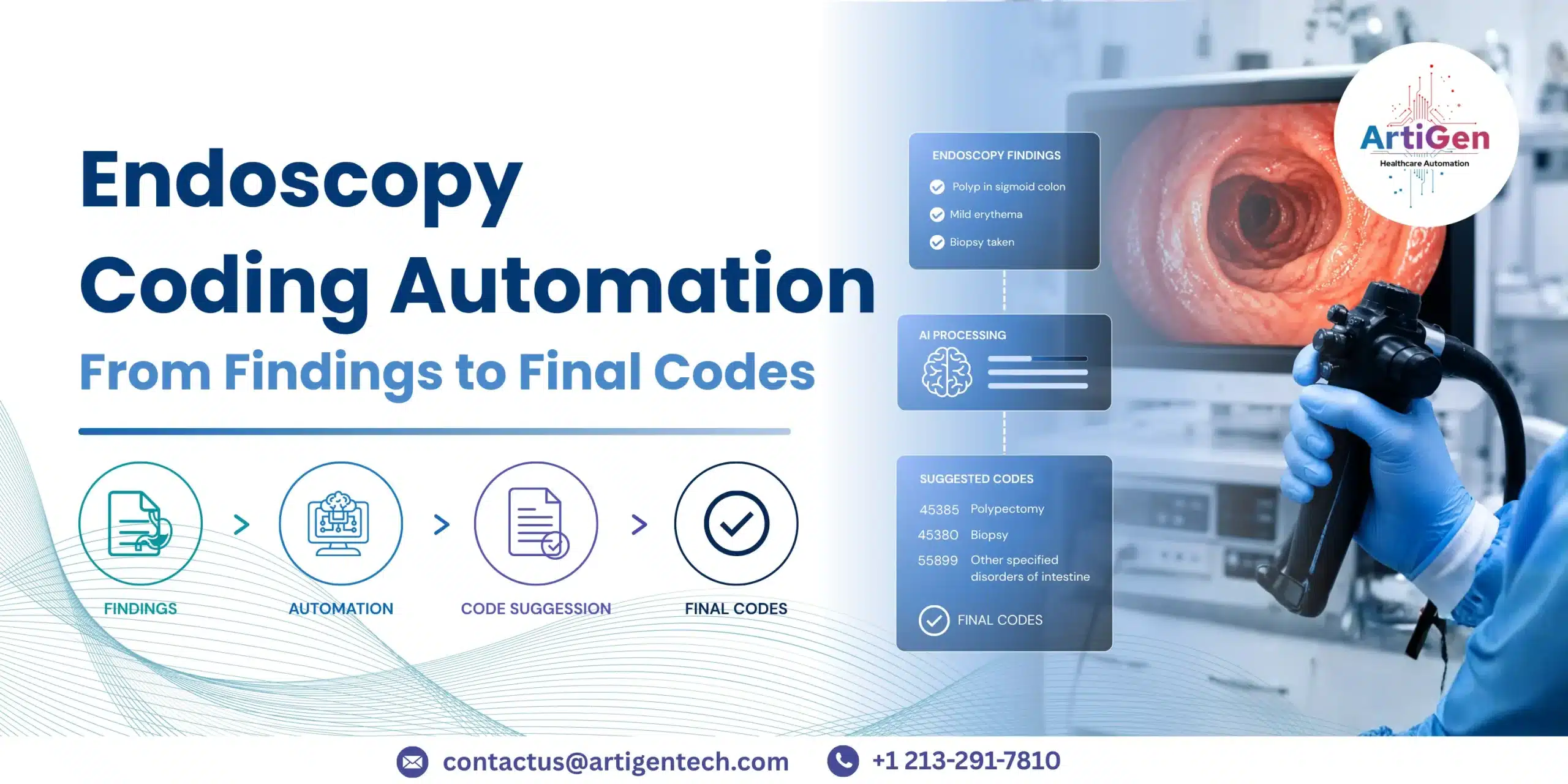
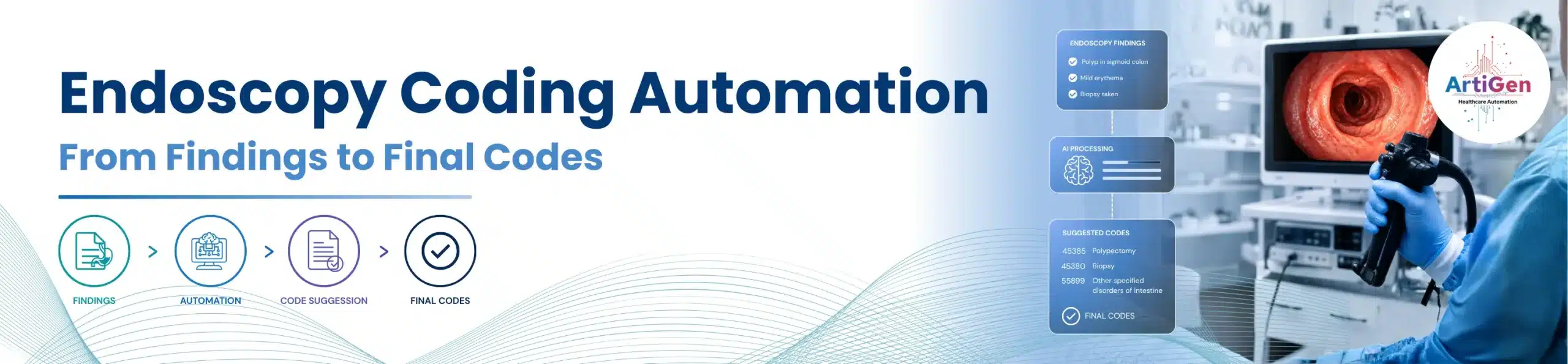
From Endoscopy Findings to Final Codes
One of the most valuable capabilities of automated medical coding is transforming clinical findings into accurate code recommendations.
Example Scenario
Physician Documentation
Patient underwent colonoscopy for colorectal cancer screening. A 7 mm polyp was identified in the sigmoid colon and removed using a snare technique. Tissue specimen sent for pathology evaluation.
AI Analysis
The AI system identifies:
- Colonoscopy performed
- Polyp detected
- Snare removal completed
- Pathology specimen obtained
Recommended Coding
- CPT 45385 – Colonoscopy with removal of tumor/polyp by snare technique
- ICD-10 K63.5 – Polyp of colon
This automated workflow demonstrates how Computer-Assisted Coding accelerates coding accuracy while reducing manual review requirements.
Common Endoscopy CPT Codes Used in Gastroenterology Coding
AI solutions frequently identify the following Endoscopy CPT codes:
Procedure | CPT Code |
Diagnostic Colonoscopy | 45378 |
Colonoscopy with Biopsy | 45380 |
Colonoscopy with Polypectomy | 45385 |
Diagnostic EGD | 43235 |
EGD with Biopsy | 43239 |
EGD with Dilation | 43249 |
ERCP Diagnostic | 43260 |
ERCP with Stone Removal | 43264 |
Capsule Endoscopy | 91110 |
Modern endoscopy coding software automatically maps documentation to the appropriate Endoscopy CPT codes, reducing coding variability and supporting compliance.
Understanding Endoscopy Coding Guidelines
Accurate Endoscopy Coding guidelines are essential for ensuring compliant reimbursement, reducing claim denials, and maintaining coding consistency across gastroenterology practices. Coders must carefully review procedure documentation, physician findings, pathology reports, and payer-specific requirements when assigning Endoscopy CPT Codes.
Proper application of gastroenterology coding guidelines, modifier usage, and documentation standards helps prevent undercoding, overcoding, and compliance risks.
AI-powered coding solutions can automatically validate coding decisions against current Endoscopy Coding guidelines, enabling healthcare organizations to improve coding accuracy, streamline audits, and support efficient revenue cycle management.
The Role of Computer-Assisted Coding in Endoscopy
Healthcare organizations increasingly rely on Computer-Assisted Coding and Computer-assisted coding software to handle growing procedural volumes.
Benefits Include
Faster Coding Turnaround
AI reviews documentation within seconds.
Improved Accuracy
AI minimizes missed procedures and coding inconsistencies.
Better Compliance
Built-in validation supports adherence to gastroenterology coding guidelines and payer requirements.
Reduced Administrative Burden
Automation allows coders to focus on complex cases requiring human expertise.
These advantages make Computer-assisted coding software a key component of modern Medical Coding Software platforms.
Supporting Gastroenterology Coding Services with AI
Endoscopy coding is only one component of broader gastroenterology coding services.
Healthcare providers must also manage:
- Colonoscopy coding
- EGD coding
- ERCP coding
- Capsule endoscopy coding
- GI surgery coding
- Diagnostic procedure coding
AI-driven gastroenterology coding software helps organizations manage these services more efficiently by automating repetitive tasks and ensuring coding consistency.
As healthcare systems continue expanding, scalable gastroenterology coding services become increasingly important for operational success.
Handling Gastroenterology Modifiers Automatically
Modifiers are among the most error-prone elements of coding.
Common gastroenterology modifiers include:
- Modifier 25
- Modifier 26
- Modifier 33
- Modifier 52
- Modifier 53
- Modifier 59
- Modifier PT
- Modifier TC
AI-powered endoscopy coding software evaluates documentation context and recommends appropriate gastroenterology modifiers when supported by clinical evidence.
This reduces compliance risks and improves reimbursement accuracy.
Coding Gastroenterology Procedures More Efficiently
One of the greatest challenges in coding gastroenterology procedures is identifying the specific intervention performed.
AI systems automatically detect:
- Biopsy procedures
- Polypectomies
- Dilation procedures
- Hemostasis procedures
- Diagnostic procedures
- Therapeutic procedures
Automated recognition improves consistency when coding gastroenterology procedures, especially in high-volume healthcare environments.
Supporting Gastrointestinal Surgery CPT Codes
Many gastroenterology practices perform procedures that overlap with surgical coding requirements.
AI helps identify appropriate:
- Gastrointestinal surgery CPT codes
- Endoscopic surgery codes
- Therapeutic procedure codes
- Operative service codes
This ensures greater coding accuracy while supporting proper reimbursement for advanced GI procedures.
Improving Compliance through Clinical Documentation Improvement
Coding accuracy starts with documentation quality.
AI solutions strengthen Clinical documentation improvement initiatives by identifying:
- Missing diagnoses
- Incomplete procedure details
- Unsupported code assignments
- Documentation inconsistencies
Better documentation directly supports more accurate AI in medical coding workflows and improved reimbursement outcomes.
The Business Benefits of Healthcare Coding Automation
Organizations adopting Healthcare coding automation often experience:
Faster Revenue Cycles
Claims are processed more quickly due to reduced coding delays.
Lower Denial Rates
Improved coding accuracy reduces payer rejections.
Increased Productivity
Coders spend less time on repetitive tasks.
Better Compliance
AI validates coding decisions against established rules.
Improved Scalability
Organizations can manage larger procedural volumes without proportional staffing increases.
These advantages make Healthcare coding automation a strategic investment for healthcare organizations.
The Future of AI in Gastroenterology Medical Coding
The future of AI in medical coding continues to evolve rapidly.
Emerging capabilities include:
- Real-time coding assistance
- Predictive denial prevention
- Automated compliance monitoring
- Advanced NLP interpretation
- Intelligent documentation enhancement
- AI-driven quality audits
Future AI Medical Coding platforms will become increasingly capable of handling complex Gastroenterology Medical Coding workflows with minimal manual intervention.
How ArtigenTech Supports AI-Powered Coding Transformation
At ArtigenTech, we help healthcare organizations modernize coding operations through intelligent automation solutions designed for specialty-focused coding environments.
Our AI-powered approach supports:
- Medical Coding Automation
- Clinical documentation improvement
- Automated medical coding
- Computer-Assisted Coding
- Healthcare coding automation
- Gastroenterology Medical Coding
- Endoscopy Coding Guideline
- Compliance-driven coding workflows
By combining clinical intelligence, automation, and AI-driven analytics, we help healthcare organizations improve coding accuracy, streamline operations, and accelerate revenue cycle performance.
Conclusion
Endoscopy coding requires accurate interpretation of clinical findings, procedure details, diagnoses, and documentation requirements. Traditional manual workflows often struggle to keep pace with growing procedural volumes and increasing compliance demands.
Through AI Medical Coding software, Computer-assisted coding software, and intelligent Medical Coding Automation, healthcare organizations can transform endoscopy coding from a labor-intensive process into a streamlined, data-driven workflow.
From identifying findings to assigning final codes, AI is redefining how Endoscopy Coding, Gastroenterology coding, and gastroenterology in medical billing are performed. As healthcare continues embracing automation, AI-powered coding solutions will play an increasingly important role in improving efficiency, compliance, and financial performance.