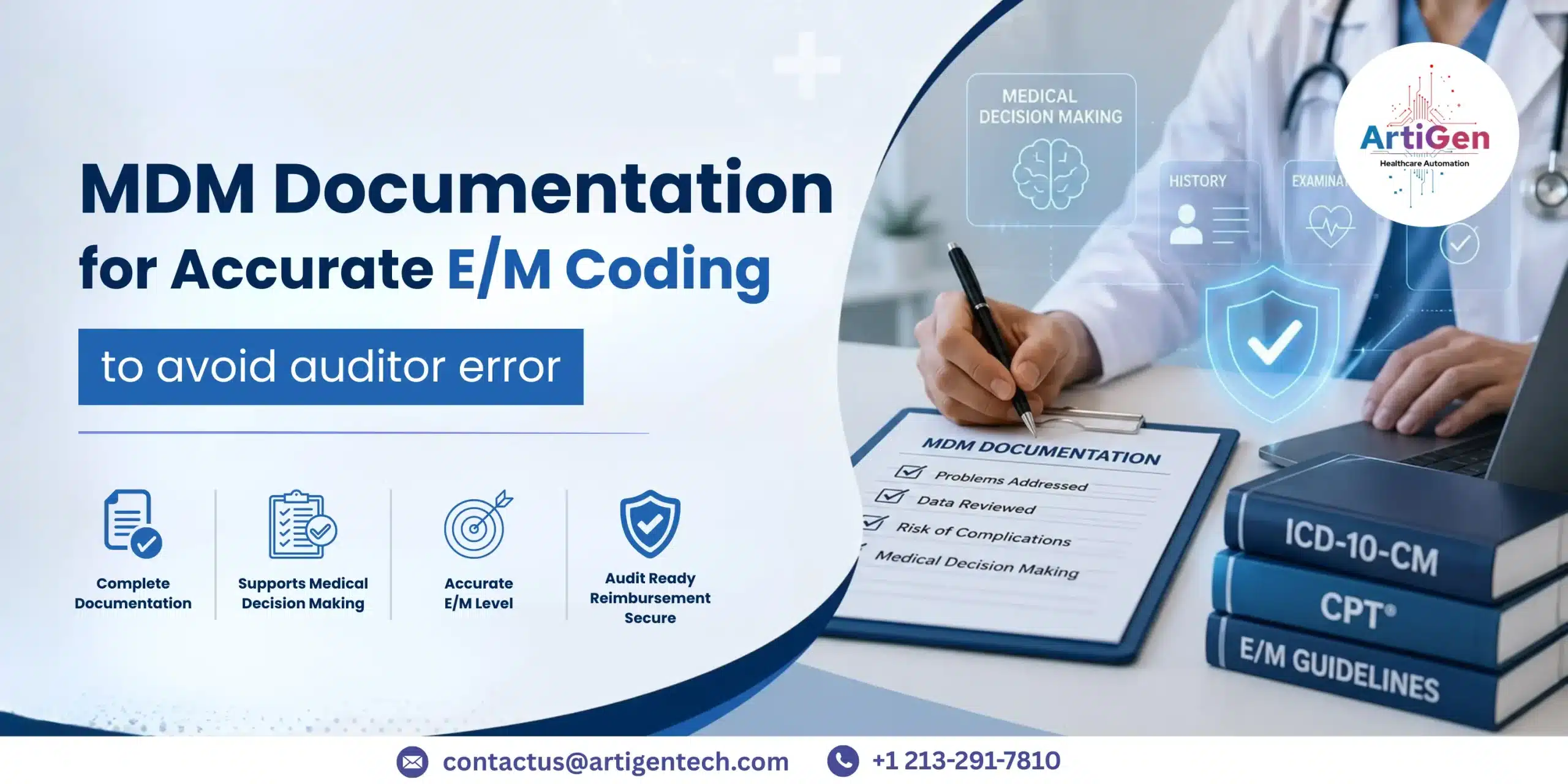
MDM vs. Symptom Isolation: Why Auditors Reject the Symptom Checklist
In the era of modern Evaluation and Management Coding (E/M Coding), a dangerous documentation habit has emerged in clinics nationwide: Symptom Isolation. Following E/M coding guidelines, providers must ensure that every encounter supports accurate Medical Decision Making Documentation rather than relying solely on symptom lists.
Many providers mistakenly believe that listing a high volume of severe, patient-reported symptoms automatically elevates the complexity of the encounter. However, Medical Coding Audit teams and medical auditors are actively cracking down on this practice. An isolated list of complaints does not equal high-level clinical work or meet E/M documentation requirements.
To survive a medical coding audit, documentation must shift from a mere history-gathering exercise to a holistic evaluation of all Medical Decision Making (MDM) elements. Strong Medical Decision Making Documentation not only supports compliant Evaluation and Management Coding but also protects your clinic’s revenue and strengthens medical coding compliance.
The Core Problem: Why “Symptom Isolation” Fails an Audit
Symptom isolation occurs when a note features a highly detailed Chief Complaint (CC) and History of Present Illness (HPI)—such as severe chest pain, radiating numbness, or profound dizziness—but the assessment and plan fail to show corresponding clinical analysis.
Auditors reject these notes for Level 4 or Level 5 billing due to two structural flaws that directly affect Medical Decision Making, MDM coding, and Medical Necessity Documentation.
1. Symptoms Merge into the Final Diagnosis
Per CPT E/M guidelines, signs and symptoms that are functional attributes of a defined, established diagnosis are not counted as separate, multiple problems.
If a patient presents with an acute ankle sprain accompanied by severe swelling, localized bruising, and an inability to bear weight, an auditor will not count these as four distinct problems. They are consolidated into a single, acute, uncomplicated injury (Low Complexity, Level 3).
Proper Medical Coding Documentation requires providers to document the actual condition addressed rather than relying on a lengthy symptom checklist.
2. The “Risk” Must Match the “Problem”
Listing a potentially high-risk symptom (e.g., chest pain) does not secure a high-level code if the provider’s final clinical impression determines the problem is minor (e.g., mild gastroesophageal reflux) and prescribes a low-risk treatment.
The overall Medical Decision Making (MDM) score is driven by the nature of the problem addressed, not the terrifying nature of what the symptom might have been before the evaluation took place.
Accurate Medical Necessity Documentation and complete medical decision making documentation are essential to justify higher-level E/M Coding services.
The Holistic MDM Approach: Meeting the 2-out-of-3 Rule
Auditors do not look at symptoms in a vacuum; they look for a clear, documented relationship between the three pillars of Medical Decision Making: Number/Complexity of Problems, Data Reviewed, and Risk of Management.
To support a higher-level code (like Level 4 or 5), the provider must show a cohesive clinical narrative where at least two of these elements align at that high threshold.
This holistic approach is the foundation of MDM Medical Coding, modern Evaluation and Management Coding, and current Medical Decision Making Guidelines.
MDM Element | What the Auditor Looks For | Evidence of Holistic Care |
Problem Complexity | Not just the symptoms, but the status of the condition (e.g., acute with systemic symptoms, or an undiagnosed new problem with an uncertain prognosis). | The provider explicitly documents the differential diagnoses they are ruling out to manage the clinical uncertainty. |
Data Reviewed | Active processing of objective information to evaluate those symptoms. | Documenting the independent interpretation of an imaging study or discussing the complex presentation with an external specialist. |
Risk of Management | The inherent risk of the treatment or diagnostic path chosen to address the symptoms. | Documenting prescription drug management decisions or evaluating a patient for minor surgery with identified risk factors. |
Proper E/M Documentation, adherence to Medical Decision Making Guidelines, and complete Medical Coding Documentation are what transform a symptom-focused note into one that successfully passes a Medical Coding Audit.
Case Study: The Wrong Way vs. The Right Way
Consider how the exact same patient encounter can fail or pass a Medical Coding Audit based entirely on holistic documentation versus symptom isolation.
Following Evaluation and Management Coding principles and proper Medical Decision Making Documentation is what separates an audit failure from a compliant claim.
The Symptom Isolation Approach (Audit Failure / Down coded to Level 3)
HPI:
Patient presents with severe, unrelenting right ankle pain, extreme localized swelling, and severe bruising following a twisting injury. Patient states they are entirely unable to bear weight and experience throbbing pain (8/10).
Assessment/Plan:
Right ankle sprain. Gave patient an ankle brace. Told to rest and elevate. Ordered an ankle X-ray.
Why it fails:
The provider listed multiple severe symptoms but treated the condition as a standard, uncomplicated ankle injury. Ordering a single X-ray results in Straightforward/Low Data.
The overall Medical Decision Making (MDM) defaults to Low Complexity (Level 3) despite the dramatic symptoms. This documentation does not satisfy E/M documentation requirements or demonstrate sufficient Medical Necessity Documentation to support a higher-level service.
The Holistic MDM Approach (Audit Validated / Secured Level 4)
HPI:
Patient presents with right ankle pain and an inability to bear weight following a high-velocity twisting injury.
Assessment/Plan:
Acute right ankle injury with uncertain prognosis. Differentials include a high-grade syndesmotic (high ankle) ligament tear versus an occult, non-displaced fracture given the severe joint instability.
Data:
Personally reviewed and independently interpreted the 3-view right ankle X-ray films in real-time, confirming no cortical fracture but noting widened joint space.
Risk:
Initiated prescription-strength NSAID management for severe inflammation and scheduled an urgent MRI to rule out a surgical ligamentous rupture.
Why it passes:
The provider documented an undiagnosed problem with an uncertain prognosis (Moderate Problem), performed an independent interpretation of an image (Moderate Data), and initiated prescription drug management (Moderate Risk).
All three categories holistically support a Moderate Complexity (Level 4) service. This approach aligns with Medical Decision Making Guidelines, supports MDM Medical Coding, and follows current CPT E/M guidelines.
Editorial Takeaway for Billers and Coders
To ensure your clinic’s Medical Coding Documentation stands up to rigorous payer scrutiny and every medical coding audit, focus on complete Medical Decision Making Documentation rather than symptom volume alone.
• Educate Providers
Teach clinicians that “more words in the HPI” does not equal a higher code. They must document their mental processing in the Assessment and Plan. Strong Evaluation and Management Coding depends on documented clinical reasoning—not lengthy symptom lists.
• Look for the “Why”
When auditing a note internally, ensure that if a severe symptom is listed, the note clearly details the diagnostic or therapeutic actions taken to address that specific threat. This strengthens Medical Necessity Documentation and supports compliant E/M Coding.
• Audit for Alignment
If the data and risk sections of a note look sparse, the code must be selected based on that lower reality, regardless of how complex the patient’s complaints originally sounded.
Consistent internal Medical Coding Audit reviews improve medical coding compliance and ensure documentation accurately reflects the provider’s medical decision making (MDM).
The EHR Trap: How Templates Inadvertently Fuel “Symptom Isolation”
The “Click-Happy” HPI
Most EHRs utilize point-and-click macro templates for the History of Present Illness (HPI) and Review of Systems (ROS). With three or four clicks, a provider can automatically generate a massive, highly detailed narrative of patient symptoms: “Patient reports severe pain, swelling, localized bruising, radiating numbness, throbbing, and severe stiffness.”
Because the system makes it effortless to build an imposing list of complaints, providers frequently experience a false sense of security. They assume that a lengthy, complex-looking note naturally justifies a Level 4 or Level 5 code.
The Assessment & Plan (A&P) Disconnect
The structural flaw of the EHR is that while the HPI is heavily automated, the Assessment & Plan section typically requires manual data entry or free text. This creates a severe drop-off in Medical Decision Making Documentation and overall Medical Coding Documentation quality.
When a provider is rushing, they click through a dramatic symptom checklist in the HPI, but then drop down a generic, single-sentence diagnosis in the A&P (e.g., “Ankle sprain. RICE protocol.”).
This weakens medical decision making documentation, making it difficult to justify higher levels of Evaluation and Management Coding.
Auditors refer to this as a “top-heavy” note. Because the 2021/2023 E/M coding guidelines stripped out the structural history requirements (HPI/ROS elements) as billing determinants, an exhaustive EHR symptom list carries zero weight in code selection.
If the provider’s cognitive processing isn’t mirrored in the A&P, the automation of the EHR effectively sets the clinic up for an immediate downcode.
Strong E/M Documentation, Medical Necessity Documentation, and MDM Medical Coding practices are essential to support compliant Evaluation and Management Coding.
Provider Checklist: Transitioning from Symptoms to Strategy
Distribute this quick-reference checklist to your providers to help them align their documentation with holistic medical decision making (MDM) principles and strengthen medical coding documentation.
1. Reframe the Diagnosis (Problem Complexity)
- Avoid the “Symptom Dump”: Did you group functional symptoms (swelling, pain, and bruising) under the umbrella of the main diagnosis rather than listing them as separate, active problems? This supports accurate MDM coding and improves overall Medical Coding Documentation.
- Document Clinical Uncertainty: If the final diagnosis is not yet clear, did you explicitly state the differential diagnoses or complications you are trying to rule out? (e.g., “Evaluating for high-grade ligamentous tear vs. occult fracture given joint instability” converts a low-level sprain into an uncertain prognosis.) This aligns with Medical Decision Making Guidelines and strengthens Medical Decision Making Documentation.
2. Capture Cognitive Work (Data Reviewed)
- Go Beyond “Review”: If you looked at an imaging study or lab report, did you document a brief summary of the findings rather than just writing “Reviewed MRI” or “X-ray negative”? This is a critical component of E/M Documentation and supports compliant Evaluation and Management Coding.
- Note Independent Interpretations: If you logged into the image viewer to look at the actual films/scans yourself, did you explicitly write:
“Personally reviewed and independently interpreted the images, noting…”?
This level of detail strengthens Medical Decision Making Documentation and supports MDM Medical Coding.
- Log External Conversations: If you spoke with a radiologist, physical therapist, or orthopedic specialist about this patient, did you document that specific discussion? Proper documentation improves medical coding compliance and supports Medical Decision Making during a Medical Coding Audit.
3. Clear up the Treatment Risk (Risk of Management)
- Link the Medication: If you are modifying, renewing, or starting a prescription medication (or deciding not to prescribe based on risk), is that clinical thought process documented? This reinforces Medical Necessity Documentation, supports MDM coding, and satisfies CPT E/M guidelines.
- Detail the Surgical Decision: If an injection or minor procedure is discussed, did you note the specific risks or patient-specific factors considered when making that choice? Clear documentation improves E/M documentation requirements, strengthens medical coding documentation, and helps ensure medical coding compliance during payer reviews and every medical coding audit.