The Impact of MRI Complexity on Coding and Reimbursement
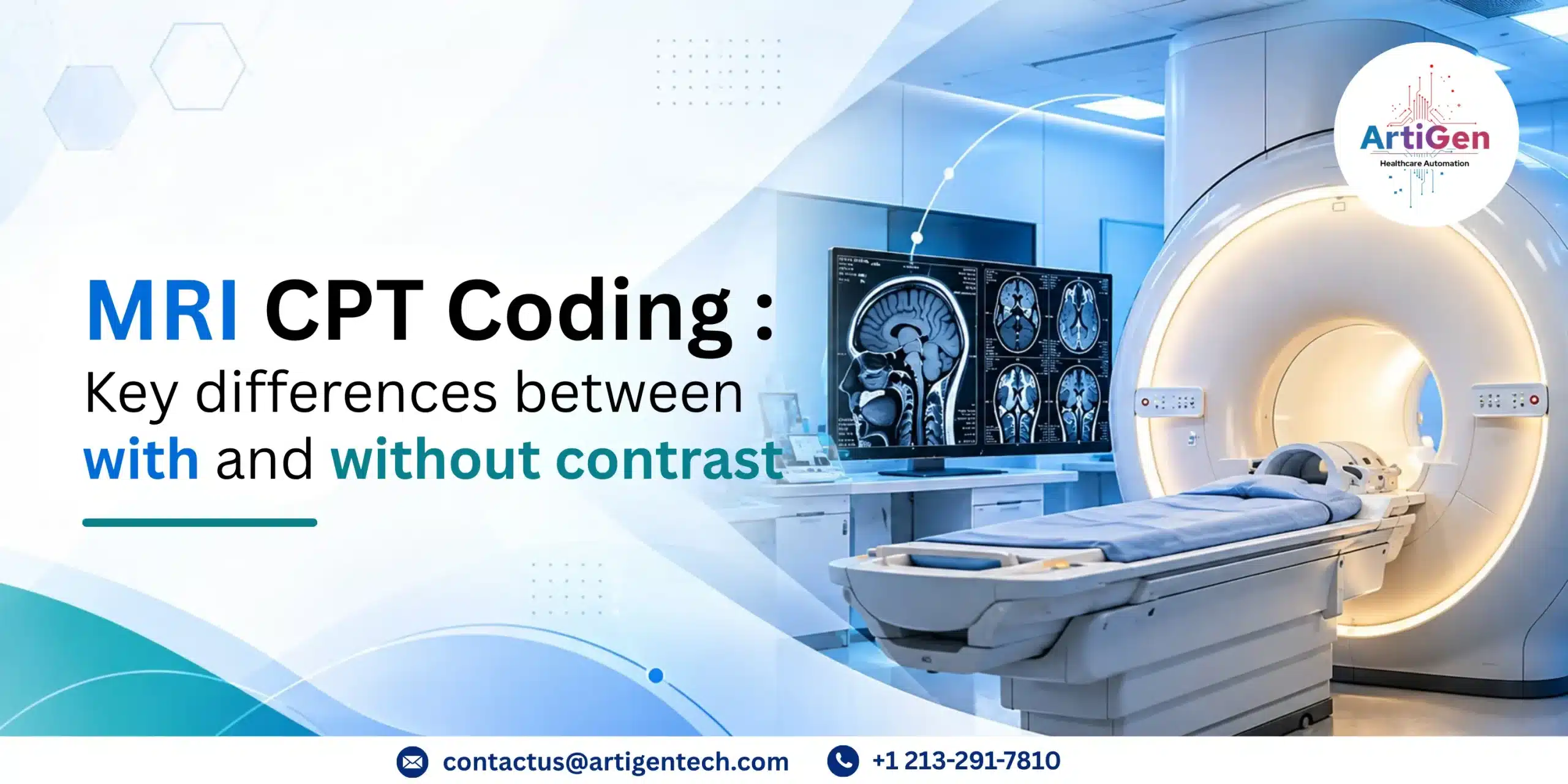
Magnetic resonance imaging (MRI) is widely used in diagnostic radiology to evaluate the brain, spine, joints, abdomen, pelvis, and other areas of the body. From a coding perspective, one of the most important distinctions is whether an exam is done as an MRI without contrast, an MRI with contrast or an MRI with and without contrast.
This distinction has a direct impact on MRI CPT Codes, MRI procedure codes, medical necessity, documentation, billing and reimbursement. It takes more than just identifying the body part examined for radiology teams to be able to accurately code diagnostic radiology. Before choosing the accurate radiology CPT codes, coders should compare the documented procedure to the administration, clinical indication, diagnosis, authorization, and payer-specific requirements.
MRI With Contrast vs. MRI without Contrast
MRI without contrast is done without the use of a contrast material. For some clinical indications, non-contrast imaging may provide enough information to evaluate anatomy, structural abnormalities, injuries, or other conditions.
An MRI with contrast involves an injection of contrast material to enhance the visibility of specific tissues, lesions, blood vessels, or regions with abnormal enhancement. The need for contrast depends on the clinical state of the patient and the imaging protocol.
An MRI with and without contrast examination includes imaging performed before and after contrast administration. Pre-contrast images provide baseline information, while post-contrast images help evaluate enhancement patterns and additional diagnostic findings.
These are important differences when applying MRI coding guidelines, MRI billing guidelines, and MRI contrast coding guidelines. The use of an MRI with and without contrast for an MRI is incorrectly billed as two services, which can lead to incorrect MRI CPT Codes, coding edits or claim problems.
Understanding Brain MRI CPT Codes
The brain MRI family provides a straightforward example of how contrast affects coding.
| Examination | CPT Code |
| Brain MRI without contrast | 70551 |
| Brain MRI with contrast | 70552 |
| Brain MRI without contrast followed by with contrast | 70553 |
A brain MRI without contrast CPT code of 70551 represents an MRI of the brain without contrast. A brain MRI with contrast CPT code of 70552 represents an examination performed with contrast. A brain MRI with and without contrast CPT code of 70553 represents an examination performed without contrast followed by contrast material administration and additional imaging.
The difference between these MRI procedure codes is important, and coders should report the evaluation that was actually performed. The CMS list these brain MRIs as 70551, 70552 and 70553.
A common MRI coding error is assuming that 70551 and 70552 should simply be reported together whenever both non-contrast and contrast-enhanced images are obtained. When the documented examination meets the description of 70553, the appropriate code should be considered rather than automatically reporting separate codes.
What Documentation Should Coders Review?
Accurate MRI coding documentation is important when selecting MRI CPT Codes. There should be enough information in the medical record to identify the examination performed and to substantiate the diagnosis and medical necessity associated with the examination.
For an MRI examination, coders should review:
- Anatomical region and laterality examined
- Physician’s order vs actual procedure performed
- Clinical indication or reason for the study
- Whether the examination was performed without contrast
- Whether contrast was administered
- Pre-contrast and post-contrast imaging, when applicable
- Contrast-related documentation
- Final radiology report
- Medical necessity – Diagnosis supporting the examination
- Authorization information, when required
Documentation should support both parts of the screening for an MRI with and without contrast. If contrast was ordered but not given, coders should not automatically assign an MRI with contrast CPT code or an MRI with and without contrast CPT code.
This is the intersection of MRI coding documentation, MRI diagnosis coding and MRI medical necessity coding. The procedure CPT code should match the service performed NOT service ordered by the physician and the diagnosis should correspond to the documented clinical reason for the examination.
MRI Medical Necessity and ICD-10 Coding
An essential component of coding and billing process is MRI medical necessity. Even if the CPT code is technically accurate, the documentation or diagnosis might not support the need for the screening, and that can lead to a denial.
Accurate ICD-10-CM coding for MRI should be based on the condition, symptom, sign or other diagnosis documented by the appropriate provider. A diagnosis should not be chosen simply because it is commonly associated with a specific MRI procedure.
For example, when reviewing a brain MRI, the brain MRI CPT code identifies the imaging service, and the ICD-10-CM diagnosis explains the clinical reason for the service. This relationship is significant for MRI medical necessity coding, payer review and MRI reimbursement.
Accurate MRI diagnosis coding can assist in providing evidence for the connection between clinical conditions of the patient with the imaging service. In contrast, a lack of documentation and incomplete diagnosis information can result in MRI claim denials.
MRI Modifiers and Component Billing
Modifiers can also affect how radiology CPT codes are reported. The appropriate modifier depends on the circumstances of the service, how the imaging was performed, and how the claim is being submitted.
Modifier 26 identifies the professional component of an applicable diagnostic service. For MRI, this generally relates to the radiologist’s professional interpretation when the professional component is separately reported.
Modifier TC identifies the technical component, which generally represents the technical performance and resources associated with the imaging service.
Modifier 50 for bilateral procedure, when a same procedure is performed on both sides (Right & Left) of the anatomical site
Modifier RT to indicate left anatomical site (Right hand/Right shoulder)
Modifier LT to indicate right anatomical site (Left knee/Left foot)
Modifier 52 for reduced services when an examination is started but not fully completed.
Modifier 53 Discontinued procedure, applicable when the physician discontinues a procedure under the relevant reporting criteria
Modifier 59 may identify a distinct procedural service in circumstances where separate reporting is supported.
Modifier 76 identifies a repeat procedure by the same physician or other qualified healthcare professional when applicable.
When applicable, these modifiers help distinguish professional and technical services. Coders should verify whether the payer requires professional, technical, or global reporting rather than automatically appending a modifier.
These modifiers should not be used simply to bypass an edit or obtain payment. Proper MRI billing compliance requires the documentation to support the modifier and the circumstances of the service.
Common MRI Coding and Billing Errors
When documentation and coding are not properly aligned, a number of MRI coding errors can happen.
Common issues include selecting the wrong brain MRI CPT code, confusing MRI with contrast with MRI with and without contrast, reporting an MRI without contrast code when contrast-enhanced imaging was performed, and selecting a diagnosis that does not support MRI medical necessity.
Other issues include:
- Incorrect MRI contrast CPT codes
- Incomplete MRI coding documentation
- Diagnosis and procedure mismatch
- Authorization and procedure mismatch
- Incorrect modifier application
- Insufficient medical necessity documentation
- Incorrect reporting of separate MRI services
- Failure to verify payer-specific MRI billing guidelines
These issues can increase the likelihood of MRI claim denials and delay MRI reimbursement.
For example, if an exam was authorized as an MRI without contrast and the final service was with contrast, the coding and authorization information may need to be reviewed further. Similarly, documentation does not support the medical necessity of the clinical indication, the claim may be denied.
MRI Billing Guidelines and Reimbursement
Effective MRI billing guidelines include multiple elements of the MRI procedure performed, MRI CPT codes, diagnosis, medical necessity, documentation, modifiers, authorization, and payer requirements.
Accurate MRI coding guidelines assist coders to consistently distinguish between MRI with contrast, MRI without contrast, and MRI with and without contrast. The correct application of these rules helps to support MRI billing compliance and can reduce preventable coding issues.
Correct claims submission is also a necessary requirement for MRI reimbursement. Complete documentation or an unsupported diagnosis can impact payment even when the correct MRI is performed.
Therefore, it is recommended that radiology organizations approach MRI billing as a comprehensive process rather than a step in coding.
How ArtigenTech supports MRI Coding Automation in Radiology
MRI coding automation can assist organizations in more effectively managing repetitive coding and documentation workflows as radiology volumes rise.
AI-assisted workflows may help identify relevant procedure details, review documentation and flag potential inconsistencies for coder review. Automation cannot replace professional coding judgement, particularly for complex cases, payer-specific rules and medical necessity determinations.
ArtigenTech’s RadioNEX AI supports radiology coding workflows by helping teams to streamline repetitive processes across imaging documentation and coding operations. Automation can assist high-volume diagnostic radiology coding teams to be more efficient while still maintaining human supervision.
When MRI coding automation is part of a broader radiology workflow, it can help organizations move towards reducing repetitive MRI coding errors, improving documentation consistency and helping achieve more efficient claim preparation.
Conclusion
Understanding the difference between MRI with contrast, MRI without contrast, and MRI with and without contrast is essential for accurate radiology billing and coding. The correct MRI CPT codes should reflect the examination actually performed, while MRI diagnosis coding, ICD-10-CM information, medical necessity, documentation, and modifiers should support the claim.
For brain MRI, 70551, 70552, and 70553 provide key examples of how contrast affects CPT selection. Proper application of MRI coding guidelines, MRI billing guidelines, and MRI contrast coding guidelines can help reduce MRI coding errors, strengthen MRI billing compliance, and support appropriate MRI reimbursement.
As radiology organizations increasingly adopt automation, MRI coding automation can provide additional workflow support. Solutions such as RadioNEX AI from ArtigenTech can help radiology teams streamline coding-related workflows while keeping professional coding review and compliance at the center of the process.
Frequently Asked Questions
1. What is the CPT code for a brain MRI without contrast?
The brain MRI without contrast CPT code is 70551.
2. What is the CPT code for a brain MRI with contrast?
The brain MRI with contrast CPT code is 70552.
3. What is the CPT code for a brain MRI with and without contrast?
The brain MRI with and without contrast CPT code is 70553.
4. Can 70551 and 70552 be reported together?
When the documented examination meets the description of 70553, coders should not automatically report 70551 and 70552 separately. The complete documentation and applicable coding and payer rules should be reviewed.
5. Why is MRI medical necessity important?
MRI medical necessity establishes why the imaging examination was clinically required. Appropriate MRI medical necessity coding, diagnosis coding, and supporting documentation can help reduce avoidable claim denials.
6. How can MRI coding automation help?
MRI coding automation can support repetitive documentation and coding workflows, helping radiology teams identify relevant coding information and potential inconsistencies while allowing professional coders to perform final validation.