GERD ICD-10-CM Code K21.9: Documentation and Coding Guide
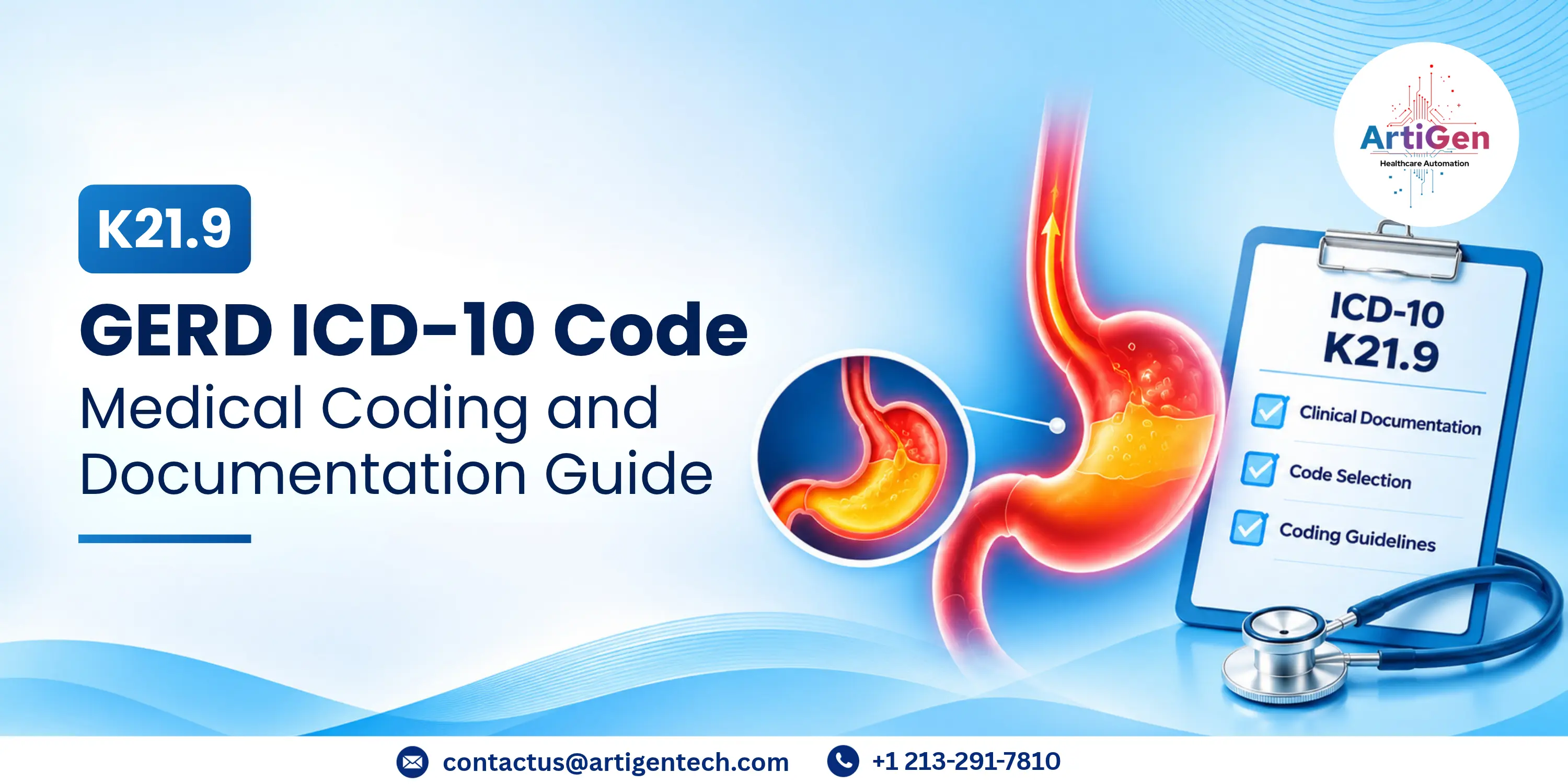
Gastroesophageal Reflux Disease (GERD) is a chronic digestive disorder or condition characterized by the repeated backward flow of stomach contents, including acid and non-acidic gastric fluids, into the esophagus (the muscular tube connecting the mouth to the stomach).
GERD occurs when the lower esophageal sphincter (LES), a ring of muscle between the esophagus and stomach, becomes weakened or fails to close properly. This allows stomach contents to flow back into the esophagus, potentially causing irritation, inflammation, heartburn, and discomfort.
The GERD ICD-10-CM code depends on the provider’s documented diagnosis and whether esophagitis or bleeding is present. For gastroesophageal reflux disease without esophagitis, the applicable ICD-10-CM code is K21.9. When GERD is documented with esophagitis, K21.00 or K21.01 may apply depending on whether bleeding is documented.
Accurate GERD coding supports proper clinical documentation, claims processing, reimbursement, compliance, and revenue cycle management. Coders should review the complete medical record instead of assigning a code based only on symptoms such as heartburn or acid reflux.
GERD ICD-10-CM Codes
ICD-10-CM Code | Description |
K21.9 | Gastro-esophageal reflux disease without esophagitis |
K21.00 | Gastro-esophageal reflux disease with esophagitis, without bleeding |
K21.01 | Gastro-esophageal reflux disease with esophagitis, with bleeding |
The ICD-10-CM code K21.9 is used when the provider documents GERD without esophagitis. The K21.9 diagnosis code should be supported by the provider’s clinical assessment, medical history, symptom evaluation and additional diagnostic investigations when necessary. It should not be assigned solely from medication use or patient-reported symptoms.
What Is the GERD ICD-10-CM Code K21.9?
The GERD diagnosis medical code K21.9 represents gastro-esophageal reflux disease without esophagitis.
The gastroesophageal reflux disease ICD-10-CM category is frequently searched by coders from medical record of services rendered by providers looking for the appropriate GERD code. When the provider documents GERD without esophagitis, the ICD-10-CM code for gastroesophageal reflux disease without esophagitis is K21.9.
The ICD-10-CM code for gastroesophageal reflux may also be K21.9 when the provider confirms GERD and does not document esophagitis.
GERD without Esophagitis ICD-10-CM
The ICD-10-CM for GERD without esophagitis is:
K21.9 — Gastro-esophageal reflux disease without esophagitis
The term GERD unspecified ICD-10-CM is commonly used in searches for this code.
Similar terms to indicate K21.9 are as follows :
- Laryngitis due to gastroesophageal reflux
- Laryngopharyngeal reflux
- Reflux laryngitis
- Acid / Gastric reflux
- Esophageal reflux without esophagitis
However, coders should review the provider’s actual diagnosis instead of relying on search terminology. K21.9 specifically represents GERD without esophagitis.
Acid Reflux ICD-10–CM
The acid reflux ICD-10-CM search is common because patients and providers may use “acid reflux” and “GERD” interchangeably in everyday communication.
However, coders should determine whether the provider has documented a confirmed diagnosis.
If the provider documents GERD without esophagitis, K21.9 may be appropriate. If the record only documents acid reflux as a symptom, the ICD-10-CM code acid reflux should be determined from the provider’s documented diagnosis and applicable coding guidance.
The acid reflux dx code should therefore not be selected solely from the patient’s reported symptoms.
Likewise, the dx code for acid reflux depends on whether the provider documents acid reflux as a diagnosis, symptom, or part of another gastrointestinal condition.
GERD vs. Heartburn ICD-10–CM
Heartburn and GERD are related but should not automatically be coded as the same condition.
The heartburn ICD-10-CM search generally relates to the symptom of burning discomfort associated with reflux. The ICD-10-CM for heartburn depends on how the provider documents the condition.
For example:
Documentation: “Patient reports frequent heartburn.”
This does not automatically establish GERD.
Documentation: “GERD without esophagitis. Patient reports recurrent heartburn.”
This supports the GERD diagnosis code K21.9 when consistent with coding guidelines.
Coders should therefore distinguish symptoms from confirmed diagnoses.
GERD with Esophagitis ICD-10-CM
The coding approach changes when esophagitis is documented.
The GERD with esophagitis ICD-10-CM category includes:
- K21.00 — Gastro-esophageal reflux disease with esophagitis, without bleeding
- K21.01 — Gastro-esophageal reflux disease with esophagitis, with bleeding
Therefore, the ICD-10-CM GERD with esophagitis selection depends on the provider’s documentation and whether bleeding is present.
K21.9 should not be used when the provider clearly documents GERD with esophagitis.
The term reflux esophagitis ICD-10-CM is also commonly searched when researching GERD-related coding. Coders should review the complete provider documentation and applicable ICD-10-CM classification before selecting the final code.
GERD with Gastritis ICD-10-CM Code
The search phrase GERD with gastritis ICD-10-CM code can cause confusion because GERD and gastritis are separate conditions.
When both are documented, the coder should review the record and determine the appropriate code for each condition – K29.70 (Gastritis) and K21.9 (GERD). There is no single combination code that should automatically be assigned simply because GERD and gastritis appear together, they can be coded separately.
For example, if the provider documents “GERD without esophagitis and gastritis,” K21.9 may represent the GERD component, while the applicable gastritis code should be evaluated separately.
Pregnancy Complicated by GERD ICD-10-CM Code
The pregnancy complicated by GERD ICD-10-CM code requires additional review because pregnancy-related coding follows specific ICD-10-CM guidelines.
Coders should determine whether the provider establishes GERD as a condition complicating pregnancy and then apply the appropriate pregnancy-related and GERD codes based on the documentation and sequencing requirements.
K21.9 should not automatically be assigned as the only code simply because GERD is documented during pregnancy.
For GERD complicating pregnancy, the appropriate coding sequence is: O99.611, K21.9
O99.611 – Diseases of the digestive system complicating pregnancy, unspecified trimester
K21.9 – Gastro-esophageal reflux disease without esophagitis
GERD Documentation Requirements
Accurate GERD coding depends on clear clinical documentation.
Important documentation may include:
- Confirmed GERD diagnosis
- Presence or absence of esophagitis
- Presence or absence of bleeding
- Relevant diagnostic findings
- Endoscopy findings
- Symptoms
- Treatment or medication management
- Associated gastrointestinal conditions
For example:
“GERD without esophagitis, controlled with medication.”
This documentation supports the K21.9 diagnosis code when applicable.
Documentation such as “reflux” or “heartburn” alone may require additional review before selecting a dx code GERD.
Common GERD Coding Errors
Common errors include:
- Assigning K21.9 when esophagitis is documented.
- Coding GERD from symptoms like heartburn, dysphagia or regurgitation.
- Using medication history as the only basis for diagnosis.
- Ignoring documented bleeding.
- Combining GERD and gastritis without reviewing each diagnosis.
- Failing to review pregnancy-related coding requirements.
- Using outdated ICD-10-CM information.
Using a structured review process can improve accurate GERD coding and reduce inconsistencies between clinical documentation and submitted claims.
GERD Coding Example
Provider documentation:
“GERD without esophagitis. Patient reports acid reflux and heartburn. Continue current medication.”
Code:
K21.9 — Gastro-esophageal reflux disease without esophagitis
Here, the provider has established GERD and has not documented esophagitis. The symptoms provide clinical context but do not change the primary GERD code.
If the provider documents GERD with esophagitis, the coder should evaluate K21.00 or K21.01 instead.
Technology and GERD Coding
Technology-supported coding workflows can help identify GERD-related terms across clinical documentation, including:
- GERD
- Acid reflux
- Heartburn
- Dysphagia
- Regurgitation
- Esophagitis
- Reflux esophagitis
- Gastritis
- Bleeding
- Pregnancy-related documentation
Automated review can flag cases where the documentation and selected GERD ICD-10-CM code may require additional review.
For healthcare organizations handling large coding volumes, technology can support coding consistency while qualified professionals make the final coding decision.
Frequently Asked Questions
1. What is the GERD ICD-10-CM code?
The GERD ICD-10-CM code for GERD without esophagitis is K21.9.
2. What is the ICD-10-CM code for GERD unspecified?
The ICD-10code for GERD unspecified is commonly searched as K21.9. Its official description is gastro-esophageal reflux disease without esophagitis.
3. What is the ICD-10-CM code for gastroesophageal reflux disease without esophagitis?
The ICD-10-CM code for gastroesophageal reflux disease without esophagitis is K21.9.
4. What is the ICD-10-CM for GERD without esophagitis?
The ICD-10-CM for GERD without esophagitis is K21.9.
5. What is the acid reflux dx code?
The acid reflux dx code depends on the provider’s documentation. Confirmed GERD without esophagitis may be coded K21.9.
6. What is the dx code for GERD?
The dx code for GERD depends on the documented condition. K21.9 applies to GERD without esophagitis.
7. What is the GERD with esophagitis ICD-10-CM code?
The GERD with esophagitis ICD-10-CM category includes K21.00 for esophagitis without bleeding and K21.01 for esophagitis with bleeding.
8. What is the ICD-10-CM for heartburn?
The ICD-10-CM for heartburn depends on whether the provider documents heartburn as a symptom or establishes a related diagnosis such as GERD.
Final Takeaway
The GERD ICD-10-CM code K21.9 is used for gastro-esophageal reflux disease without esophagitis. Accurate coding requires review of the provider’s diagnosis, esophagitis status, bleeding status, associated conditions, and applicable ICD-10-CM guidelines.
Understanding the difference between acid reflux ICD-10-CM, heartburn ICD-10-CM, GERD without esophagitis, and GERD with esophagitis ICD-10-CM helps coding teams select codes that accurately represent the documented condition.
ArtigenTech supports healthcare organizations with technology-enabled medical coding workflows that help manage documentation-driven coding requirements and improve coding consistency.