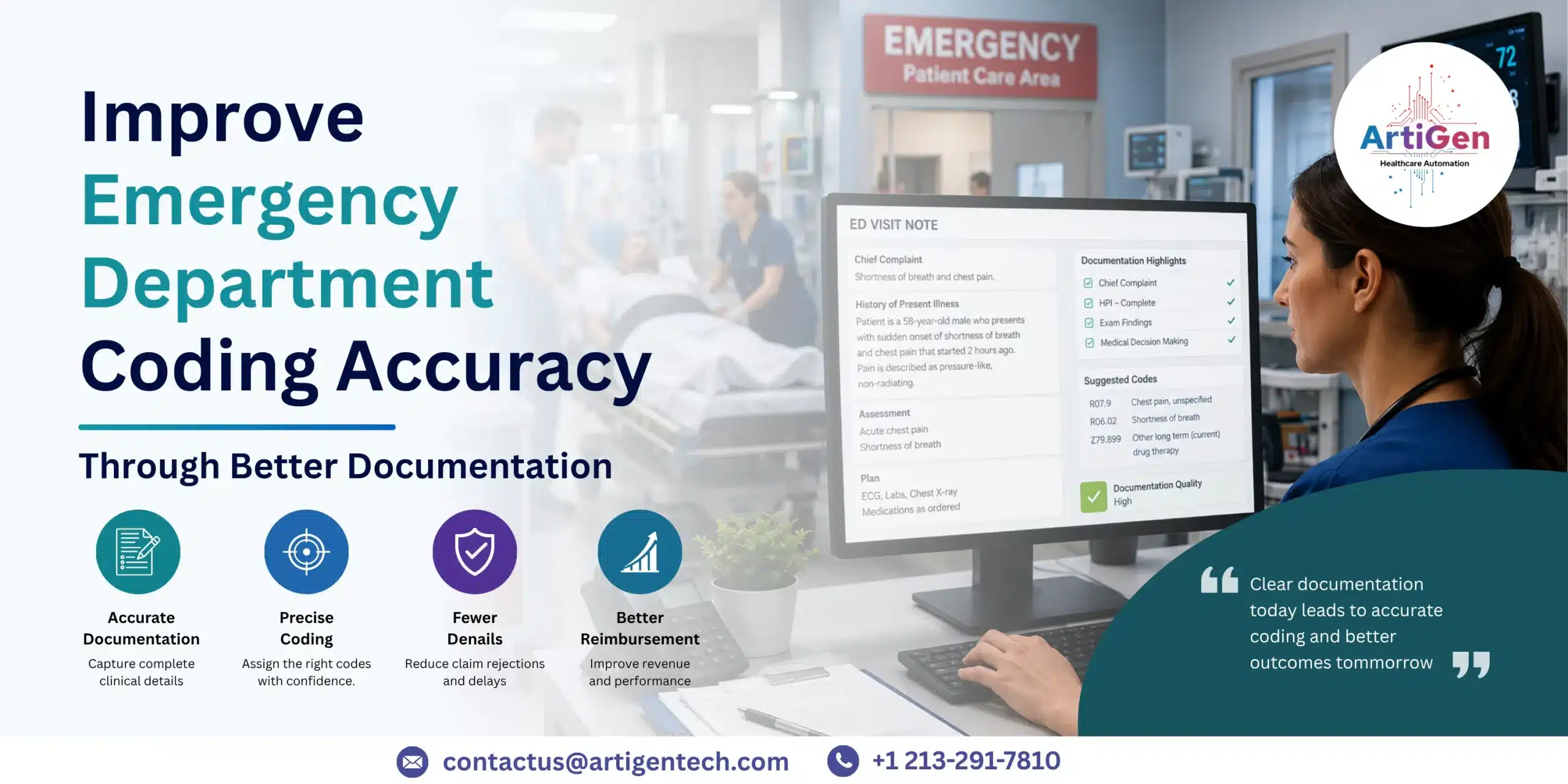
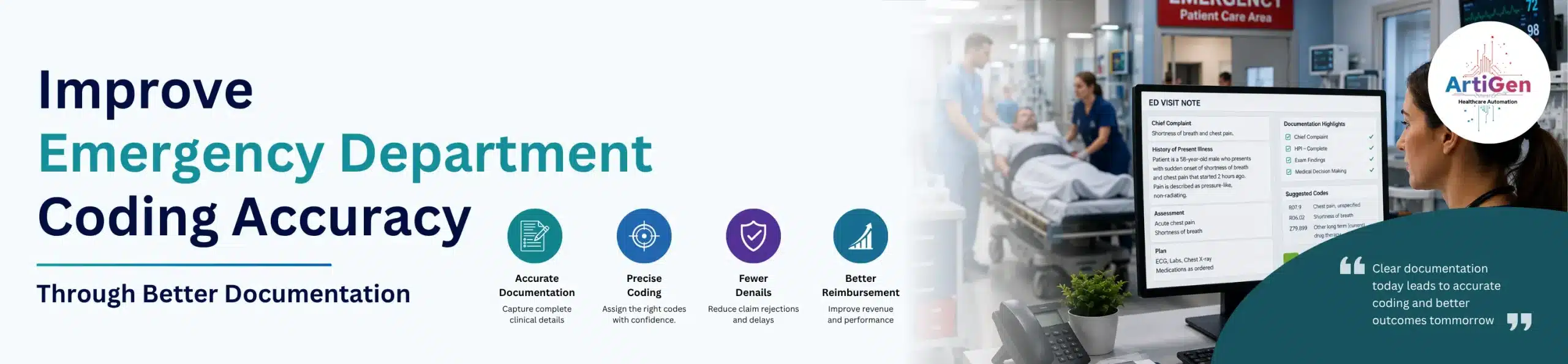
Observation vs Emergency Visit Coding: Why Documentation Matters
Observation vs Emergency Visit Coding
Observation services and emergency department visits are both types of outpatient encounters but serve different clinical and reimbursement purposes. Accurate documentation dictates whether a patient is eligible for observation care, emergency services, or Critical Care Coding. Proper documentation is essential to compliant emergency department billing and coding, reimbursement accuracy, and revenue cycle performance.
With healthcare organizations dealing with more complex documentation, accurate emergency room medical coding is now more important than ever. At ArtigenTech we help healthcare providers improve their coding accuracy and operational efficiency with AI-powered clinical intelligence and medical coding automation.
Why Observation vs Emergency Visit Coding Matters
One of the most common challenges in emergency department coding is differentiating between emergency department services and observation care. Although both services may occur at the same patient encounter, they have different coding, billing, and documentation requirements.
Improper classification can lead to:
- Claim denials
- Revenue leakage
- Compliance risks
- Audit findings
- Incorrect reimbursement
- Documentation deficiencies
Effective emergency department billing requires a coder knowledge of patient acuity, physician documentation, observation orders, medical necessity, and payer-specific regulations.
Understanding the Types of Emergency Department Encounters
Different types of emergency department visits have different coding complexity and reimbursement.
Common types of emergency department services include:
- Low-acuity emergency visits
- Moderate-complexity emergency visits
- High-acuity emergency visits
- Trauma encounters
- Observation services
- Urgent emergency care
- Surgical emergencies
- Critical care coding encounters
Understanding the different types of emergency department services provides coders with a better understanding of appropriate coding pathways and reimbursement strategies.
Observation vs Emergency Visit: What’s the Difference?
Although both observation and emergency services are outpatient encounters, they have distinct clinical objectives.
Category | Emergency Visit | Observation Service |
Purpose | Immediate diagnosis and treatment | Short-term monitoring |
Status | Outpatient | Outpatient |
Coding | Emergency E/M services | Observation services |
Documentation | Emergency physician documentation | Observation orders and monitoring |
Reimbursement | Emergency department payment | Observation payment |
Clinical Goal | Acute intervention | Determine admission necessity |
Successful emergency department billing and coding depend on an understanding of these differences.
Emergency Department Coding Workflow
Successful emergency department medical coding is done through an organized workflow to ensure proper reimbursement and regulatory compliance.
Emergency Department Coding Workflow
Patient Arrival
↓
Emergency Physician Evaluation
↓
Clinical Documentation
↓
Diagnosis Assignment (ICD-10-CM)
↓
Procedure Assignment (CPT)
↓
Charge Capture
↓
Observation Review
↓
Critical Care Review
↓
Claim Submission
↓
Payment Reconciliation
This workflow helps healthcare organizations improve emergency room billing, coding quality, and revenue cycle performance.
CPT Code for Emergency Room Visit Selection
Selecting the right CPT code for an emergency room visit is one of the most critical tasks in emergency room medical coding.
Common emergency department cpt codes include:
CPT Code | Description |
99281 | Minor emergency visit |
99282 | Low severity emergency encounter |
99283 | Moderate severity emergency encounter |
99284 | High severity emergency encounter |
99285 | Severe emergency encounter |
The assignment of a cpt code emergency room visit is based on the severity of the patient’s condition, the physician work performed, diagnostic testing and documented medical necessity. One of the most critical elements in ensuring accurate emergency room medical coding and revenue cycle performance is selecting the appropriate cpt code for er visit.
The appropriate cpt code for er visit depends on:
- Medical decision-making complexity
- Patient severity
- Diagnostic testing performed
- Physician documentation
- Medical necessity
- Risk assessment
Accurate cpt code emergency room visit assignment results in compliant reimbursement and lowers denial rates.
CPT Code for Emergency Department Visit vs Observation Coding
One of the most common coding challenges is distinguishing observation services from the cpt code for emergency department visit.
Common emergency room cpt codes and ED cpt codes include:
- 99281
- 99282
- 99283
- 99284
- 99285
Observation coding requires separate physician documentation, observation orders, and medical necessity support. The right cpt code selection for emergency department visit has a huge impact on reimbursement and compliance outcomes.
Real-World Coding Example
Patient Scenario
A 65-year-old patient arrives at the emergency department with:
- Chest pain
- Shortness of breath
- Elevated blood pressure
- Cardiac history
The emergency physician performs:
- Comprehensive evaluation
- ECG testing
- Troponin testing
- Chest imaging
- Continuous monitoring
Because the patient’s condition remains uncertain, the physician places the patient in observation status for 18 hours.
Assigned Codes
Service | Code |
ICD-10-CM | R07.9 – Chest Pain |
CPT Code for Emergency Department Visit | 99284 |
ECG CPT | 93000 |
Revenue Code Emergency Room | 0450 |
Observation Service | Appropriate observation coding |
This example demonstrates how documentation has a direct impact on emergency department billing and coding, reimbursement, and compliance.
Why Documentation Matters in Emergency Department Coding
Accurate documentation supports proper assignment of emergency room cpt codes, validates the selected cpt code emergency room visit, and ensures that the correct emergency room code is reported for billing and reimbursement purposes.
Documentation serves as the foundation of successful emergency department coding and reimbursement.
Incomplete documentation often results in:
- Incorrect emergency room code assignment
- Claim denials
- Underbilling
- Overbilling
- Compliance issues
- Reduced reimbursement
Effective er coding requires documentation that clearly supports:
✓ Chief complaint
✓ History of present illness
✓ Medical necessity
✓ Diagnostic testing
✓ Physician decision-making
✓ Observation status
✓ Treatment plans
✓ Discharge instructions
Emergency department billing and coding accuracy are both improved through comprehensive documentation.
Critical Care Coding in Emergency Departments
Many emergency encounters require Critical Care Coding, especially when patients present with life-threatening conditions.
Common Critical Care Coding scenarios include:
- Septic shock
- Cardiac arrest
- Respiratory failure
- Stroke
- Major trauma
- Acute myocardial infarction
The most common Critical Care Coding CPT codes include:
CPT Code | Description |
99291 | First 30–74 minutes |
99292 | Additional 30-minute increments |
Accurate Critical Care Coding requires:
- Physician time documentation
- Medical necessity
- Continuous physician management
- Comprehensive clinical documentation
Emergency Medicine Coding Guidelines
Following established emergency medicine coding guidelines is critical for coding accuracy and compliance.
Key emergency medicine coding guidelines include:
- Code only documented services.
- Validate medical necessity.
- Distinguish observation from emergency services.
- Review critical care requirements.
- Verify diagnosis specificity.
- Capture all billable services.
- Support all procedures with documentation.
Implementing the emergency medicine coding guidelines can help organizations reduce audits and improve reimbursement performance.
Revenue Code Emergency Room Reporting
Hospitals also rely on revenue code emergency room classifications for facility billing.
Common revenue code emergency room classifications include:
Revenue Code | Description |
0450 | General Emergency Room |
0451 | EMTALA Screening |
0452 | Emergency Services Beyond Screening |
0456 | Urgent Care |
0459 | Other Emergency Services |
Accurate assignment of revenue code emergency room classifications allows for proper facility reimbursement and reporting.
Common Challenges in Emergency Medical Coding
Despite technological advancements, emergency medical coding remains highly complex.
Common challenges include:
Documentation Deficiencies
Missing physician documentation impacts coding accuracy.
Observation Status Errors
Improper classification affects reimbursement.
Complex Medical Decision-Making
Multiple diagnoses increase coding complexity.
Critical Care Documentation
Insufficient documentation affects Critical Care Coding.
High Patient Volumes
Large case volumes create operational challenges.
These challenges make accurate emergency room billing increasingly difficult using manual workflows alone.
How AI Improves Emergency Department Coding
AI-powered solutions can validate emergency CPT codes automatically, suggest relevant emergency room CPT codes, assist with accurate CPT code for ER visit assignment, and improve workflow efficiency across the emergency department in medical coding service.
Artificial intelligence is revolutionizing emergency department coding by increasing efficiency, improving documentation quality, and enhancing coding accuracy.
AI-powered solutions can:
- Analyze physician documentation
- Recommend emergency cpt codes
- Validate ED cpt codes
- Support Critical Care Coding
- Detect documentation gaps
- Improve charge capture
- Reduce coding turnaround times
- Enhance compliance monitoring
AI-powered automation gives a significant boost to emergency room medical coding and reimbursement outcomes.
How ArtigenTech Supports Emergency Room Medical Coding
At ArtigenTech, we help healthcare organizations optimize emergency department billing and coding through AI-powered clinical intelligence.
Our solutions help providers:
- Improve emergency room medical coding
- Optimize emergency department coding
- Enhance ed medical coding
- Strengthen Critical Care Coding
- Validate emergency department cpt codes
- Improve emergency room billing
- Reduce claim denials
- Improve reimbursement accuracy
- Support regulatory compliance
By combining AI and clinical expertise, ArtigenTech helps healthcare organizations modernize emergency coding operations.
Key Takeaways
✔ Observation services and emergency visits require different coding approaches.
✔ Accurate documentation drives compliant emergency department billing and coding.
✔ Proper selection of the cpt code for emergency room visit directly impacts reimbursement.
✔ Critical Care Coding requires detailed physician documentation.
✔ Following emergency medicine coding guidelines improves compliance.
✔ AI-powered automation enhances emergency medical coding accuracy and efficiency.
Conclusion
The difference between observation services and emergency department visits is far more than merely semantic. Accurate documentation drives coding accuracy, reimbursement outcomes and compliance performance.
With healthcare documentation becoming more complex, organizations must improve their emergency department coding, emergency room billing and clinical documentation practices.
At ArtigenTech, we empower healthcare organizations to leverage the power of AI-powered medical coding solutions to improve coding accuracy, optimize revenue cycle efficiency, and change the future of emergency medical coding.
FAQ
1. What is the difference between observation and emergency visit coding?
Observation coding is used for short-term patient monitoring to determine whether hospital admission is necessary, while emergency visit coding applies to the immediate evaluation and treatment of acute medical conditions. Accurate documentation determines the correct coding and reimbursement pathway.
2. What CPT codes are used for emergency department visits?
The most commonly used emergency department CPT codes are 99281, 99282, 99283, 99284, and 99285. These codes are selected based on the complexity of medical decision-making, patient severity, and physician documentation.
3. Why is documentation important in emergency department coding?
Documentation supports medical necessity, coding accuracy, reimbursement, and compliance. Incomplete or inaccurate documentation can lead to claim denials, incorrect coding, audit risks, and revenue loss.