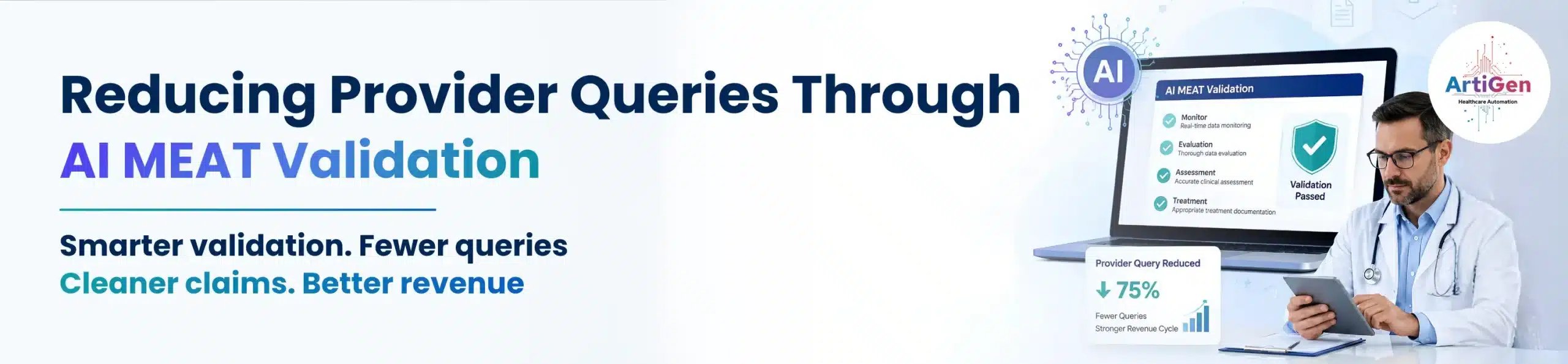
Reducing Provider Queries through Intelligent MEAT Validation
Provider queries are one of the biggest productivity challenges in today’s value-based healthcare environment. While queries are essential for clarifying incomplete documentation, excessive queries slow coding operations, delay claim submission, and create frustration for both providers and coding teams.
In many organizations, coding professionals spend a significant portion of their day requesting clarification because clinical documentation does not fully meet MEAT criteria for HCC coding. In the absence of diagnoses, incomplete assessments, or undocumented treatment plans, coders are left on hold until the providers respond.
For healthcare organizations focused on HCC risk adjustment, the need to improve documentation quality has become just as important as improving coding accuracy. Organizations are abandoning reliance on retrospective reviews and increasingly adopting AI MEAT validation to identify documentation gaps before they become coding issues.
Why MEAT Validation Matters
The success of risk adjustment coding depends on documentation quality. Every diagnosis reported for HCC submission must be supported by appropriate clinical evidence that meets accepted documentation guidelines.
The MEAT criteria provide a standardized framework to validate whether a documented condition is reportable for risk adjustment.
MEAT represents:
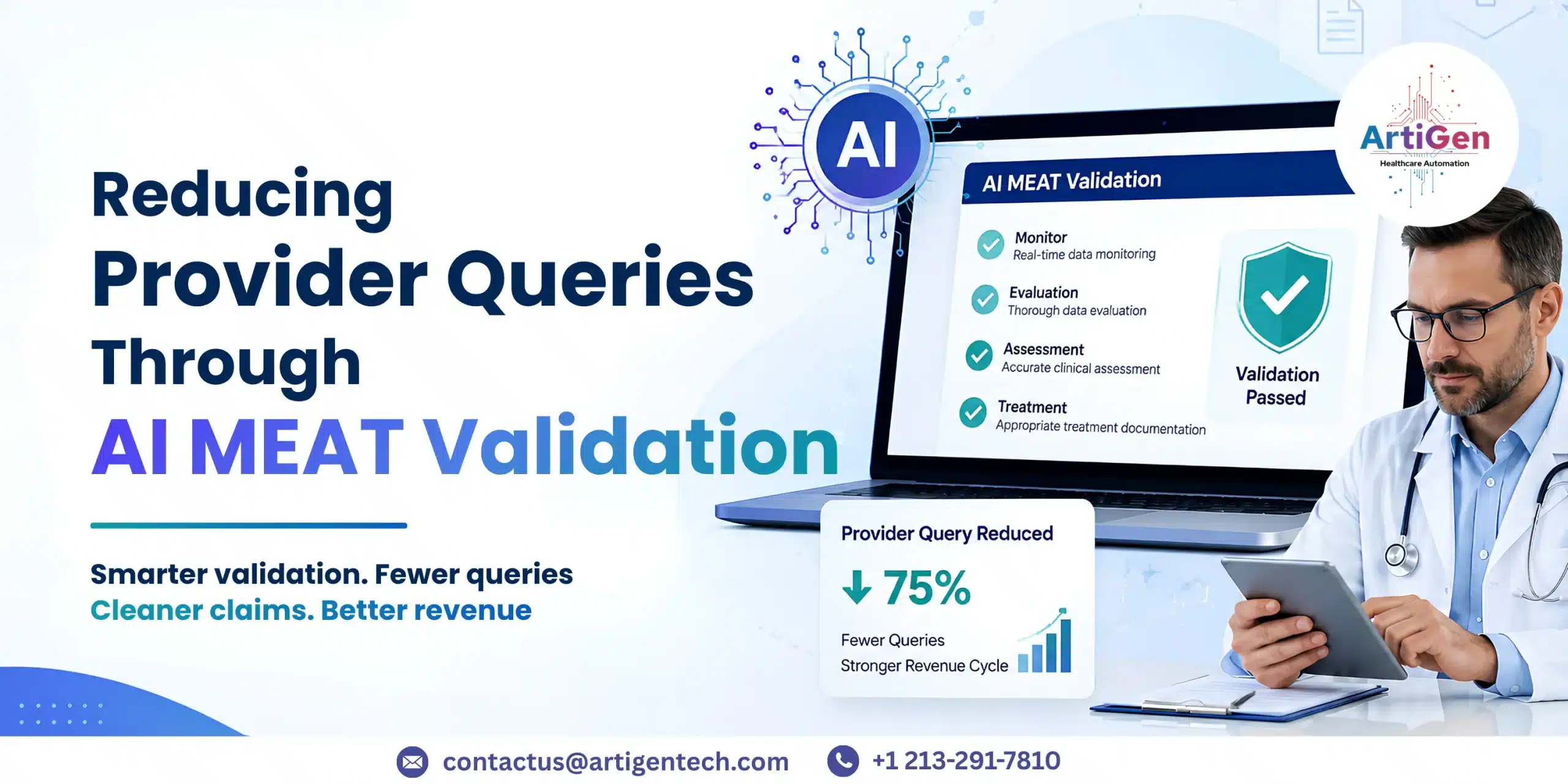
- Monitor
- Evaluate
- Assess / Address
- Treat
When documentation demonstrates one or more of these activities, coders can confidently assign HCC diagnoses while maintaining medical coding compliance.
Following established MEAT documentation guidelines helps organizations:
- Improve coding accuracy
- Reduce provider queries
- Strengthen risk adjustment documentation
- Support compliant reimbursement
- Improve RAF score accuracy
- Enhance clinical documentation improvement
Without consistent MEAT validation, incomplete documentation often leads to missed coding opportunities and unnecessary clarification requests.
Why Providers Receive So Many Documentation Queries
Most provider queries are not caused by incorrect diagnoses—they result from incomplete documentation.
Common documentation gaps include:
- Chronic conditions listed without assessment
- Missing treatment plans
- Incomplete monitoring documentation
- Lack of clinical evaluation
- Insufficient medical decision-making
- Unsupported diagnosis specificity
The providers may have done what was appropriate for the patient’s condition, but the documentation may not meet MEAT criteria for risk adjustment in full.
This creates an uncertainty for coding teams. Coders must seek clarification before assigning diagnoses to be compliant with HCC coding guidelines.
Reducing these documentation gaps is the primary goal of modern clinical documentation enhancement initiatives.
The Relationship between Clinical Documentation and Risk Adjustment
Successful HCC risk adjustment depends on strong collaboration between providers and coders.
Providers focus on patient care.
Coders translate that care into reportable diagnoses.
The connection between both is medical coding documentation.
Accurate documentation supports:
- Complete diagnosis capture
- Accurate RAF calculations
- Reliable risk adjustment documentation
- Better quality reporting
- Stronger medical coding compliance
Organizations that invest in clinical documentation improvement programs often experience fewer provider queries because documentation is complete from the beginning.
Understanding the MEAT Validation Process
The MEAT validation process is a structured review of provider documentation to determine whether every reported diagnosis includes sufficient supporting evidence.
Rather than simply identifying a diagnosis, coders evaluate whether documentation demonstrates:
- Monitoring of the condition
- Clinical evaluation
- Assessment or management
- Treatment or ongoing care
This review ensures diagnoses meet established risk adjustment documentation guidelines and align with current HCC coding guidelines.
When the MEAT validation process is performed consistently, organizations reduce coding uncertainty while improving documentation quality.
Documentation Best Practices That Reduce Provider Queries
High-quality documentation begins at the point of care.
Providers can significantly reduce follow-up queries by following proven MEAT documentation best practices.
These include:
Document Active Chronic Conditions
Only report diagnoses that were monitored, evaluated, assessed, or treated during the encounter.
Support Every Diagnosis
Each documented condition should include supporting clinical evidence that satisfies MEAT documentation for HCC coding.
Include Medical Decision-Making
Assessment and treatment decisions provide valuable support for risk adjustment documentation and improve coding confidence.
Document Treatment Changes
Medication adjustments, referrals, laboratory review, imaging interpretation, or care planning demonstrate active disease management.
Follow Standard Documentation Guidelines
Consistent documentation guidelines improve coding quality while supporting compliant risk adjustment coding.
Why Traditional MEAT Validation Is No Longer Enough
Manual documentation review has long been the standard approach for validating HCC documentation. However, today’s healthcare organizations manage thousands of patient encounters every day, making retrospective reviews increasingly difficult.
Traditional validation methods often result in:
- Delayed provider feedback
- Increased documentation queries
- Missed HCC opportunities
- Inconsistent coding decisions
- Higher administrative workload
As organizations adopt advanced risk adjustment models, manual review alone cannot keep pace with documentation volume.
This is where intelligent automated MEAT validation is transforming modern clinical documentation improvement.
How AI Is Transforming MEAT Validation
Modern AI MEAT validation solutions use Artificial Intelligence and Natural Language Processing (NLP) to review provider documentation while the clinical encounter is still in progress.
Instead of waiting for coders to identify missing information, AI continuously evaluates documentation against MEAT criteria, risk adjustment documentation guidelines, and HCC coding guidelines.
This proactive approach helps provider’s correct documentation before claims reach the coding team, reducing unnecessary provider queries and improving overall documentation quality.
How Real-Time MEAT Validation Changes the Coding Workflow
Traditional documentation reviews occur after the patient encounter, leaving coders to identify missing information and send provider queries. This retrospective approach delays coding completion and creates unnecessary back-and-forth communication.
With real-time MEAT validation, documentation is reviewed as providers complete their notes. AI evaluates whether each diagnosis satisfies MEAT criteria, verifies supporting evidence, and alerts providers when documentation is incomplete.
A typical MEAT validation process includes:
Patient Encounter
↓
Provider Documentation
↓
AI Reviews Clinical Notes
↓
MEAT Criteria Validation
↓
Missing Documentation Alert
↓
Provider Updates Documentation
↓
Risk Adjustment Documentation Review
↓
HCC Coding Validation
↓
Claim Submission
This intelligent workflow reduces coding delays while strengthening medical coding documentation and ensuring better alignment with risk adjustment documentation guidelines.
Benefits of Automated MEAT Validation
Automated MEAT validation is increasingly being used by healthcare organizations in place of manual documentation review to boost coding quality and operational efficiency.
Key benefits include:
- Fewer provider clarification queries
- Improved clinical documentation improvement
- Better compliance with medical coding compliance requirements
- More accurate risk adjustment coding
- Stronger HCC risk adjustment performance
- Reduced coding turnaround time
- Higher documentation consistency
- Better support for value-based reimbursement
Unlike manual reviews, automated MEAT validation continuously analyzes documentation and identifies missing evidence before coding begins.
How ArtigenTech Enables Intelligent MEAT Validation
At ArtigenTech, intelligent automation goes beyond identifying diagnosis codes. Our AI-powered platform evaluates documentation against MEAT criteria for HCC coding, validates clinical evidence, and supports providers with real-time recommendations.
Using AI MEAT validation, the platform can:
- Review provider notes during documentation
- Validate MEAT documentation for HCC coding
- Detect missing Monitor, Evaluate, Assess, or Treat elements
- Improve medical coding documentation
- Support clinical documentation improvement
- Strengthen risk adjustment documentation
- Reduce unnecessary provider queries
- Improve coding confidence and compliance
By embedding intelligence directly into the documentation workflow, ArtigenTech helps healthcare organizations achieve more complete documentation while reducing manual coding effort.
Best Practices for Reducing Provider Queries
Organizations can dramatically improve documentation quality by following these MEAT documentation best practices:
- Train providers on current HCC coding guidelines.
- Establish clear documentation guidelines to standardize documentation.
- Conduct periodic documentation audits.
- Use AI enabled real time MEAT validation at the point of encounter.
- Encourage complete documentation of assessment and treatment.
- Automate MEAT validation and embed it into existing EHR workflows.
- Assess documentation quality using standard risk adjustment models.
These strategies close documentation gaps and improve coding accuracy organization-wide.
Key Takeaways
- Strong clinical documentation improvement begins with complete provider documentation.
- Following MEAT documentation guidelines helps support compliant risk adjustment coding.
- Consistent MEAT validation for providers reduces clarification requests and improves coding productivity.
- Automated MEAT validation and real-time MEAT validation enable earlier detection of documentation gaps.
- AI-powered validation improves medical coding compliance, strengthens HCC risk adjustment, and supports accurate risk adjustment documentation.
- Intelligent documentation review helps healthcare organizations maximize coding quality while reducing administrative burden.
Conclusion
Provider queries typically occur due to incomplete documentation rather than incorrect coding. Healthcare organizations that use intelligent AI MEAT validation can prevent coding delays by ensuring that all diagnoses are supported by sufficient MEAT criteria and are consistent with risk adjustment documentation guidelines before coding.
ArtigenTech’s AI-powered validation platform combines clinical documentation improvement, automated MEAT validation and advanced risk adjustment coding intelligence to help providers document more effectively, reduce manual queries, improve medical coding compliance and improve HCC coding accuracy.
The end result is a faster, more efficient documentation workflow that allows for better reimbursement, higher coding quality, and better value-based care outcomes.
Frequently Asked Questions
What is MEAT validation in medical coding?
MEAT validation in medical coding is the process of verifying that clinical documentation supports a diagnosis through Monitor, Evaluate, Assess/Address, and Treat (MEAT) criteria before it is reported for HCC or risk adjustment coding.
Why is MEAT validation important for HCC coding?
MEAT validation ensures that diagnoses reported for HCC risk adjustment are supported by complete clinical evidence, helping organizations maintain compliance, improve RAF score accuracy, and reduce claim denials.
How does AI improve the MEAT validation process?
AI MEAT validation automatically reviews provider documentation, detects missing MEAT elements, supports risk adjustment documentation, and provides real-time feedback to reduce provider queries and improve coding accuracy.