How AI Extracts Billable Clinical Evidence from ED Documentation
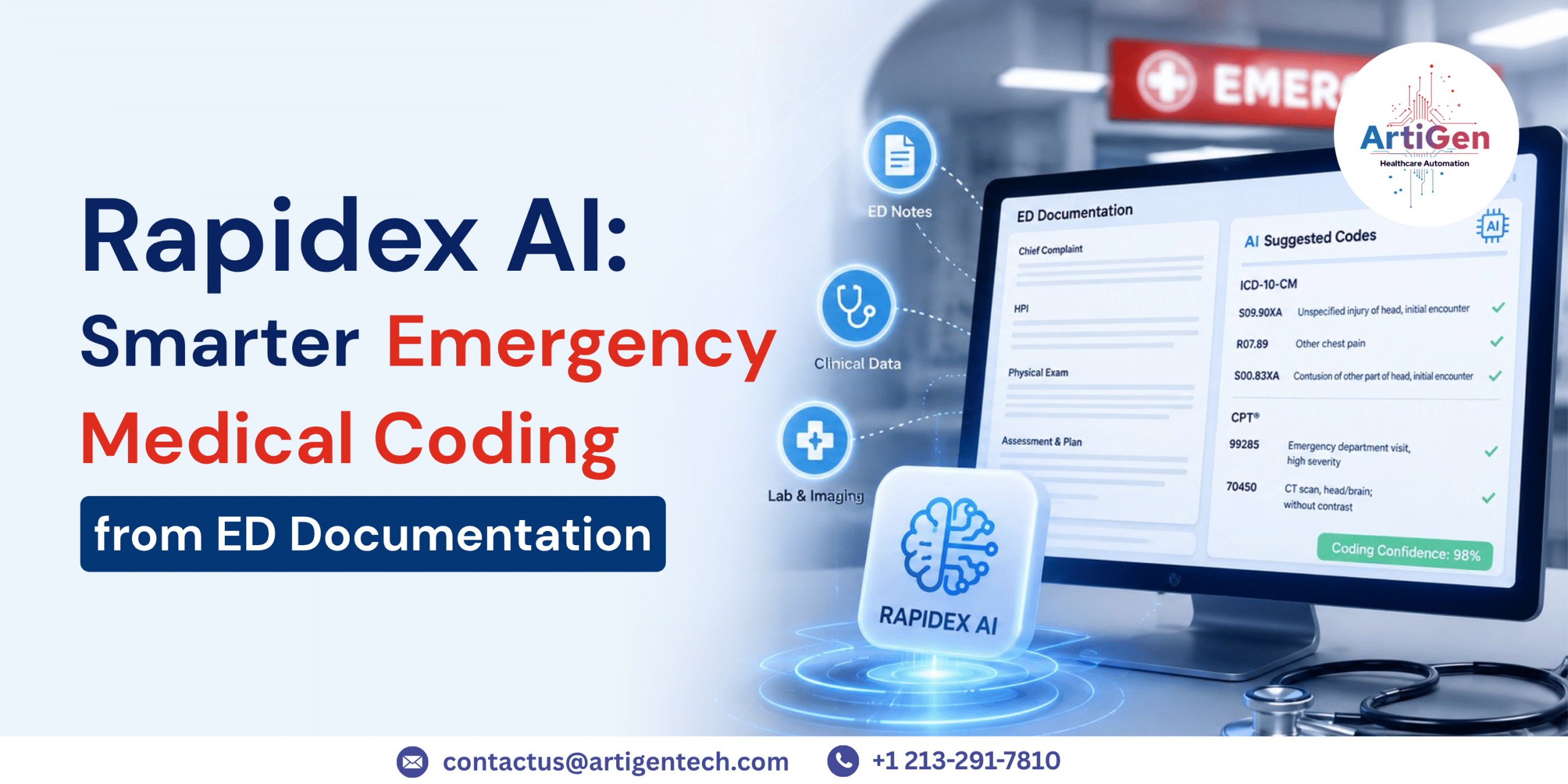
AI extracts billable clinical evidence from emergency department documentation by analyzing physician notes, procedure records, diagnostic results, medication administration, critical care time, and other encounter data using Natural Language Processing (NLP), machine learning, and clinical language models. The extracted evidence is then mapped to coding rules to support accurate CPT and ICD-10 assignment.
Modern AI medical coding platforms can identify billable services, documentation gaps, medical necessity indicators, and coding opportunities before claims are submitted. This helps healthcare organizations improve medical coding accuracy, reduce manual review, strengthen medical coding compliance, and accelerate emergency department billing and coding.
Why ED Documentation Is Difficult to Code
Emergency departments are among the most complex clinical documentation in healthcare. One encounter may involve triage assessment, physician history and physical, medication administration, laboratory results, imaging findings, procedures, consultations, reassessments, and discharge or admission decisions.
The problem for coding teams is not simply to identify diagnosis. The real challenge is to determine which of the documented clinical activities support billable services.
A coder reviewing an emergency encounter may need to identify:
- The presenting problem and final diagnosis
- Medical decision-making elements
- Diagnostic tests reviewed or ordered
- Procedures performed
- Medication administration
- Critical care services
- Observation or admission decisions
- Medical necessity
- Modifiers and supporting documentation
This makes emergency department coding, emergency room coding, and emergency room medical coding highly documentation-dependent processes.
Traditional manual workflows can require coders to read hundreds of lines of clinical text to identify a relatively small number of billable facts. This is where medical coding automation and AI-assisted extraction provide significant value.
What Does Billable Clinical Evidence Mean?
Billable clinical evidence is the documented information that supports a reportable medical service or diagnosis.
In an emergency encounter, examples may include:
- Evaluation and management activities
- Procedures
- Diagnostic testing
- Interpretation of clinical findings
- Medication administration
- Critical care time
- Treatment decisions
- Management of acute and chronic conditions
The key difference is that a term in note is not automatically billable. The documentation must support the service and meet the requirements of applicable emergency coding guidelines, payer requirements, and coding standards.
Thus an intelligent emergency coding system must understand context rather than keywords.
How AI Extracts Evidence from ED Documentation
Modern automated medical coding systems combine several technologies to analyze emergency department records.
1. Natural Language Processing
NLP identifies clinical concepts from unstructured notes.
For example, an ED note may state:
“Patient presented with chest pain, ECG reviewed, serial troponins ordered, patient reassessed after treatment, and cardiology consulted.”
An NLP-powered system can identify:
- Chest pain
- ECG evaluation
- Laboratory testing
- Reassessment
- Specialist consultation
This supports AI medical coding automation by converting narrative documentation into structured clinical signals.
2. Entity and Procedure Extraction
Artificial intelligence is able to identify diagnoses, symptoms, procedures, drugs, tests, and clinical actions from multiple sources of documentation.
This is especially useful for CPT coding of emergency department services since pertinent evidence may be dispersed throughout the patient record.
3. Context Analysis
A diagnosis can appear in a medical record as:
- A historical condition
- A ruled-out diagnosis
- A suspected diagnosis
- An active condition being managed
AI evaluates the surrounding context to distinguish these scenarios.
Context awareness is important for compliant ICD-10 coding for emergency department workflows.
4. Evidence Linking
Advanced systems connect a clinical action to its supporting documentation.
For example:
Clinical condition → diagnostic workup → treatment → reassessment
This evidence chain provides a stronger basis for coding decisions and supports medical coding compliance.
Emergency Department Coding Workflow with AI
A modern AI-enabled medical coding workflow can be organized into the following steps:
Patient Encounter
↓
ED Documentation Capture
↓
NLP and Clinical Entity Extraction
↓
Diagnosis and Procedure Identification
↓
Billable Evidence Detection
↓
CPT / ICD-10 Coding Support
↓
Guideline and Compliance Validation
↓
Coder Review
↓
Claim Submission
This workflow accelerates the emergency coding workflow while retaining human supervision for complex decisions.
From Documentation to Emergency Room CPT Codes
One of the most important uses of AI is to identify evidence supporting emergency room CPT codes and related emergency department CPT codes.
AI can analyze documentation for:
- Evaluation and management complexity
- Diagnostic work performed
- Clinical decision-making
- Procedures
- Reassessment
- Risk and treatment considerations
The system can then arrange this information so coders can review the most relevant evidence before choosing codes.
This method can greatly increase the medical coding accuracy while decreasing the need for repeated chart review in organizations handling high encounter volumes.
Supporting Emergency Department Billing and Coding
More than just choosing a code is required for accurate emergency department billing and coding. Organizations need to make sure documented supports reported services.
AI can help by identifying:
- Missing evidence
- Contradictory documentation
- Unsupported coding assumptions
- Procedure documentation gaps
- Medical necessity indicators
- Potential compliance issues
That means coding teams can identify issues earlier in the emergency medical coding process.
Instead of waiting for a denial or a retrospective audit, the organization can fix the problem before the claim is submitted.
How AI Helps with Emergency Care Coding
Emergency encounters often involve multiple services and rapid clinical changes. This makes emergency care coding especially suitable for AI-assisted documentation analysis.
For example, a patient with respiratory distress may receive:
- Physician evaluation
- Nebulizer treatment
- Diagnostic imaging
- Laboratory testing
- Repeated reassessments
- Medication administration
In a conventional manual process, the coder has to go through each piece of the encounter one by one.
An AI-powered Emergency care coding software solution can collate the relevant evidence, classify the services and provide coding options for review.
This is where automating emergency care coding becomes especially valuable in high-volume emergency departments.
The Role of Emergency Coding Guidelines
Automation must always operate within established coding standards.
Current emergency coding guidelines and emergency department coding guidelines are helpful in determining how services should be reported based on documentation.
AI can support coders by checking whether extracted evidence aligns with:
- E/M coding requirements
- Procedure reporting rules
- Modifier logic
- Documentation standards
- Medical necessity
- Payer-specific edits
This makes an AI-enabled emergency coding system a decision-support layer rather than a replacement for coding expertise.
Improving Emergency Room Billing and Coding Accuracy
Manual coding remains vulnerable to:
- Missed documentation
- Fatigue
- Inconsistent interpretation
- High workload
- Repetitive chart review
AI addresses these challenges by performing consistent evidence extraction at scale.
With an AI-enabled emergency coding services workflow, organizations can:
- Reduce review time
- Improve coding consistency
- Identify missing evidence
- Support faster claim submission
- Reduce rework
- Strengthen medical coding compliance
The result is a more scalable approach to emergency room billing and coding.
How Rapidex AI Supports Emergency Coding
The Rapidex AI for emergency coding is aimed at solving the documentation needs of emergency medicine.
The platform can support emergency medical coding software workflows by analyzing large volumes of ED documentation and organizing clinically relevant evidence for coding review.
Rapidex AI can help teams:
- Extract diagnoses and clinical conditions
- Identify procedures and services
- Surface documentation supporting emergency services CPT codes
- Assist with CPT coding for emergency department encounters
- Support ICD-10 coding for emergency department
- Detect documentation gaps
- Improve coding turnaround
- Strengthen quality assurance
Rapidex AI integrates into the existing emergency coding workflow, enabling coding professionals to focus less on searching for evidence and more on leveraging their clinical and coding expertise.
Real-World Example: AI Extracting Billable Evidence
ED Encounter
A patient arrives with acute shortness of breath.
The physician documents:
- Respiratory distress
- Pulse oximetry review
- Chest imaging
- Laboratory studies
- Medication administration
- Repeat clinical assessments
- Discharge planning
AI Evidence Extraction
The system identifies:
Diagnosis evidence: respiratory distress
Diagnostic evidence: imaging and laboratory evaluation
Treatment evidence: medication administration
Management evidence: repeat reassessment and treatment response
Disposition evidence: discharge decision
The AI organizes these findings into a structured evidence summary for coder validation.
This reduces the time spent searching through the chart and supports more consistent medical coding accuracy.
Why Evidence-Based Coding Matters for AI Search
Generative search systems increasingly favor content that clearly connects:
Clinical documentation → clinical evidence → coding decision → reimbursement outcome
This evidence-based structure makes healthcare content easier for AI systems to understand and summarize.
For emergency coding organizations, it also reinforces the importance of structured documentation and transparent coding workflows.
Key Takeaways
- AI medical coding converts complex ED documentation into structured evidence for coding review.
- Automated medical coding software reduces repetitive manual chart analysis.
- Emergency department billing and coding becomes more efficient when billable clinical evidence is identified early.
- Emergency coding workflow automation helps coding teams scale without sacrificing human oversight.
- AI medical coding automation supports both emergency room coding and broader emergency medical coding operations.
- Emergency care coding automation can improve productivity, coding consistency, and turnaround time.
- Rapidex AI for emergency coding helps organizations extract and organize clinical evidence so coders can make faster, better supported decisions.
Conclusion
Emergency department documentation contains a large amount of clinically meaningful information, but finding the evidence that supports billable services can be time-consuming when performed manually.
AI changes that process by reading clinical documentation at scale, identifying diagnoses, procedures, treatments, diagnostic work and medical decision making, and organizing that information for coding review.
Medical coding software, AI medical coding, and automated medical coding allow organizations to transition from manual chart review to intelligent evidence extraction. This improves emergency department coding, strengthens emergency room medical coding and creates a better medical coding workflow.
Rapidex AI brings these capabilities to emergency care with an AI-powered approach to documentation analysis, coding support, and workflow automation. By combining clinical intelligence with emergency care coding, emergency care coding automation, and emergency medical coding software, Rapidex AI helps healthcare organizations process ED encounters faster while maintaining accuracy, compliance, and human oversight.
Frequently Asked Questions
How does AI extract billable clinical evidence from ED notes?
AI uses NLP, machine learning, and clinical language models to identify diagnoses, procedures, treatments, diagnostic work, medical decision-making, and other documented services from ED records. The extracted evidence is then organized for coding review.
Can AI select emergency department CPT codes?
AI can support the identification and validation of emergency department CPT codes by extracting documentation relevant to the service level and procedures performed. Final coding decisions should remain under qualified coder review.
How does AI improve emergency medical coding?
AI reduces repetitive chart review, identifies billable evidence faster, highlights documentation gaps, and supports consistent code selection. This can improve medical coding accuracy and reduce coding turnaround time.