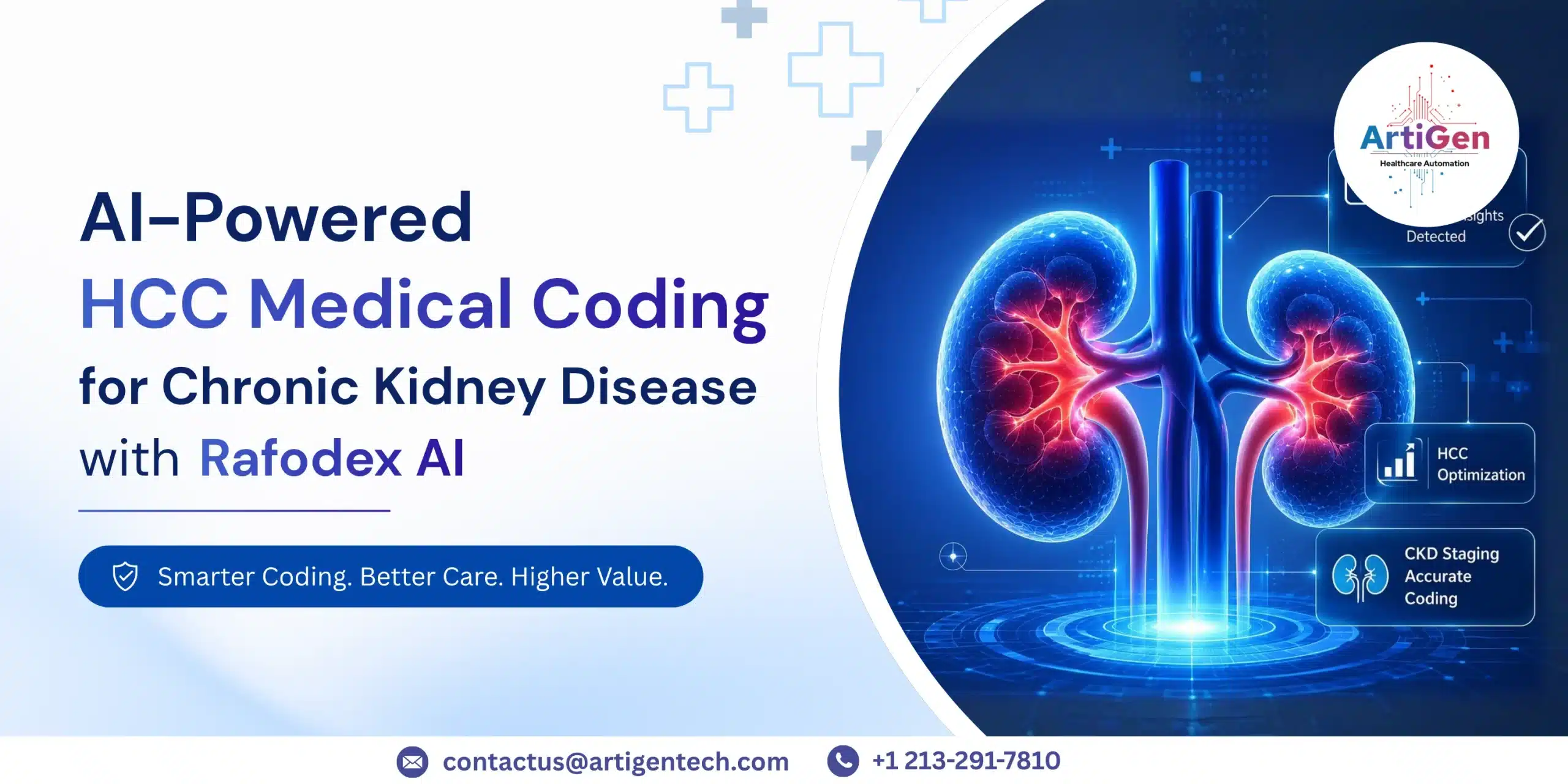

AI-Powered HCC Medical Coding for Chronic Kidney Disease
HCC medical coding for Chronic Kidney Disease (CKD) is more than just finding a kidney diagnosis. Risk adjustment coding requires complete provider documentation, documented CKD stage, applicable MEAT criteria for HCC coding, accurate ICD-10-CM assignment, and correct CMS-HCC model mapping.
CMS is offering dedicated CMS-HCC risk adjustment model software and ICD-10-CM mappings for 2026, which makes model-year validation critical for HCC risk adjustment workflows. According to the CMS FY 2026 ICD-10-CM guidelines, CKD is coded by documented stage as follows:
- CODE RANGE: N18.1 –N18.9
- Stage 3 CKD – N18.3
- Stage 4 CKD – N18.4
- End-Stage Renal Disease (ESRD) – N18.6
- CKD, unspecified stage – N18.9
Important coding point
If the documentation states CKD with hypertension, ICD-10-CM generally requires a combination code from I12.(*) – or I13.(*) along with the appropriate N18.(*)- code to identify the CKD stage.
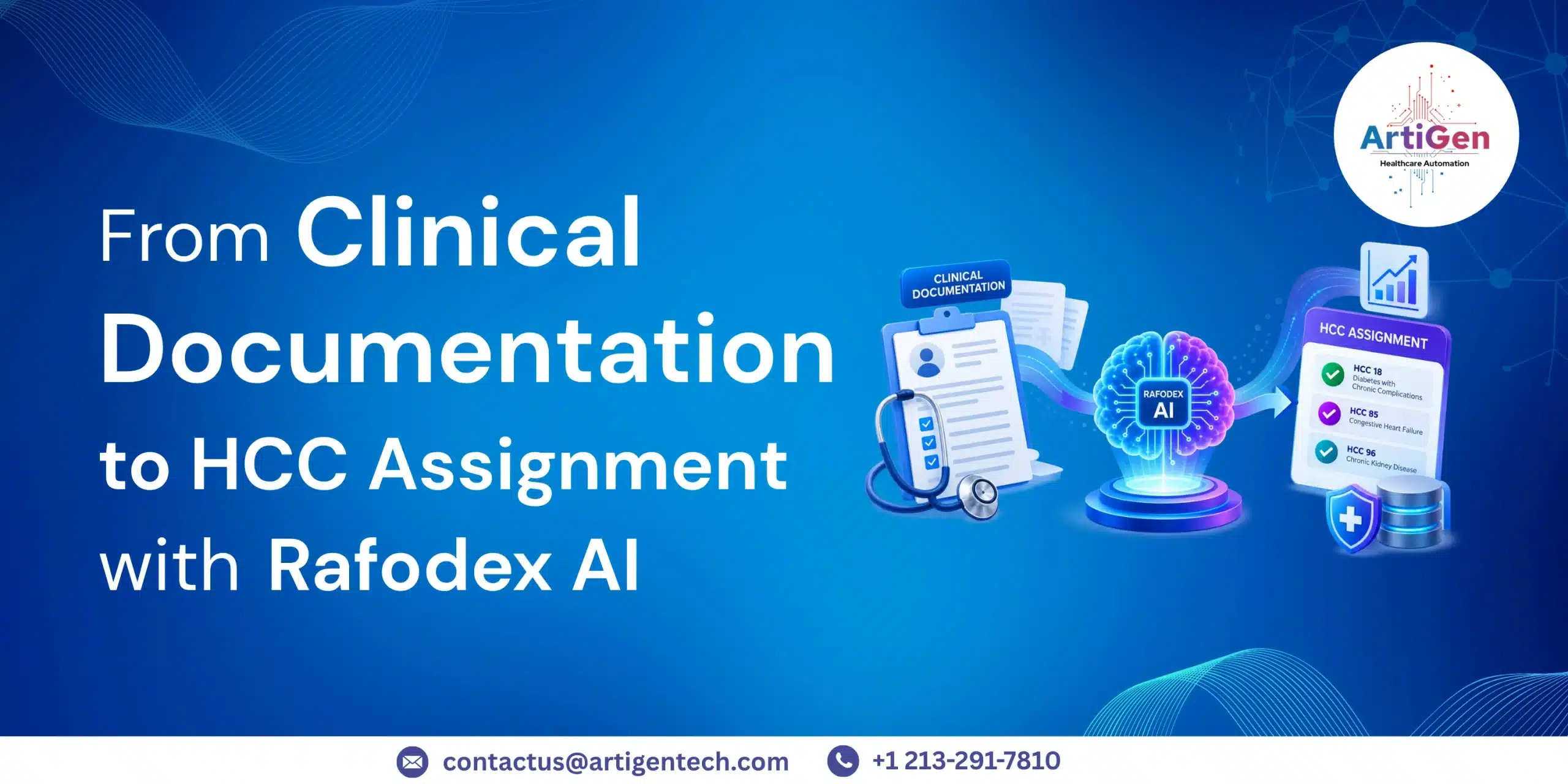
AI-powered HCC medical coding automation can combine clinical documentation, CKD staging, MEAT criteria, ICD-10 coding, HCC mapping, and validation into a single workflow. Rafodex AI applies this method to HCC medical coding, enabling coding teams to review complex CKD encounters more efficiently.
Why CKD Requires Accurate HCC Medical Coding
CKD frequently appears alongside diabetes, hypertension, cardiovascular disease, and other chronic conditions. This makes chronic kidney disease coding particularly important in Medicare risk adjustment workflows.
A provider note of “CKD” alone may not be specific enough for accurate chronic kidney disease ICD-10 assignment. The record should be consistent with the clinically documented stage of CKD and the management of the condition by the provider.
In Risk adjustment coding, the objective is not to get as many diagnoses as possible. It is to report diagnoses with appropriate clinical documentation and applicable coding and risk-adjustment requirements.
Thus, accurate HCC documentation is the first step in proper HCC risk adjustment, followed by diagnosis selection, mapping to ICD-10, HCC validation, and audit review.
Chronic Kidney Disease Coding Starts with Documentation
Strong medical coding documentation is the foundation of compliant HCC medical coding.
For a CKD encounter, documentation may include:
- CKD diagnosis
- Current stage
- Dialysis for ESRD stage
- Kidney transplant status
- Acute Kidney Injury (AKI) combination codes
- Hypertensive heart and CKD diseases
- Renal function monitoring
- Relevant laboratory review
- Assessment of disease status
- Treatment or medication management
- Associated conditions
- Follow-up or care planning
The FY 2026 ICD-10-CM Official Guidelines state that CKD severity is classified by stages 1–5, with stage 3 further divided into N18.30, N18.31, and N18.32. The guideline also directs assignment of N18.6 when ESRD is documented.
So, accurate chronic kidney disease coding should start with provider documentation, not a generic diagnosis search.
This is where medical coding automation can assist by flagging missing CKD-stage information and referring the record for proper coder review.
Understanding Chronic Kidney Disease ICD-10 and HCC Mapping
The Chronic kidney disease ICD-10 category contains stage-specific N18.(*) codes. The correct diagnosis code must be selected from the provider’s documentation and the current ICD-10-CM code set.
ICD-10-CM category has stage-specific N18.(*) codes. The provider’s documentation and the current ICD-10-CM code set must be referenced to select the appropriate diagnosis code.
After the ICD-10-CM codes are assigned, the next step is ICD-10-CM HCC mapping with appropriate CMS Hierarchical Condition Category (CMS-HCC) risk adjustment Model V28.
An intelligent HCC coding software workflow links:
Provider documentation → ICD-10-CM diagnosis → CMS-HCC V28 Model mapping → HCC validation for Risk Adjustment Factor (RAF) score
This is important because HCC icd-10 codes and their relationship to an HCC are dependent on the applicable risk-adjustment model and mapping year.
CMS offers model software and ICD-10 mappings for each relevant year, including 2026 resources.
A reliable risk adjustment software platform should therefore be based on the correct model-year mapping and not on an outdated static database.
Diabetes, Hypertension and CKD Coding: Why Clinical Relationships Matter
Diabetes and CKD coding is another area where documentation specificity matters.
When a patient has diabetes and CKD, coders must apply the applicable ICD-10-CM coding combination codes, conventions and capture the documented CKD stage. The relationship between the conditions should be supported according to the official coding rules rather than inferred solely by the presence of both diagnoses.
AI can review the record for documentation involving:
- Diabetes
- CKD
- CKD stage
- Renal function
- Dialysis & Kidney transplant status
- Medication management
- Provider assessment
- Related complications
This makes Diabetes and CKD coding a strong use case for HCC medical coding automation.
CKD HCC coding is not about creating a relationship between conditions. It is to document exactly what the provider documented and what the appropriate coding rules support.
MEAT Criteria for HCC Coding
The MEAT criteria for HCC coding are commonly used in risk-adjustment workflows to evaluate evidence of clinical management.
MEAT represents:
Monitor
Reviewing renal function, laboratory values, symptoms, or disease progression.
Evaluate
Reviewing or interpreting clinical findings and assessing the patient’s condition.
Assess or Address
Documenting the current status of CKD and the provider’s management decisions.
Treat
Managing the condition through medication, treatment, referrals, or other documented interventions.
For HCC coding for chronic kidney disease, AI can identify evidence associated with the MEAT criteria for HCC coding and present that evidence to the coder.
This makes HCC coding with MEAT criteria more transparent and supports consistent validation.
How AI Improves CKD HCC Coding
Traditional HCC medical coding might involve coders manually reviewing progress notes, lab results, assessment and plan sections, medication records, and prior encounters.
AI-based automated HCC coding changes this workflow by automatically pulling out relevant evidence.
A modern risk adjustment software solution can:
- Identify CKD terminology.
- Detect the documented stage.
- Extract relevant clinical evidence.
- Identify MEAT-related activity.
- Support diagnosis-code selection.
- Perform ICD-10 HCC mapping.
- Validate the potential HCC.
- Flag documentation inconsistencies.
- Route complex cases for coder review.
This approach supports automated HCC coding without replacing qualified coding professionals.
How the HCC Identifier Fits Into the Workflow
An hcc identifier can be used as a practical reference within an intelligent workflow to connect a supported diagnosis with its relevant HCC category.
Instead of displaying only a code, an AI platform can present an evidence chain:
Diagnosis → ICD-10-CM code → HCC identifier → supporting documentation → MEAT evidence
This provides coding experts with more insight into the reasons behind a case’s HCC review flag.
In an enterprise HCC coding software environment, an HCC identifier can also be used to support quality review queues, analytics, and HCC coding audit workflows.
This is not a replacement for the official CMS model mapping.
HCC Coding Guidelines and Compliance
Following current HCC coding guidelines is essential for accurate HCC risk adjustment.
A compliant workflow should validate:
- Provider documentation
- ICD-10-CM code selection
- CKD stage
- MEAT evidence
- Applicable model mapping
- Encounter requirements
- Audit support
Organizations also need to keep up-to-date with risk adjustment documentation guidelines and make sure their HCC coding compliance process meets the CMS requirements that apply to them.
CMS has emphasized the importance of reporting clinically meaningful diagnoses to the risk adjustment model and offers model-specific software and mappings.
This makes model-aware medical coding automation particularly valuable for organizations with large HCC populations.
HCC Validation and Coding Audit
A strong HCC validation process verifies that the diagnosis, documentation, ICD-10-CM code, and HCC mapping are consistent.
An AI-supported HCC coding audit can review:
- Diagnosis-to-documentation linkage
- CKD stage specificity
- MEAT evidence
- Provider documentation
- ICD-10-to-HCC mapping
- Potential unsupported diagnoses
This helps organizations improve HCC coding compliance and be ready for an external review.
For HCC coding for chronic kidney disease, validation must also confirm that the documented stage is consistent with the reported diagnosis.
Rafodex AI for HCC Medical Coding
Rafodex AI is designed to help healthcare organizations modernize HCC medical coding through intelligent documentation analysis, coding support, and validation.
For CKD workflows, Rafodex AI can help coding teams:
- Identify CKD diagnoses
- Extract documented CKD stage
- Review MEAT criteria for HCC coding
- Support hcc icd-10 codes validation
- Connect diagnoses with ICD-10 HCC mapping
- Identify documentation gaps
- Support HCC validation
- Assist with HCC coding audit preparation
Rafodex AI combines AI with medical coding automation, resulting in more consistent and scalable CKD HCC coding.
AI-Powered CKD HCC Coding Workflow
Provider Documentation
↓
CKD Diagnosis Detection
↓
CKD Stage Identification
↓
MEAT Criteria Review
↓
ICD-10-CM Coding
↓
ICD-10 HCC Mapping
↓
HCC Validation
↓
Coder Review
↓
Risk Adjustment Submission
This workflow connects with chronic kidney disease coding, Risk adjustment coding, HCC risk adjustment and intelligent validation into one process.
Common CKD HCC Coding Challenges
Missing CKD Stage
A record may document CKD without a specific stage. Chronic kidney disease ICD-10 coding requires attention to the documented stage.
Historical Diagnoses
A diagnosis may appear in a problem list without demonstrating current clinical relevance.
Incomplete MEAT Evidence
Documentation may identify CKD but provide limited evidence of monitoring, evaluation, assessment, or treatment.
Outdated Mapping
Using an outdated mapping file can create incorrect hcc icd-10 codes or HCC assignment.
Documentation Inconsistency
Conflicting CKD stages across notes can require provider clarification.
AI-powered hcc medical coding automation can identify these patterns and prioritize them for human review.
Best Practices for CKD HCC Coding
Effective HCC coding with MEAT criteria should follow several principles:
Document the stage:
Provider documentation should identify the clinically supported CKD stage.
Capture active management:
The record should demonstrate applicable MEAT criteria.
Validate diabetes and Hypertension relationships:
Apply current rules to Diabetes, Hypertension and CKD coding rather than relying on assumptions.
Use current mapping:
CMS publishes current model software and ICD-10 mappings, including 2026 resources.
Validate before submission:
A final HCC validation step can identify unsupported or inconsistent coding.
Frequently Asked Questions
What is HCC medical coding for CKD?
HCC medical coding for CKD connects documented kidney disease, ICD-10-CM coding, applicable MEAT evidence, and current HCC model mapping to support compliant risk-adjustment reporting.
Why is CKD stage important for risk adjustment?
CKD stage determines the appropriate chronic kidney disease ICD-10 code. The resulting diagnosis may then be evaluated under the applicable CMS-HCC model and mapping.
How does AI improve HCC coding?
AI can analyze medical coding documentation, identify CKD stages and MEAT evidence, support ICD-10 HCC mapping, and flag cases that require coder review.
Key Takeaways
- Risk adjustment coding begins with complete, specific provider documentation.
- HCC medical coding for CKD requires accurate diagnosis and stage documentation.
- HCC risk adjustment depends on the applicable model and current mapping resources.
- MEAT criteria for HCC coding help connect documented clinical management to the diagnosis.
- ICD-10 HCC mapping must be performed using the appropriate model-year resources.
- HCC medical coding automation reduces repetitive review and supports validation.
- Automated HCC coding should support—not replace—qualified coding judgment.
- Rafodex AI connects documentation, CKD coding, MEAT evidence, and HCC validation in one intelligent workflow.
Conclusion
Accurate HCC medical coding for Chronic Kidney Disease requires a connected approach that begins with provider documentation and continues through chronic kidney disease coding, ICD-10-CM assignment, MEAT review, HCC mapping, and validation.
Simply identifying CKD in a medical record is not enough for organizations managing Medicare risk adjustment. The documented stage, clinical management, applicable HCC coding guidelines, and current CMS-HCC mapping need to be taken into account.
Automation of hcc medical coding with AI is a practical way to connect these elements. Automation can improve consistency and reduce manual effort by combining clinical documentation analysis, MEAT criteria for HCC coding, ICD-10 HCC mapping, HCC validation and HCC coding audit support.
With Rafodex AI, healthcare organizations can modernize CKD HCC coding, strengthen HCC coding compliance and build a more scalable approach to Risk adjustment coding – turning clinically supported documentation into accurate, traceable and model-aware HCC coding decisions.