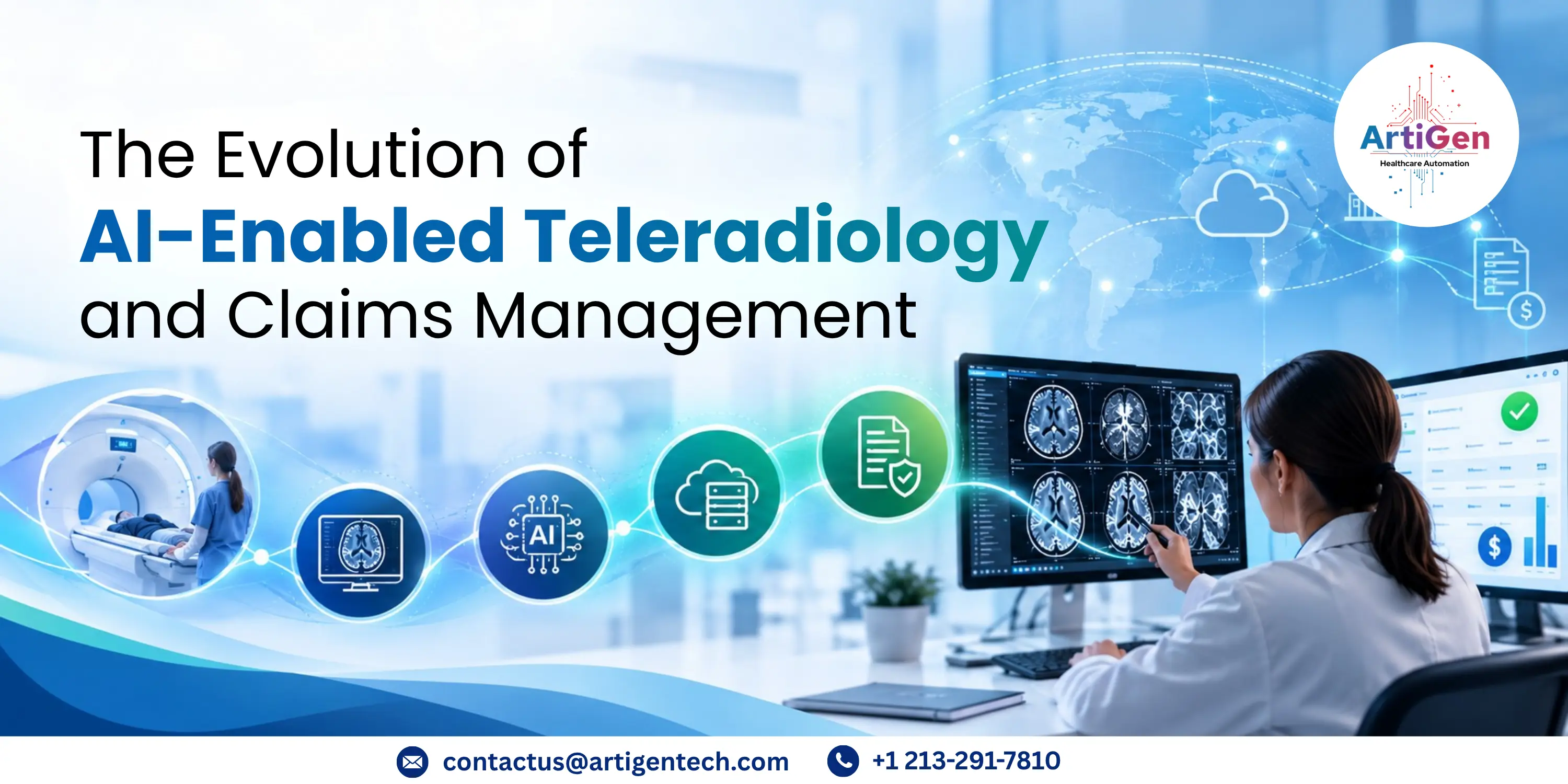
Radiology departments have some of the highest radiology claims denials in medical billing. This is because they have to deal with complicated radiology CPT codes selection, missing medical necessity documentation, and payer-specific radiology coding guidelines that change all the time. The growing use of artificial intelligence in radiology and radiology artificial intelligence is helping healthcare organizations address these challenges. AI for radiology can support coding, documentation review, and denial prevention, while AI in radiology can help make the claims workflow more proactive.
Traditional denial management is reactive; teams only fix errors after a denial comes in. This causes money to leak out, payments to be delayed, and more work for the administration due to radiology billing errors. AI in radiology operations can help organizations identify potential issues earlier, while the benefits of AI in medical imaging extend beyond image analysis into coding and revenue-cycle workflows.
Artificial Intelligence (AI) is changing the way radiology medical billing works today by making it a proactive, real-time, error-prevention process with predictive coding models. The role of artificial intelligence in radiology now extends across AI and radiology workflows, including AI in diagnostic imaging, radiology coding services, and radiology billing and coding.
Why Radiology Denials Are Increasing
Radiology depends a lot on structured clinical documentation, correct CPT coding, and following the rules set by payers. Even small mistakes can cause denials. The use of radiology imaging software, radiology AI, and radiology AI workflow technologies can help identify these issues before claims are submitted.
Modern AI diagnostic imaging workflows can connect clinical information with coding requirements, while AI for radiology diagnosis can support diagnostic workflows. At the same time, machine learning radiology and machine learning in radiology can identify patterns in historical claims and denial data.
Top Causes of Radiology Claim Denials
Denial Category | Examples | Impact |
Incorrect CPT/HCPCS Codes | Wrong code for imaging type, missing modifiers | Underpayment or non-payment |
Medical Necessity Denials | Diagnosis not matching CPT, insufficient documentation | Claim rejection |
Missing Prior Authorization | MRI, CT scans without payer approval | Automatic denial |
Incomplete Clinical Notes | Missing laterality, body part, contrast details | Coding ambiguity |
Duplicate Claims | Multiple claims submitted for the same study | Payer flags and rejects |
OCR/Manual Entry Errors | Wrong patient ID, DOS, referring provider | Processing delays |
With thousands of imaging procedures daily, manual QC becomes impossible, especially with diagnostic radiology CPT codes and interventional radiology coding requirements. This is one area where radiology automation, AI radiology software, and radiology AI solutions can support high-volume workflows.
Why Predictive Coding Models Are the Future
Predictive coding models use machine learning algorithms that look at past data to find patterns, risks, and the chances of denials. As healthcare organizations evaluate the best medical imaging AI solutions, these technologies can support radiology coding, documentation review, and claim denial prevention.
They help radiology teams:
- Find mistakes in claims before you send them in
- Give each claim a score based on how likely it is to be denied
- Suggest the correct CPT, ICD-10, modifier, based on radiology coding guidelines
- Automatically learn the rules for each payer
- Cut down on the amount of work people have to do by 60–70%
Predictive models are increasingly becoming part of AI radiology workflows because they can support both clinical and administrative processes. The combination of machine learning radiology and AI in radiology allows organizations to analyze historical information and identify potential denial risks.
How Predictive Models Work in Radiology
Predictive radiology coding uses machine learning algorithms that support AI for radiology, machine learning in radiology, and AI diagnostic imaging workflows:
- NLP (Natural Language Processing) to pull information out of radiology reports
- Deep Learning models for categorizing types of procedures
- Engines based on rules for payer guidelines
- Supervised ML models that learned from past denial outcomes
- Automatic checking for ICD-10–CPT alignment
- Risk scoring in real time for each claim
This eliminates repetitive tasks and pushes coders to focus only on high-complexity cases. These capabilities are important benefits of AI in medical imaging, particularly when radiology artificial intelligence is integrated into existing radiology imaging software.
How Predictive Models Prevent Radiology Claim Denials
Here is how AI transforms the coding cycle and demonstrates the role of artificial intelligence in radiology:
✔ Step 1: Scan documentation (OCR + NLP)
AI extracts details from:
- Radiology reports
- Physician orders
- Referrals
- Imaging notes
These capabilities can support AI in diagnostic imaging by extracting relevant information from clinical documentation. They can also support radiology coding services by making documentation review more efficient.
✔ Step 2: Match findings → ICD-10
The model automatically maps clinical findings to correct ICD-10 diagnoses.
Example:
“Acute sinusitis” → J01.90
“Suspicion of stroke” → I63.9
This demonstrates how AI for radiology diagnosis and AI for radiology can connect clinical information with downstream coding workflows.
✔ Step 3: Auto-validate CPT codes using radiology CPT codes
It checks:
- With vs without contrast
- Body part accuracy
- Technical vs professional component
- Bundling rules
- Add-on codes
Automated CPT validation is an important application of radiology automation and radiology AI software because it can support consistent radiology billing and coding.
✔ Step 4: Modifier Validation
The system evaluates if:
- 26/TC are required
- 59 is valid
- XE, XS, XP, XU modifiers apply
✔ Step 5: Medical Necessity Prediction
AI checks medical necessity against:
- LCD/NCD policies
- Payer-specific rules
- Historical denial patterns
This is an important example of the benefits of AI in radiology, as AI can support medical necessity validation before a claim reaches the payer.
✔ Step 6: Real-time denial scoring
Each claim is assigned a 0–100 denial risk score.
Example:
- Score 0–30 → Low risk
- Score 31–60 → Medium risk
- Score 61–100 → High risk
Real-time scoring demonstrates how radiology AI can support proactive claim management.
✔ Step 7: Instant Correction Recommendations
The model suggests:
- Add missing diagnosis
- Adjust incorrect CPT
- Insert correct modifier
- Add medical necessity statement
This type of AI radiology workflow can reduce repetitive manual review and support radiology coding services.
Benefits of Predictive Coding for Radiology
1. 60–70% reduction in avoidable denials
AI catches missing medical necessity, wrong CPT/ICD-10 pairs, and absent modifiers. These capabilities demonstrate the benefits of AI in radiology and the practical value of AI in radiology operations.
2. 40–55% faster coding turnaround time
Radiology medical coding automation reduces manual lookup work. AI-supported radiology coding services can help coders review information more efficiently.
3. 95% accuracy in CPT/ICD-10 mapping
Continuously learning from new rules for payers. Machine learning in radiology can support continuous improvement of coding and claims workflows.
4. Real-time LCD/NCD validation
Prevents “not medically necessary” denials. This is another example of the benefits of AI in medical imaging when clinical information is connected to coding workflows.
5. Increased radiology reimbursement
Fewer denials → higher first-pass acceptance rates. AI and radiology workflows can support cleaner claims and more consistent radiology billing and coding.
6. Consistency across coders
AI ensures standardization even in high-volume departments. This is one of the key benefits of AI in radiology, particularly when organizations process large numbers of imaging claims.
Technical Architecture of Predictive Radiology Coding with Radiology AI Coding
This AI setup ensures each claim meets payer with radiology coding compliance, reducing radiology audit errors. A structured radiology AI workflow can connect clinical documentation, coding, and denial prediction.
Core Components
Layer | Technology Used | Purpose |
Data Ingestion | HL7, FHIR, PACS data, EHR data | Pull radiology reports, images, orders |
Preprocessing | OCR, text normalization | Clean notes, extract findings |
NLP Engine | BERT, GPT-based models | Understand body part, contrast, technique |
Procedure Classification | CNNs, deep learning | Predict CPT codes accurately |
Denial Prediction Model | Gradient Boosting, Random Forest, XGBoost | Predict probability of denial |
Rule Engine | Payer policies, NCD/LCD | Validate medical necessity |
Feedback Loop | Reinforcement learning | Improve accuracy over time |
This layered setup makes sure that every claim goes through AI filtering before it gets to the payer. The combination of AI radiology software, radiology imaging software, and machine learning radiology technologies can support this type of workflow.
Real-Time AI Validation for Radiology Claims
Key Validation Checks Performed by Predictive Models
- Mapping the medical need for CPT and ICD
- Accuracy with and without contrast
- Validation of the side (laterality)
- Checking for prior authorization
- Matching of referral orders
- Modifier requirements that are specific to the payer
- Fullness of documentation
- Finding duplicate claims
- Ultrasound CPT code guidelines
Everything happens within seconds, directly inside the coder’s workflow. This illustrates how AI in radiology operations and radiology automation can support real-time claim validation.
Radiology Coding Before vs After Predictive AI
Traditional → Reactive
AI Workflow → Proactive + denial-proof, supporting what is predictive coding at a practical level.
Process Step | Traditional Workflow | Predictive AI Workflow |
Report Reading | Manual | NLP extracts findings instantly |
CPT Selection | Coder-dependent | AI predicts CPT with 95–98% probability |
Modifier Assignment | Manually checked | Auto-suggested based on payer rules |
Denial Detection | After rejection | AI predicts and prevents denial |
Final QC | Manual double-checking | AI risk-score flags issues |
Submission | Reactive | Proactive + denial-proof |
Predictive AI guarantees faster, cleaner, and payer-compliant submissions. This demonstrates the role of artificial intelligence in radiology in moving radiology coding from a reactive process to a proactive workflow.
ArtigenTech Radionex AI: The Complete Denial-Prevention Engine for Radiology
ArtigenTech’s predictive AI engine is built specifically to solve radiology revenue leakage. ArtigenTech Radionex AI combines radiology AI solutions, AI for radiology, and radiology coding capabilities to support denial prevention.
Key Capabilities
✔ Predictive Denial Detection looks at more than 200 denial variables
✔ Real-Time Coding Assistant—fixes CPT, ICD-10, and modifiers
✔ LCD/NCD Compliance Which Happens Automatically
✔ Validator for Medical Necessity
✔ Payer-Rule Engine — continuously updated
✔ Innovative Documentation Extractor
✔ Summary of Coding Ready for Audit
Unique Advantages
- Takes care of radiology, GI, urgent care, HCC, anesthesia, and more
- Works with EMR, RIS, and PACS
- Cuts the amount of work coders have to do by 50–60%
- Increases the First-Pass Claim Rate (FPCR) by 25–30%
These capabilities position ArtigenTech as a radiology AI solution supporting coding and denial prevention. For organizations evaluating AI radiology companies, the ability to connect coding, documentation, and claims workflows is increasingly important.
Key Features of ArtigenTech for Radiology Coding
1. AI-Based CPT Prediction Engine
- Identifies scan type (MRI, CT, US, X-Ray)
- Supports diagnostic radiology CPT codes and interventional radiology coding workflows.
- Detects contrast use, body region, technique
- Suggests correct CPT and modifiers
This supports radiology coding services through AI-enabled CPT analysis and automated validation.
2. Medical Necessity Validator
Matches ICD-10 to CPT using:
- Ensures LCD/NCD and radiology coding compliance.
- Payer-specific documentation requirements
- Historical approval patterns
Medical necessity validation is an important part of radiology billing and coding and AI in radiology operations.
3. Predictive Denial Model
- Learns from past denials
- Highlights high-risk claims
- Recommends corrections
- Automates QC workflows
The predictive model demonstrates the practical application of radiology artificial intelligence and AI radiology solutions to denial prevention.
4. Smart Audit Dashboard
- Tracks denial patterns and radiology audit errors.
- Coding accuracy
- High-risk documentation areas
- Coder performance
5. Real-Time Coding Assistance
Integrated within:
- PACS
- EHR
- Radiology Information System (RIS)
This integration allows AI radiology software to operate within existing radiology workflows while supporting radiology AI workflow requirements.
Sample Output: AI Coding & Denial Probability
Example values showing how radiology AI coding predicts risk and prevents denials.
Attribute | Value |
Predicted CPT | 70450 – CT Head Without Contrast |
Predicted ICD-10 | R51.9 – Headache |
Denial Probability | 12% (Low Risk) |
AI Feedback | Meets payer LCD requirements; documentation complete |
Another example:
Attribute | Value |
Predicted CPT | 72148 – MRI Lumbar Spine Without Contrast |
Predicted ICD-10 | M54.5 – Low Back Pain |
Denial Probability | 74% (High Risk) |
AI Alert | Medicare LCD requires additional clinical findings |
AI not only detects the issue but instructs the coder on what is missing. This demonstrates how AI denial prevention, radiology AI, and predictive coding can work together.
Example: How ArtigenTech Prevents a Real High-Risk Radiology Denial
Demonstrates AI correction of ICD-10, documentation fixes, and CPT accuracy to prevent radiology claim denials.
Procedure: MRI Brain (with contrast) → CPT 70553
Documented reason: “Persistent headaches”
AI detects:
- ICD-10 R51 (Headache) does not justify contrast MRI
- Payers require: G93.9, G45.9, R56.9, R90.89
- Missing medical necessity notes
- Incorrect contrast documentation
AI action:
- Recommends appropriate ICD-10
- Suggests adding “neurological symptoms” documented in physician notes
- Flags missing documentation
- Predicts 85% denial risk
Result:
The coder corrects the errors → claim approved in first submission.
This example shows how AI for radiology, AI in diagnostic imaging, and radiology AI solutions can support coding and denial prevention.
Why ArtigenTech’s Predictive Model Stands Out
✓ Trained on millions of claims for radiology
✓ keeps learning from new denials
✓ can be changed to fit the needs of a hospital, practice, or payer
✓ Cloud infrastructure that is safe under HIPAA
✓ Easy to use
ArtigenTech doesn’t just automate coding for radiology; it also makes the whole revenue cycle a proactive workflow that can’t be denied, which transforms radiology into a proactive denial-proof workflow using Predictive Coding Models and radiology medical coding automation.
This approach combines radiology automation, AI in radiology, and radiology and AI capabilities to support the complete coding workflow.
Final Conclusion
Radiology coding is too complex and high-volume for manual processes to keep pace. AI-powered predictive coding models are now necessary, not optional, as claim denials rise and compliance becomes stricter.
The growing artificial intelligence in radiology market is expanding beyond diagnostic applications. AI in radiology, AI for radiology, and radiology artificial intelligence can support coding, billing, documentation, and denial prevention.
ArtigenTech’s Radionex AI can predictive AI engine empowers radiology departments to:
- Stop denials before they happen
- Improve the accuracy of coding
- Keep following the rules for LCDs and NCDs
- Increase FPCR (First-Pass Claim Rate) and income
- Reduce operational workload
- Increase radiology reimbursement
The benefits of AI in radiology extend across clinical and administrative workflows. AI in radiology operations can help organizations improve efficiency, while AI and radiology technologies can support more connected imaging workflows.
Radiology teams that use predictive coding models get paid faster, have fewer denials, and make more money.
If you’re ready to eliminate radiology denials at scale, ArtigenTech Radionex AI is the solution built for it.