Charge Capture in Urgent Care: How Coders Ensure Every Service Is Billed
Introduction
Urgent care centers have become a critical part of modern healthcare delivery, providing fast and convenient treatment for non-life-threatening conditions. From minor injuries and infections to diagnostic testing and preventive care, urgent care facilities handle a high volume of patients every day. While patient care remains the top priority, ensuring that every service provided is accurately documented, coded, and billed is equally important for financial sustainability.
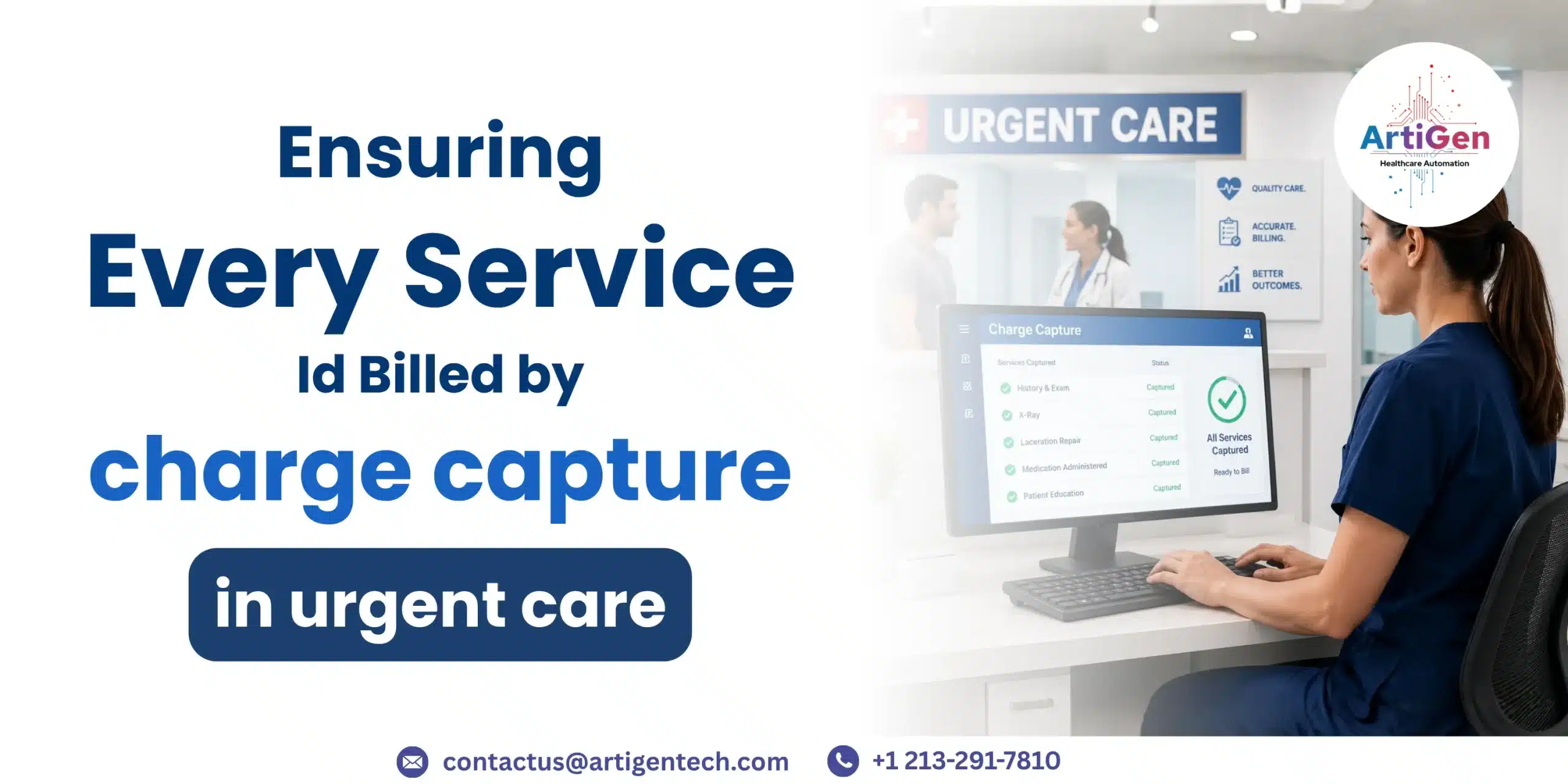
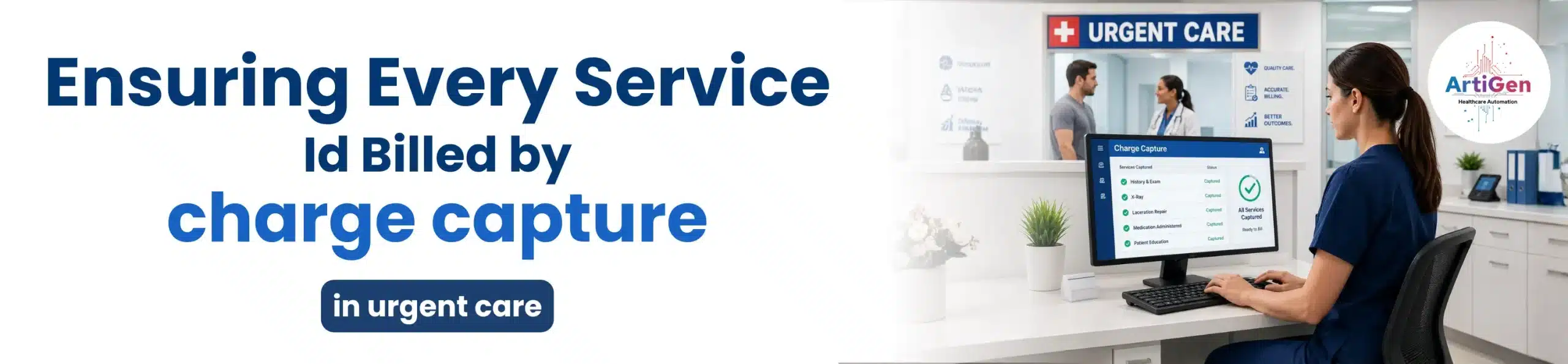
That’s where Urgent Care Charge Capture comes into action. A clear charge capture process ensures that every billable service, procedure, medication and diagnostic test is accurately captured and submitted for reimbursement. Without effective healthcare charge capture, urgent care facilities face the potential for revenue leakage, denied claims, compliance issues, and inaccurate reimbursement.
Medical coders are the backbone of this process. Medical Billing and Coding helps to make sure that no legitimate charge is missed with detail documentation review and adherence to urgent care coding guidelines.
As healthcare organizations increasingly adopt Medical Coding Automation, ArtigenTech’s solutions are helping urgent care providers improve coding accuracy, improve workflows and enhance Urgent Care Revenue Cycle Management.
What Is Charge Capture in Healthcare?
Before understanding the coder’s role, it is important to answer a common question: what is charge capture in healthcare?
Charge capture in healthcare is the process of capturing and documenting all services provided to a patient so that they can be billed correctly and reimbursed. Each patient visit results in multiple billable activities, including:
- Physician evaluations
- Diagnostic testing
- Laboratory services
- Medication administration
- Minor procedures
- Imaging studies
- Vaccinations
- Follow-up treatments
Revenue cycle charge capture is concerned with making sure that each service provided is coded and submitted for reimbursement.
The financial health of an urgent care organization is directly influenced by an effective urgent care charge capture medical billing workflow, which supports accurate claims submission and prevents missed charges.
Why Urgent Care Charge Capture Is Challenging
Unlike specialty clinics that focus on a limited range of services, urgent care facilities handle a wide variety of medical conditions and procedures.
A single patient visit may include:
- Evaluation and Management (E/M) services
- Identify New or Established patient office or other outpatient visit
- Rapid Imaging diagnostic/Screening tests
- After hours codes
- Wound repairs, Incision & drainage
- Medication injections
- Hydration & infusion codes
- Vaccinations & supplies codes
- Patient transfer and Referral to other specialties
- Follow-up instructions
This diversity makes Urgent Care Billing and Coding particularly complex.
Common challenges include:
High Patient Volume
Urgent care centers often see dozens or hundreds of patients daily. Under busy conditions, providers may unintentionally omit documentation for certain services.
Documentation Gaps
Incomplete clinical notes can lead to missing charges and inaccurate coding.
Coding Complexity
Accurate assignment of urgent care CPT codes and diagnosis codes requires a careful review of provider documentation.
Revenue Leakage
Without effective charge capture optimization organizations risk losing reimbursement for services provided but never billed.
Such challenges make effective Urgent Care Charge Capture a critical part of operational success.
The Role of Medical Coders in Charge Capture
Medical coders play a central role in ensuring complete and accurate billing.
Their responsibilities include:
- Reviewing clinical documentation
- Identifying billable services
- Assigning accurate diagnosis codes
- Selecting correct procedure codes
- Identifying relevant modifiers & HCPCS codes
- Ensuring compliance with payer guidelines
- Supporting reimbursement accuracy
Coders with expertise in Medical Billing and Coding and strong documentation review skills help ensure that every service is accounted for.
Clinical Documentation Improvement and Charge Capture
Quality documentation is the first step to accurate coding.
Clinical Documentation Improvement (CDI) programs help providers to document patient encounters more clearly and specifically.
Coders frequently work alongside CDI specialists to verify:
- Clinical Validation
- Present on Admission (POA) Indicators
- Medical necessity
- Treatment complexity
- Diagnosis-Related Group (DRG) Accuracy
Strong Clinical Documentation Improvement initiatives enhance coding accuracy and reduce denials.
For example, “upper respiratory infection” documentation is less specific than documentation of the exact diagnosis supported by clinical findings. More specificity equals better ICD-10 Coding for Urgent Care and better reimbursement results.
CPT Coding for Urgent Care Services
One of the primary responsibilities of coders is assigning accurate CPT coding for urgent care services.
Common urgent care CPT codes may include:
Service | CPT Code |
Office Visit (E/M) | 99202–99215 |
Rapid Strep Test | 87880 |
Influenza Test | 87804 |
Laceration Repair | 12001–13160 |
X-Ray Services | Various CPT Codes based on views |
Vaccine Administration | 90461, 90471 |
Correct CPT coding for urgent care helps to get providers paid for services rendered.
Errors in urgent care CPT codes can result in:
- Underbilling
- Overbilling
- Claim denials
- Compliance concerns
Coders carefully review documentation to support every reported procedure.
ICD-10 Coding for Urgent Care Encounters
Diagnosis coding is equally important.
The process of assigning diagnosis codes that accurately reflect the patient’s condition is known as ICD-10 Coding for Urgent Care.
Examples include:
Condition | Example ICD-10 Code |
Acute Sinusitis | J01.90 |
Streptococcal Pharyngitis | J02.0 |
Influenza | J10.1 |
Otitis Media | H66.90 |
Urinary Tract Infection | N39.0 |
Sprained Ankle | S93.401A |
Proper Reimbursement and Medical Necessity with Accurate ICD-10 Coding for Urgent Care.
Coders ensure that diagnosis codes correspond with documented symptoms, physician assessments, and treatment plans.
Understanding the Charge Capture Process
The charge capture process follows a structured workflow designed to ensure complete reimbursement.
Step 1: Patient Encounter
The patient receives care and treatment.
Step 2: Documentation
Providers document:
- Symptoms
- Diagnoses
- Procedures
- Medications
- Labs/tests ordered
Step 3: Coding Review
Coders review records and assign:
- ICD-10 codes
- CPT codes
- Modifiers & HCPCS codes when applicable
Step 4: Charge Entry
All billable services are entered into billing systems.
Step 5: Claims Submission
Claims are submitted to payers for reimbursement.
Step 6: Reconciliation and Audit
Charge capture audit reviews are performed by organizations to identify missing charges and coding discrepancies.
Effective charge capture process reduces revenue leakage and improves the accuracy of reimbursement.
Common Revenue Loss Areas in Urgent Care
Several services are frequently missed during billing.
Examples include:
Diagnostic Testing
Rapid tests, laboratory services, and screenings may be overlooked.
Medication Administration
Injection administration charges are administered sometimes discontinued/cancelled.
Procedures
Minor procedures may not be separately documented.
Supplies
Certain supplies may qualify for reimbursement but remain unbilled due to bundling rules.
These missed opportunities highlight the importance of urgent care charge capture optimization strategies.
Charge Capture Audits: Finding Missed Revenue
A comprehensive charge capture audit helps organizations identify billing gaps.
Audits typically evaluate:
- Documentation completeness
- Coding accuracy
- Charge entry workflows
- Claim submission processes
- Reimbursement patterns
Benefits of a charge capture audit include:
- Increased revenue recovery
- Improved compliance
- Reduced denials
- Better operational visibility
Regular audits strengthen Urgent Care Revenue Cycle Management and help organizations maximize reimbursement.
How Urgent Care Medical Coding Automation Improves Charge Capture
Urgent care coding operations are being transformed by technology.
Modern Medical Coding Automation platforms utilize artificial intelligence and natural language processing (NLP) to analyze documentation and determine billable services.
Benefits include:
- Faster coding workflows
- Reduced manual review
- Improved accuracy
- Automated code suggestions
- Better compliance monitoring
Healthcare organizations can increase productivity and reduce coding obstacles by integrating urgent care coding automation into their daily operations.
The Rise of Urgent Care Coding Automation
As patient volumes continue to increase, urgent care coding automation is becoming a strategic investment.
AI-powered systems can:
- Extract diagnoses from clinical notes
- Recommend urgent care CPT codes
- Support ICD-10 Coding for Urgent Care
- Identify missed charges
- Flag documentation deficiencies
Rather than replacing coders, these solutions enhance coder efficiency and accuracy.
How ArtigenTech Supports Urgent Care Coding Workflows
ArtigenTech understands the unique aspects of Urgent Care Billing and Coding, documentation accuracy and revenue integrity.
Our AI-driven coding solutions help healthcare organizations:
- Improve healthcare charge capture
- Strengthen Clinical Documentation Improvement
- Accelerate coding workflows
- Support accurate E/M levels & CPT coding for urgent care
- Enhance ICD-10 Coding for Urgent Care
- Reduce coding backlogs
- Improve reimbursement outcomes
- Delivers a lower Turnaround Time (TAT)
Healthcare providers can improve their operations without sacrificing coding quality and compliance, with advanced urgent care Medical Coding Automation.
Intelligent automation allows organizations to achieve superior financial performance through solutions ranging from documentation challenges to charge capture services and Urgent Care Revenue Cycle Management optimization.
Best Practices for Charge Capture Optimization
Healthcare organizations can improve performance by following these strategies:
Educate Providers
Ensure clinicians understand documentation requirements.
Conduct Regular Audits
Routine charge capture audit activities identify revenue gaps.
Improve Documentation Quality
Invest in Clinical Documentation Improvement programs.
Leverage Automation
Implement Medical Coding Automation and urgent care coding automation tools.
Monitor Performance Metrics
Track denial rates, and coding accuracy.
These strategies support ongoing charge capture optimization and revenue growth.
Conclusion
In addition to providing high-quality patient care, successful urgent care operations necessitate precise billing and reimbursement. Effective urgent care charge capture in healthcare means that each service rendered is documented, coded and billed correctly.
Urgent care organizations can significantly enhance their financial performance and reduce revenue leakage by integrating advanced Medical Coding Automation, comprehensive Clinical Documentation Improvement, regular charge capture audits, and strong Medical Billing and Coding practices.
As healthcare continues to evolve, ArtigenTech’s intelligent urgent care coding automation solutions are helping providers strengthen Urgent Care Revenue Cycle Management, improve coding accuracy, and make sure that every legitimate service is properly reimbursed.